

Long before today's high-tech tackle bags were even a concept, the legends of saltwater angling got by on pure grit and hard-earned wisdom. For sportfishing pioneers like Ed and Frank Murray, who built a legacy in the world of big-game tournaments, a successful day wasn't just about landing the fish; it was about having a flawless system and gear that could take a beating from the ocean. Those early lessons, learned in the heat of competition, are baked right into the DNA of today's good fishing backpacks.
Lessons from Legends The Murray Brothers Fishing Legacy
The Murray Brothers spent decades chasing marlin and tuna in some of the most competitive saltwater sportfishing tournaments on the water. All that time taught them a core truth: victory often comes down to what happens between the bites. It’s about how fast you can swap a lure, how easily you can grab a tool, and how well your gear is shielded from corrosive salt spray.
Back then, a simple tackle box was all you had. But on the deck of a rocking boat, battling a grander marlin, a clunky box is more of a liability than an asset. You can't carry it hands-free, everything inside becomes a jumbled mess, and it offers almost no real protection from the elements. This constant fight with clunky, inefficient gear is what pushed serious anglers like the Murrays to find a better way.
The Need for Better Gear
Ed and Frank Murray knew that every second spent digging for a leader or searching for pliers was a missed opportunity in a tournament. That frustration fueled the demand for a new kind of system—one that delivered on three key fronts:
- Instant Access: Your most critical tools and tackle had to be right there when you needed them, not buried under a pile of gear.
- Impeccable Organization: You needed a dedicated spot for lures, leaders, and terminal tackle to make quick, smart decisions when the bite was hot.
- Environmental Endurance: Equipment had to survive the relentless, corrosive saltwater environment day in and day out, without failing.
This philosophy—that how you manage your gear is just as important as your rod and reel—is the very foundation of the modern fishing backpack. It’s not just about carrying stuff; it's about performing when it counts.
From Tackle Box to Tactical Tool
This legacy of tournament-proven experience really drives a crucial point home for any angler today. The jump from a simple tackle box to one of today's good fishing backpacks is more than just an equipment upgrade; it's a total shift in mindset. You can dive deeper into this evolution by exploring the rich details of sportfishing history and its pioneers.
For anyone serious about their fishing, the right pack isn't a luxury—it's an essential piece of equipment. It’s a direct descendant of the hard-won lessons learned by legends like the Murray Brothers, proving that a well-organized, tough-as-nails pack can make or break your day on the water.
Anatomy of a High-Performance Saltwater Backpack
What really makes a saltwater fishing backpack different from a regular hiking bag? It’s all in the details. Every single component is chosen to survive the brutal, corrosive world of saltwater angling. It’s a bit like comparing a family minivan to a purpose-built safari truck; sure, they both get you around, but only one is designed to handle the absolute worst conditions without falling apart.
A truly great saltwater backpack is constructed with materials and features specifically selected to fight a constant battle against salt spray, harsh sun, and the general abuse that comes with a life on the water. This isn’t just about making a bag; it's about engineering a critical piece of gear for serious anglers.
Built to Endure The Saltwater Gauntlet
The first thing to look at is the pack's skin. You want to see marine-grade vinyl or a heavy-duty, PVC-coated nylon. These aren't just water-resistant fabrics; they actively shed water, which stops salt from soaking in and rotting the fibers from the inside out. You should also demand reinforced, double-stitched seams. That’s not a luxury—it’s a necessity to keep the pack from tearing at the stress points when it’s loaded down with heavy tackle.
And it’s not just about the fabric. Every single piece of hardware has to be chosen with corrosion in mind. Buckles, clips, and adjusters should be high-density polymer, not metal that will inevitably rust shut. This level of detail is what separates good fishing backpacks from those that will fail you after a single season.
In the saltwater world, gear failure isn't a matter of if, but when. The best backpacks are engineered to push that day as far into the future as possible through smart materials and solid construction.
The Zipper: The Unsung Hero of Gear Protection
If there's one fatal flaw in most bags, it's the zipper. A standard metal zipper can lock up solid with corrosion after just a couple of trips, turning your expensive pack into a useless, sealed box. This is why you’ll see top-tier saltwater packs use oversized, corrosion-proof YKK zippers made from tough plastic. These things are designed to keep working, even when they’re caked in dried salt.
Many of the best packs go a step further with waterproof or highly water-resistant zippers. You’ll notice they have a rubbery coating that forms a tight seal when closed, which is a lifesaver for protecting your phone, GPS, or truck keys. If you’re fishing from a center console, a skiff, or a kayak where spray is a given, this feature is absolutely critical.
Ergonomics and Smart Organization
Let's face it, if a pack is uncomfortable, you won't use it. An effective backpack has to be something you can wear all day without thinking about it. That’s where ergonomics come in.
Here are the non-negotiables for all-day comfort:
- Padded, Ventilated Back Panels: These create a channel for air to flow between you and the pack, which makes a huge difference on hot, humid days.
- Adjustable Sternum and Waist Straps: These are crucial. They allow you to shift the weight of a heavy load off your shoulders and onto your hips and core, where you can carry it much more easily.
- Load-Bearing Shoulder Straps: Look for wide, well-padded shoulder straps that are contoured to fit. They keep the pack from digging into your shoulders when it’s stuffed with tackle trays and gear.
At the end of the day, a superior saltwater backpack isn't just a bag with pockets. It's a thoughtfully designed system. Every element, from the stitching to the zippers, has a job to do: protect your gear and help you stay focused on fishing.
Matching Your Backpack to Your Angling Mission
Let's get one thing straight: there's no single “best” fishing backpack out there. There’s only the right one for your specific mission on the water. Just as sportfishing legends Ed and Frank Murray would never chase a grander marlin with a light spinning reel, your gear has to be perfectly matched to the task at hand. Your backpack is the foundation of that system.
Think about the extremes. An angler heading offshore for a multi-day tournament has completely different needs than someone navigating tight mangrove channels in a kayak. The tournament fisherman, following in the footsteps of the Murrays, needs massive capacity for a wide array of tackle, extreme waterproofing for an open cockpit, and a modular system to stay organized. Their pack is a mobile command center built for endurance.
Meanwhile, the kayak angler is all about a compact, and often fully submersible, design. They need external lash points to secure gear in a tiny space and a low profile that won’t get in the way of a paddle stroke or a cast. For them, a big, bulky pack is a serious liability.
Aligning Features with Your Fishing Style
The trick is to connect the situations you actually face with the features that will make a real difference. If you’re constantly dealing with chop and spray on an inshore trip, you need to be able to grab a new lure with one hand, no fumbling required. If your boat offers zero protection from the elements, then a 100% waterproof compartment for your phone and keys isn't a luxury—it's essential.
This is where you start to see what really matters for saltwater environments.
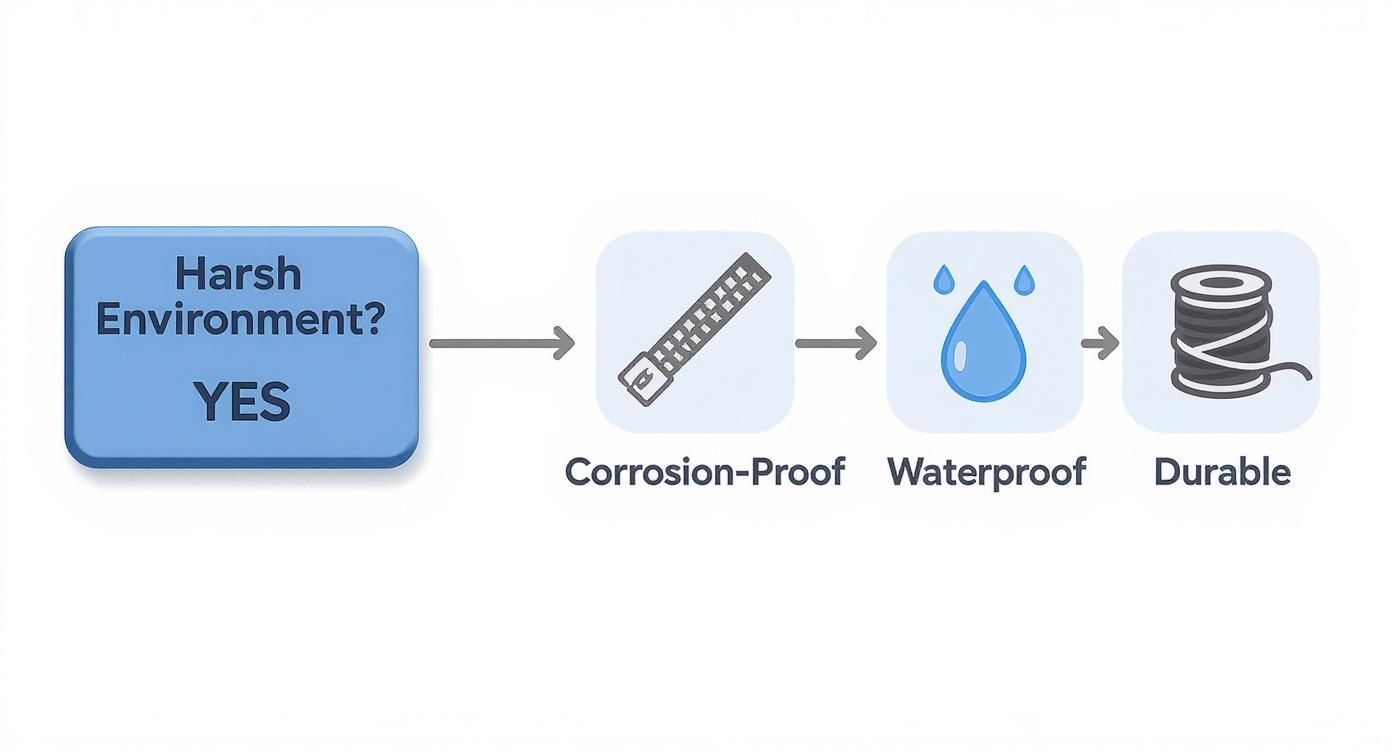
As the flowchart shows, anyone fishing in corrosive, wet conditions has to put a premium on materials and construction that can take a beating from salt and spray.
This need for purpose-built gear is driving a huge trend. The active backpack market, which includes good fishing backpacks, was valued at USD 5,413.2 million in 2022 and is projected to hit USD 10,446.7 million by 2030. That growth is a direct reflection of anglers like us demanding gear that’s built for how we actually fish. You can discover more insights about the active backpack market on GrandViewResearch.com.
Backpack Features by Fishing Environment
To make it even clearer, this table breaks down the top priorities for different types of saltwater fishing. Think of it as a cheat sheet for zeroing in on what you need most.
| Fishing Style | Key Feature Priority | Capacity Needs | Material Recommendation |
|---|---|---|---|
| Deep-Sea/Offshore | Extreme Waterproofing, Corrosion Resistance | 40-60L+ | Heavy-duty, TPU-coated nylon or fully welded PVC |
| Inshore/Flats Boat | Quick-Access Pockets, Rod/Tool Holders | 25-40L | Water-resistant 600D+ polyester with YKK zippers |
| Kayak Fishing | 100% Submersible, Compact/Low-Profile | 20-30L | RF-welded seams, roll-top closure, waterproof zippers |
| Shore/Surf Fishing | Lightweight, Integrated Cooler, Sand-Proof | 25-35L | Ripstop nylon with reinforced, easy-to-clean base |
| Day Trip (General) | Versatility, Comfort, Modularity | 20-30L | Durable polyester or nylon with water-resistant coating |
Choosing the right pack really boils down to being honest about your primary fishing style. A pack designed for offshore battles will feel clumsy on a kayak, while a surf-casting bag won't cut it on a multi-day trip.
The mark of an experienced angler isn't having the most gear, but having the right gear. A thoughtfully chosen backpack eliminates guesswork and lets you focus completely on the fish.
Ultimately, you’re looking for a pack that feels like a natural extension of how you fish. It should support your mission, protect your investment in tackle, and make you more efficient on the water. For more advice on outfitting yourself, check out our complete guide to the best saltwater fishing gear. When you take the time to evaluate your needs, you'll end up with a backpack that serves as a reliable partner on every single trip.
Packing Like a Pro for Tournament Success
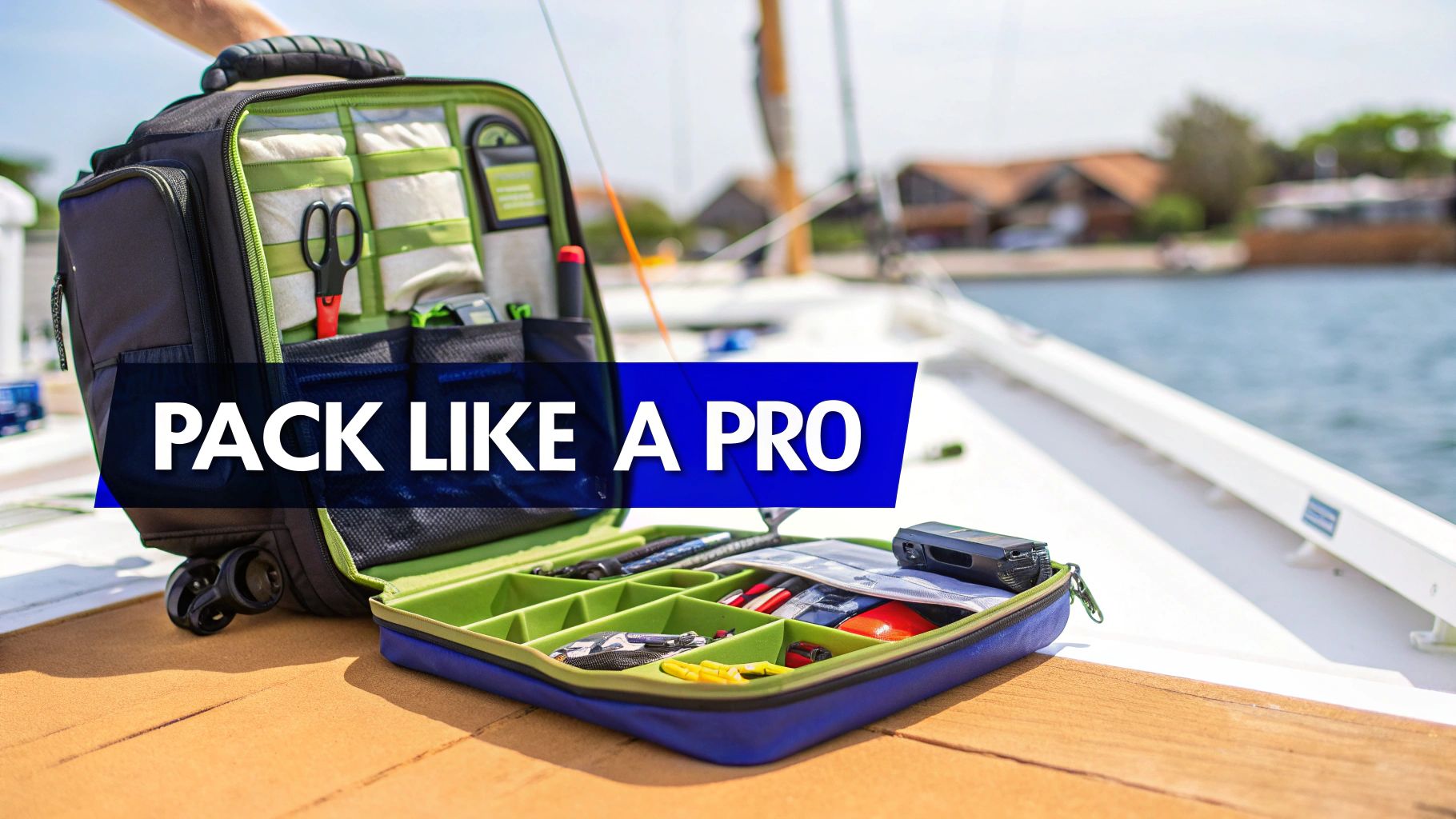
In the high-stakes world of competitive sportfishing, winning isn't just about finding the fish—it's about making every second count when they start biting. For a tournament angler, a backpack isn't just a bag. It's a mobile command center, a meticulously organized toolkit built for pure speed and efficiency. Adopting that same pro mindset, one honed over decades by legends like the Murray Brothers, can help any angler get more out of their time on the water.
It’s one thing to have all your gear with you, but it’s another thing entirely to have a system. This means every lure, every leader, and every tool has its own dedicated spot, and you can grab it by muscle memory without a second glance. A well-organized pack means no more frantic digging for pliers or searching for that one specific lure. That moment you save can be the difference between a solid hook-up and a lost fish. This is the kind of preparation that separates the good anglers from the great ones.
The Tournament Angler's System
Start thinking of your backpack in zones. Every pocket, every compartment, should have a dedicated purpose. For the pros, this isn't just a helpful tip; it's a non-negotiable part of competing at the highest level. It turns a pile of gear into a well-oiled machine.
- Primary Tackle Zone: This is your main compartment, home to your modular trays. Keep them clearly organized by species or technique. You might have one tray dedicated entirely to topwater plugs and another just for your bottom fishing rigs.
- Rapid-Access Zone: Use the external pockets for the things you need right now. This is the spot for your go-to pliers, line cutters, and maybe a hook file. No digging required.
- Support & Safety Zone: A specific side or front pocket should always hold the essentials: a first-aid kit, sunscreen, and your fishing license or permits.
This methodical approach to packing is more important than ever. Recreational fishing is booming, with over 50 million people in the U.S. hitting the water each year. That means the demand for quality, organized gear is through the roof. The worldwide outdoor equipment market, which includes good fishing backpacks, pulled in USD 27.71 billion in 2025 and is only expected to grow. You can dive deeper into the numbers on the global outdoor equipment market on Statista.com.
Pre-Rigging for Peak Performance
If there’s one time-saving trick that tournament anglers live by, it's pre-rigging. Before you even think about leaving the dock, take the time to tie a dozen or more leaders for whatever you're targeting. Keep them neatly stored on a leader wheel or in small, individual bags.
When a hot bite kicks off, you don't have a second to spare fumbling with leader spools or tying complicated knots. Having those leaders pre-rigged and ready to go means you can swap out a broken rig in under a minute and get your line right back in the water where it belongs.
When you're this prepared, your backpack stops being just a piece of gear and becomes a true partner on the water. It keeps you ready for any opportunity that comes your way, so you can focus on what really matters: reading the water, finding the fish, and winning the fight.
Protecting Your Investment from Saltwater Corrosion
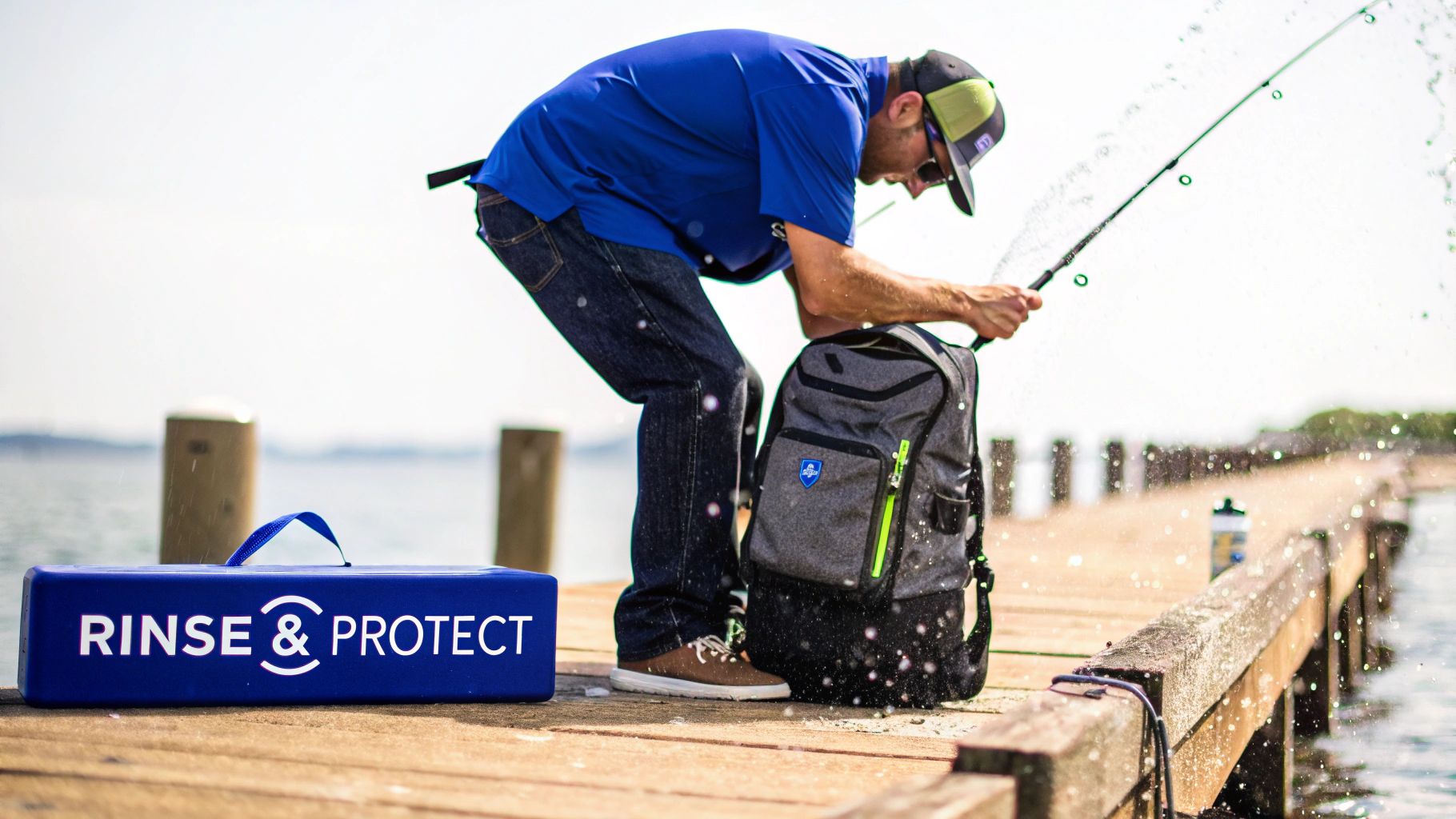
The saltwater environment is unforgiving. It's an aggressive force that will seize zippers, eat through fabric, and ruin any gear that isn't looked after. Keeping your fishing backpack in fighting shape is about more than just buying the right one; it’s about a disciplined post-trip routine that will ensure your gear lasts season after season.
Think of salt as a microscopic army of rust-causing agents. Every splash and salty spray leaves behind a residue that, if ignored, wages a quiet war on your equipment. The single most important battle you can fight is the one with fresh water right after you get off the boat or back from the surf. It's the most effective way to neutralize salt's corrosive attack.
Your Post-Trip Maintenance Checklist
This routine doesn't need to be complicated, but it does need to be consistent. Follow these steps after every single saltwater outing to dramatically extend the life of your backpack and everything in it.
- Empty and Rinse Thoroughly: First thing, take everything out. Use a hose with gentle pressure to rinse every inch of the pack, inside and out, with fresh water. Make sure to hit the zippers, buckles, and seams—all the places salt loves to hide.
- Lubricate Zippers: Once the pack is dry, hit the zippers with a quality lubricant. This simple step is what keeps them from seizing up, ensuring you can actually get into your bag when you need to.
- Inspect Stress Points: Take a minute to check high-stress areas like shoulder strap connections and handle attachments. Look for any signs of wear and tear and address them before they turn into a full-blown failure on your next trip.
A dedicated 15 minutes of post-trip care can prevent 90% of the common gear failures caused by saltwater corrosion. It’s the cheapest and most effective insurance policy you can have for your equipment.
Protecting Your Tools and Tackle
Your backpack is just the vessel; the expensive gear inside needs attention, too. Give your reels a gentle freshwater rinse and do the same for all your lures before putting them away. A quick spray of a corrosion-inhibiting product on your pliers and other metal tools will keep them from rusting shut. By making these simple habits part of your routine, you ensure every piece of your kit stays ready for action.
The demand for durable gear has fueled major growth in the fishing tackle bags market, which was valued at around USD 1.2 billion in 2023. This number is expected to climb to USD 1.8 billion by 2033, driven by serious anglers who understand that quality pays for itself. For an even deeper look at protecting your equipment, check out our guide on essential waterproof fishing gear.
Think of your fishing backpack as more than just a bag. It’s your partner on the water, your mobile command center for every cast.
The old-timers knew this. Legends like Ed and Frank Murray built their reputations on being relentlessly prepared, understanding that quality gear wasn't a luxury—it was essential. That same philosophy applies directly to the pack on your back. It’s not just a place to stuff your gear; it’s a critical piece of equipment that can make or break your day.
The right pack is an extension of your fishing strategy. It shields your expensive reels and tackle from the harsh, corrosive salt. It keeps you organized and efficient when the fish are biting and you don't have a second to waste digging for the right lure. It’s a direct investment in your success and enjoyment.
So, when you're looking for a new pack, think beyond just carrying stuff. Find one that reflects a commitment to excellence. You want a backpack that gives you the confidence to know you’re ready for whatever the ocean throws at you. After all, that’s what turns a good day of fishing into a legendary one.
Frequently Asked Questions About Fishing Backpacks
Even when you know what you’re looking for, picking the right pack can still feel like a tough choice. Let’s tackle some of the most common questions we hear from fellow anglers, keeping in mind the same principles of durability and function that guys like Ed and Frank Murray lived by.
What Is the Most Important Feature in a Saltwater Fishing Backpack?
Hands down, corrosion resistance. If a pack can't handle salt, it's not worth your time. Salt spray eats standard metal zippers and hardware for breakfast.
Your number one priority has to be a pack made from marine-grade materials—think tough PVC or a heavy-duty coated nylon. Just as important are the little things: look for non-metallic YKK plastic zippers and polymer buckles. That's the stuff that lasts season after season.
How Do I Choose the Right Size Backpack for My Fishing Trips?
The perfect size really just comes down to where you're going and for how long. There’s no single right answer, only what’s right for your trip.
- Day Trips: Hopping out for a few hours along the shore or inshore? A 20-30 liter pack is usually the sweet spot. It's got plenty of room for your tackle, tools, and a sandwich without weighing you down.
- Offshore Tournaments: Gearing up for a multi-day tournament is a different beast entirely. You'll need a much bigger pack, something in the 40-60 liter range or even larger, to haul all your tackle, a change of clothes, and other essentials.
The key is to match the pack to the mission. You don’t want to be bogged down with a giant, half-empty bag, but you definitely don't want to leave crucial gear sitting on the dock.
Are Fully Waterproof Fishing Backpacks Really Necessary?
For most situations, "water-resistant" is good enough. Not every angler needs a pack they can throw overboard. At a bare minimum, your pack should be able to shed rain and spray, which means a water-repellent finish and covered zippers are non-negotiable.
That said, if you're a kayak angler or spend your time on an open-console boat, a truly waterproof pack with welded seams and a roll-top closure is a game-changer. It’s the only way to be 100% sure that a rogue wave or a sudden downpour won't ruin your phone, camera, or GPS. Think of it as an insurance policy against a trip-ending disaster.
At the end of the day, the best backpack is one that upholds the legacy of tournament-tested gear. It needs to be tough, reliable, and perfectly suited for the job so you can keep your mind on the fish.
Inspired by the legacy of legends and built for the modern angler, Murray Brothers Palm Beach offers the battle-tested gear you need for your next adventure on the water. Explore our collection of high-quality apparel and accessories.
Leave a comment