

What Is the Best Time to Go Fishing According to Sportfishing Legends
The best time to go fishing isn't just about a lucky guess. It's a calculated decision, a moment when the tide, time of day, moon, and weather all line up just right. The legendary sportfishing duo, Ed and Frank Murray, built their entire careers on this principle—mastering the ocean's natural rhythms, not just hoping for a bite.
This guide is your playbook, built on the very same principles that led them to countless saltwater sportfishing tournament victories.
Unlocking the Angler's Code
Finding that perfect fishing window is like learning a new language—the language of the ocean. For saltwater pioneers like Ed and Frank Murray, success wasn't an accident. It was the result of a deep, almost scientific understanding of the water and the sky. They didn't just fish; they decoded the patterns that others ignored.
We’re going to break down their timeless strategies, giving you the same insights that defined an era of sportfishing. The idea is simple: nature leaves clues everywhere. You just have to know how to read them.
The Murray Brothers' Approach to Timing
Ed and Frank Murray dominated the saltwater sportfishing tournament circuit not just because they were skilled anglers, but because they mastered the variables before the first line ever touched the water. They knew a hot bite was something you could predict, not just stumble upon.
Their whole method was built around a few core pillars:
- Reading the Rhythms: They saw tides and currents as the ocean's dinner bell. Moving water stirs up bait and signals predatory fish that it’s time to eat.
- Weather as an Advantage: Most anglers see an approaching front as a reason to head in. The Murrays saw dropping barometric pressure and wind shifts as triggers that could spark an aggressive feeding frenzy.
- Seasonal Awareness: Their entire year was planned around fish migrations. They knew exactly where to be and when to be there to intercept trophy fish on their predictable journeys.
By learning to see the environment through their eyes, you stop hoping for a good day and start planning for one.
To get started, here's a quick look at the major factors we'll be diving into. Think of this as your cheat sheet for understanding what makes fish tick.
Quick Guide to Fishing Success Factors
| Factor | Optimal Conditions | Why It Matters |
|---|---|---|
| Time of Day | Dawn & Dusk (low light) | Predators use low light as cover to ambush prey. Water is also cooler. |
| Tide | Moving water (incoming or outgoing) | Moving tides create currents that concentrate baitfish, making them easy targets. |
| Moon Phase | New & Full Moons | Stronger gravitational pulls create higher tides and more current, triggering feeding. |
| Season | Varies by species migration | Fish are on the move. Being in the right place at the right time of year is critical. |
| Weather | Overcast skies, stable or falling barometer | Overcast conditions mimic low-light feeding times. A pressure drop often signals an impending storm, causing fish to feed aggressively. |
These elements don't work in isolation; they all weave together. Understanding how they interact is the real secret to consistently finding fish.
Learning from the Murray Brothers: A Legacy in Sportfishing History
To really get a handle on the best time to go fishing, you can do more than just study a chart. You can learn from the masters who practically wrote the rulebook. In the world of saltwater sportfishing, few names carry the weight of Ed and Frank Murray. Their story is more than just catching fish; it's about a revolutionary approach that transformed angling into a science and defined the golden age of big-game tournaments.
The Murray brothers weren't just lucky anglers. They were relentless observers who learned to see the ocean in a way most people couldn't. They built their entire legacy on a simple but powerful idea: the fish are always telling you something, you just have to learn how to listen. This meant paying closer attention than anyone else to the subtle shifts in current, the slightest dip in barometric pressure, and the clockwork patterns of the tides.
A Tournament-Winning Philosophy
In the cutthroat world of saltwater sportfishing tournaments, gut feelings don't bring home the hardware. The Murrays pioneered a systematic way of predicting exactly when and where the bite would fire up. Their legendary success was built on a foundation of obsessive observation and logging data from every single trip—long before apps and electronics made it easy.
They approached each day on the water like a puzzle, piecing together bits of information that others dismissed as random. This dedication allowed them to build an almost uncanny predictive model of fish behavior. Their philosophy was less about chasing fish and more about intercepting them, positioning their boat in the perfect spot at the perfect time.
For the Murrays, timing wasn't just a factor; it was everything. They understood that a specific tidal window, combined with the right weather pattern, could create a brief but intense feeding frenzy—a window that most anglers would miss entirely.
This strategic thinking gave them an edge that was impossible to ignore. While other crews were burning fuel running and gunning, hoping to stumble upon a school, the Murrays were often waiting patiently for the conditions to line up, completely confident that their moment was coming.
The Power of Paying Attention
If there's one lesson to take from the Murray brothers’ career, it's the incredible value of direct observation. They were masters at reading the water, spotting subtle signs that pointed to bait and, in turn, the big game fish hunting them. A slight change in water color, the way seabirds were behaving, or how a current swept around a reef—these were all critical clues.
Their whole approach teaches a vital lesson for any modern angler: your most important tool is your own awareness. By studying their battle-tested strategies, we get a framework for making our own time on the water more successful. It’s all about understanding the "why" behind a hot bite, not just being there by chance when it happens.
This deeper level of understanding is what separates a good angler from a truly great one. The sportfishing history these legends helped forge is filled with timeless wisdom that's just as powerful today.
Key Takeaways from the Murray Method
The Murray brothers' legacy leaves behind a clear roadmap for anyone looking to up their game. Here are the core principles they perfected over decades on the saltwater sportfishing tournament circuit:
- Master the Tides: They knew that moving water is the engine that drives the entire marine ecosystem. They planned their days around peak tidal flow, pinpointing the exact moments when currents would stack up bait and get predators fired up to eat.
- Weather Is an Opportunity: An approaching storm front wasn't a reason to head in; it was a signal that the bite was about to go off. They used a falling barometer as a powerful tell-tale sign of imminent feeding activity.
- Consistency Through Record-Keeping: Every trip, whether it was a success or a bust, was documented. This library of hard-won knowledge allowed them to spot recurring patterns and dial in their strategies for specific spots, seasons, and species.
When you adopt this mindset—treating every trip as a chance to learn and observe—you start building your own predictive model for fishing. That is the true legacy of the Murray brothers: a reminder that the best time to go fishing is rarely an accident.
Using Tides and Moon Phases to Your Advantage
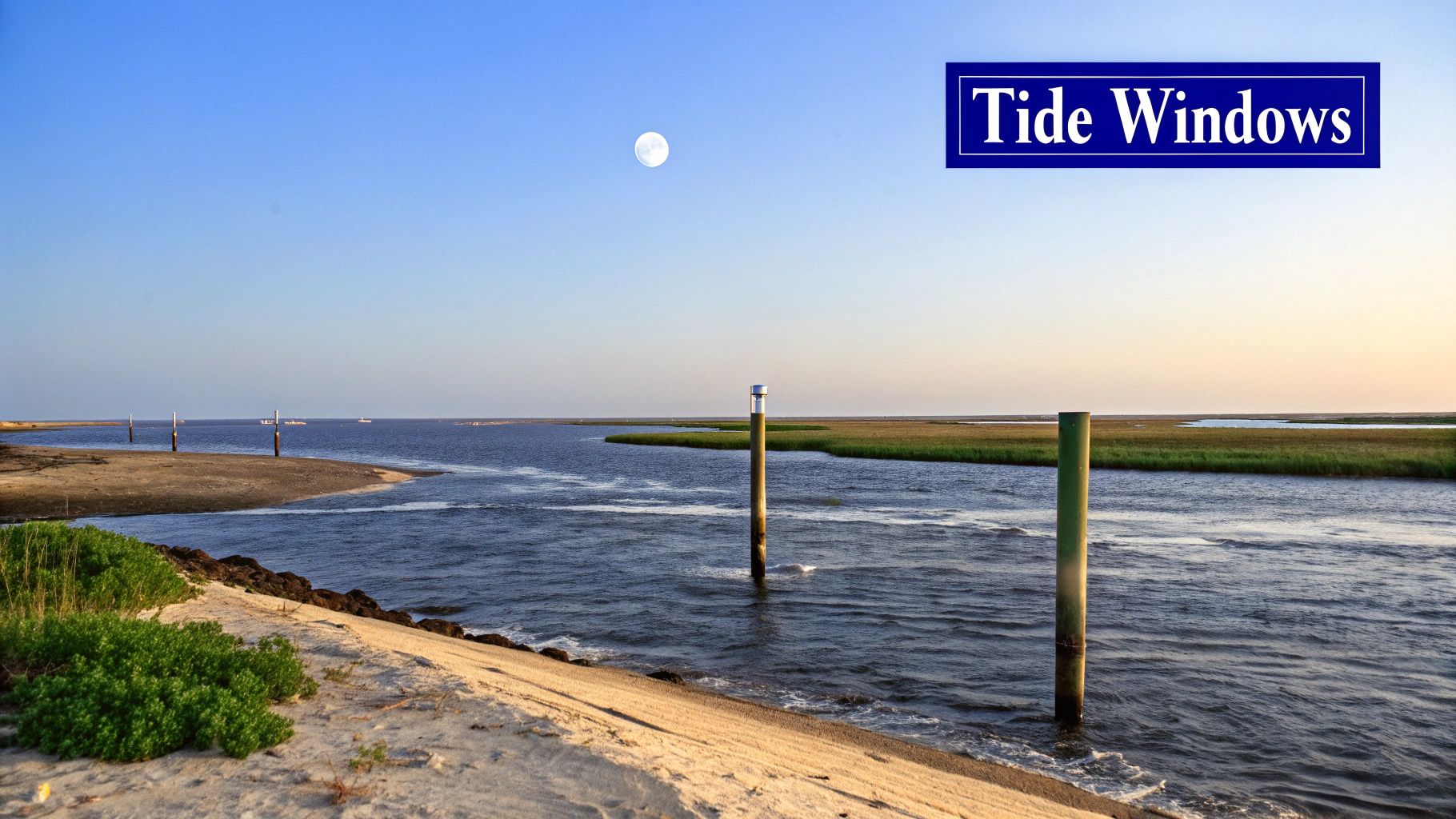
If you're a saltwater angler, the tide chart is your bible. Simple as that. A lot of things can get fish biting, but nothing is as reliable or powerful as the daily push and pull of the ocean. Sportfishing legends Ed and Frank Murray built their careers on this simple truth: moving water is the ocean's dinner bell.
Think about slack tide—that quiet time around high or low tide when the water just sits still. It’s like the kitchen is closed. Baitfish aren't moving, and the big predators are just laying low, saving energy. But the moment that water starts to rip, the kitchen doors fly open. That current is what drives the whole coastal food web, and figuring it out is your first step to finding the best time to go fishing.
Reading the Current Like the Murrays
The Murray brothers cut their teeth in the powerful currents of Jupiter, Florida, and they learned how to make that moving water work for them. They didn't just see "high" and "low" on a chart. They saw windows of peak water movement—the golden hours that trigger feeding frenzies.
An outgoing tide is like a conveyor belt, flushing bait out of estuaries and inlets. Predators know this, and they line up right at the mouth, waiting for the free buffet. On the other hand, an incoming tide pushes fresh ocean water and bait inshore, pinning them against structures like docks, points, and channel edges. The Murrays knew that game fish use these spots as perfect ambush points, letting the current deliver their next meal right to them.
This isn't just a Florida thing; it works everywhere, from skinny backwater flats to deep offshore ledges. Your job is to find these high-traffic feeding zones and make sure you're there when the current is cranking.
A tide chart isn't just about water levels; it's a daily forecast of when the bite will turn on. The hours with the strongest current—usually midway between the high and low tides—are almost always when you'll find the most aggressive fish.
The Lunar Connection: Stronger Tides, Better Fishing
So, what’s behind the tides? Look up. The gravitational pull from the moon and sun is what dictates how strong our tides are, creating a direct link between the lunar cycle and your success on the water. This is where you can take your trip planning from good to legendary.
The two most important times in the entire lunar cycle are the new moon and the full moon. During these phases, the sun, moon, and Earth are all lined up. Their combined gravitational pull creates the biggest tidal swings of the month, often called spring tides.
These super-tides give you a serious edge:
- More Current: All that water moving back and forth gets the bait stirred up and forces predators to get active and feed.
- Clearer Patterns: The extreme high and low points create very defined feeding windows that are much easier to predict.
- New Fishing Grounds: Those extra-high tides can push water into flats and mangroves that are normally high and dry, giving you a shot at fish hunting in new territory.
By planning your trips around these moon phases, you're stacking the deck in your favor. You’re not just fishing a moving tide; you’re fishing the strongest, most productive tides of the month. For a deeper dive, you can read our guide on how the full moon affects fishing. It's a trick the best anglers, like the Murrays, have used for decades to plan their tournament schedules and bring home the trophy.
How Seasonal Patterns Influence Trophy Catches
While tides and the moon dictate the daily fishing schedule, the calendar really governs the grand strategy. Any seasoned angler knows that the changing seasons trigger massive fish migrations, and if you know the patterns, you can plan for some truly incredible action. Think of it like a military campaign, just as legendary tournament anglers Ed and Frank Murray did; they used seasonal shifts to intercept trophy fish at their absolute peak.
What drives these huge movements of fish? It boils down to two simple things: water temperature and the amount of daylight. These are the environmental cues that tell fish when it's time to feed, when to spawn, and when to get moving toward more comfortable waters. For sportfishing pioneers like the Murrays, this wasn't just some interesting fact. It was the absolute foundation of their entire game plan for chasing saltwater giants.
They understood, for example, that trying to catch a blue marlin off the coast of St. Thomas in February was a complete waste of time. But from June through October? The bite was absolutely on fire. This big-picture view of fish behavior is what put them in the right ocean at the right time, year after year.
Chasing the Bite Around the Globe
The Murrays built their legendary career by doing one thing exceptionally well: following the fish. Their tournament schedule was a living map of seasonal migrations, taking them from the Bahamas in winter to the Mid-Atlantic in the summer. They were always positioning themselves directly in the path of migrating billfish and tuna. It's the ultimate expression of fishing the seasons.
You can apply that same thinking to your own fishing, even if you’re just staying local.
- Spring: As the water warms up, you'll see a ton of species pushing inshore. They're there to spawn and feed like crazy after a long, lean winter, making it a fantastic time for nearshore and flats fishing.
- Summer: The heat pushes some fish into deeper, cooler water, but it also brings the big pelagics like marlin and tuna to town in huge numbers. This is what creates those epic offshore opportunities everyone dreams about.
- Fall: This is my favorite time of year. That cooling water triggers a massive feeding frenzy as fish try to fatten up for winter. Baitfish start their migration south, and the predators are right on their tails, creating some of the most consistent action all year.
- Winter: Things might slow down in some places, but other fisheries just light up. Here in South Florida, winter brings the sailfish in close to shore, creating one of the best and most accessible fisheries in the world.
This seasonal rhythm is really the heartbeat of the sport.
Using Data to Pinpoint Peak Seasons
Modern charter operations have taken this seasonal knowledge and turned it into a science. They track catch data religiously, pinpointing the exact months—and sometimes even the specific weeks—that give you the best shot at a particular species. This is how you turn a hopeful trip into a statistically-backed mission.
Famous fishing lodges and destinations actually quantify these peak seasons to help anglers plan. Take a look at reports from the world-renowned Tropic Star Lodge in Panama. Their data clearly shows that June through September and again in December are the hottest months for blue and black marlin. Anglers looking for the biggest "grander" marlin know to book in July and August.
But if your target is a monster yellowfin tuna—we’re talking 100-250 lbs—or a sailfish, the data points to January and February as the prime window. Decades of sportfishing history and data collection allow top operations to create these reliable calendars.
Understanding these established seasonal peaks is like having a cheat sheet built from decades of on-the-water experience. It allows you to plan your ultimate fishing vacation or even just a local weekend trip with a much higher chance of success.
When you start aligning your own trips with these proven patterns, you’re not just going fishing anymore. You’re adopting the same strategic mindset that made the Murray brothers legends of the saltwater tournament world.
Turning Weather Conditions into Fishing Opportunities
Weather is the ultimate wild card. For many, a forecast full of wind and rain is a clear sign to stay on the couch. But for legendary fishermen like the Murray brothers, that same forecast was an invitation to an epic bite. They knew a secret that separates the best from the rest: weather doesn't just happen to you; it’s an active player that can kick fish behavior into high gear.
Learning to read the weather is less about predicting comfort and more about predicting opportunity. It’s not a simple sunny-versus-rainy equation. The real magic lies in the subtle shifts that happen before a front moves in—changes that flip a switch in a predator's brain and trigger an instinct to feed. These are the moments that make legends.
The Barometer Is Your Best Friend
If you had to pick one weather tool, make it the barometer. Nothing influences the bite more than barometric pressure. Think of it as the weight of the atmosphere pressing down on the water. Fish are incredibly sensitive to these changes, feeling them in their lateral lines and swim bladders.
When you have a steady, high-pressure system—those beautiful, clear "bluebird" days—the fishing can be frustratingly slow. Fish often hunker down, stick to deep cover, and get a serious case of lockjaw. But the moment that barometer starts to drop, it’s game on.
A falling barometer is nature's dinner bell. It’s a universal signal to every predator in the water that a storm is on the way, meaning food might get scarce. This triggers a pre-frontal feeding frenzy that can lead to the most aggressive bites of the year.
This isn’t about luck; it’s about timing. Keep an eye on the forecast for approaching fronts. If you can get on the water as that pressure is falling, you’re putting yourself in the middle of a feeding bonanza. Ed and Frank Murray's extensive experience on the tournament circuit taught them that a falling barometer was a green light to fish hard.
Using Wind and Clouds to Find Fish
Don't overlook wind and clouds. They're far more than just comfort factors; they're powerful tools that can pinpoint where the fish are and extend the bite, making them crucial for finding the best time to go fishing.
Wind direction, for instance, can be your best friend. A consistent wind blowing toward the shore will stack baitfish up against points, docks, and weed lines. Predators know this and will be waiting right there on those "wind-blown banks" for an easy meal.
Cloud cover offers a totally different advantage. Overcast skies create low-light conditions, basically extending the "magic hour" of dawn and dusk all day long. This encourages fish that are normally timid in bright sun to come out from cover and actively hunt. The Murray brothers always said a drizzly, gray day would out-fish a week of perfect sunny ones, and they were right.
Applying Timing Strategies To Specific Species
Theory is one thing, but putting fish in the boat is another. All that knowledge about tides, weather, and moon phases is useless until you apply it to the specific fish you’re after. This is where the rubber meets the road—turning abstract concepts into a concrete game plan for your favorite saltwater targets.
Your whole approach will shift depending on whether you're poling a flat or running 50 miles offshore. Every environment has its own unique rhythm, and the fish living there play by different rules. Let's break it down so you can build a solid strategy for any trip.
Inshore Game Plan: Snook And Redfish
When you're fishing inshore for species like snook and redfish, one factor rules them all: the tide. These fish are ambush predators that use structure—mangrove lines, oyster bars, docks—to their advantage. Your job is to be there when moving water is serving them a free lunch.
A strong outgoing tide is a dinner bell. It funnels baitfish out from the backwaters, creating a perfect feeding lane at a creek mouth or along a channel edge. That's when snook stack up and get aggressive. For redfish, a super high tide can be magic, pushing them up onto flats that are normally dry land, where they can feast on crabs and shrimp in inches of water.
The absolute best-case scenario? Combine that moving water with the low light of dawn or dusk. That added predatory advantage can kick off a red-hot bite that lasts just an hour or two.
Nearshore Opportunities: Kingfish And Cobia
Once you move out to the beaches and nearshore reefs, the puzzle gets a few more pieces. Tides still matter, of course, but seasonal migrations and water temperature become just as critical. Fish like kingfish and cobia are always on the move, shadowing massive schools of bait.
The name of the game here is interception. You want to be in the right place at the right time to cross paths with them. During the spring and fall migrations, these fish will push surprisingly close to shore, chasing bait along current rips and temperature breaks. A hard outgoing tide from a major inlet can create a "plume" of nutrient-rich water that stretches for miles, and predators love to patrol those edges.
Finding that intersection of season, current, and structure is what separates a slow day from a career day nearshore.
This flowchart is a great mental shortcut for making sense of changing weather—a skill every good angler needs.
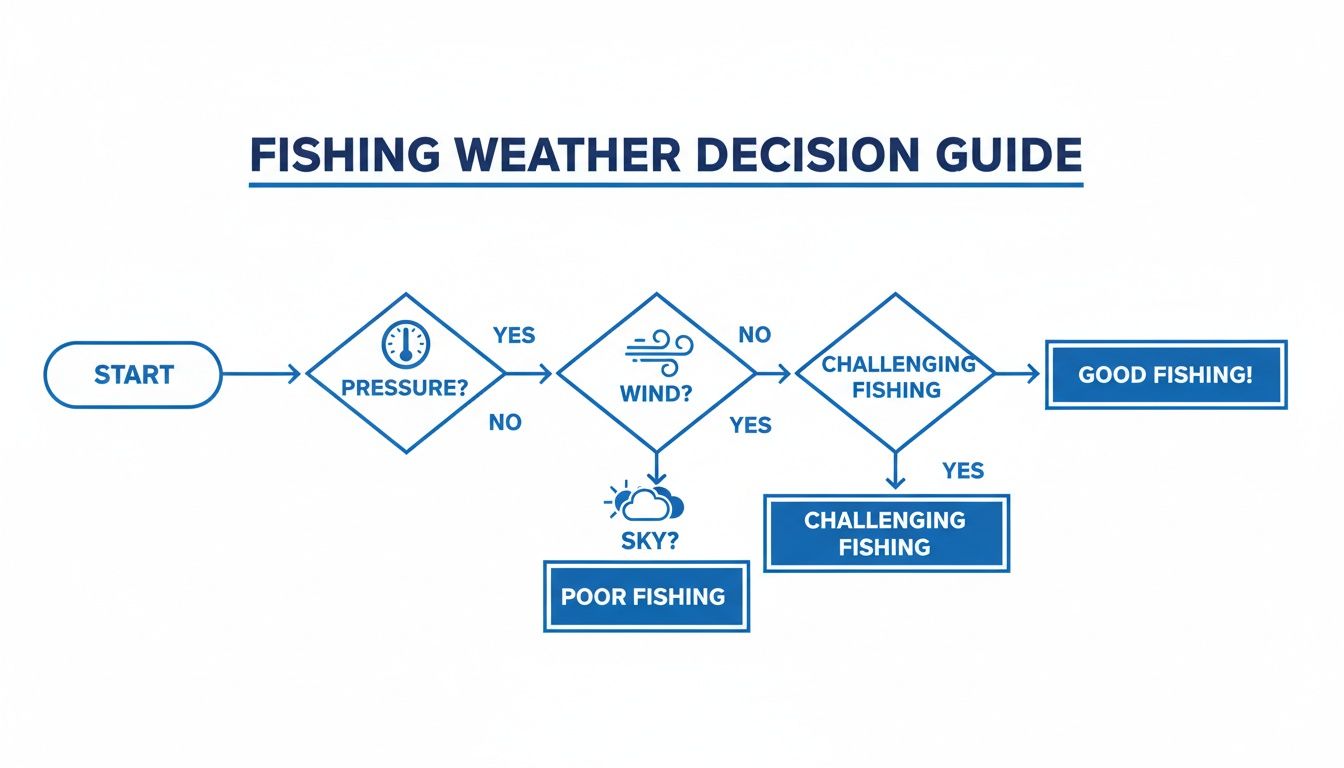
As you can see, the sweet spot often involves falling pressure, a moderate wind that helps stack up bait, and overcast skies that encourage fish to feed throughout the day.
Offshore Secrets: Billfish And Tuna
Way offshore, chasing pelagics like tuna and billfish is a whole different beast. The moon phase still heavily influences feeding activity, but the real key is understanding large-scale ocean features. This is where you start thinking less like a fisherman and more like a hunter.
For offshore legends like Ed and Frank Murray, finding the fish was about finding the right water. They weren't just fishing; they were hunting for specific conditions—temperature breaks, current eddies, and color changes—that concentrated bait and, in turn, the trophy fish they pursued.
Success in the deep blue means you’re looking for:
- Temperature Breaks: A sharp change in water temp, even just one or two degrees, acts like an invisible wall that pins baitfish. Bluefin tuna are notorious for feeding aggressively along these thermal edges.
- Current & Structure: When a powerful current like the Gulf Stream slams into an offshore seamount or canyon, it creates an upwelling. This brings deep, nutrient-rich water to the surface, attracting bait, which then attracts the giants.
- Moon Phases: The days leading up to and immediately following a full or new moon often produce the most epic offshore bites. The stronger currents get the entire food chain moving and feeding, making it a prime time to troll for marlin or chunk for tuna.
Optimal Timing For Target Saltwater Species
Every fish has its preferences. While there are always exceptions, this table gives you a solid starting point for planning your trips around some of Florida's most popular saltwater species.
| Target Species | Best Tide | Best Time of Day | Prime Season (Florida Example) |
|---|---|---|---|
| Snook | First/last 2 hours of outgoing tide | Dawn and dusk | Spring and Fall |
| Redfish | High incoming or first of outgoing | Early morning or late afternoon | Fall and Winter |
| Kingfish | Moving water, either direction | Early morning | Spring and Fall migrations |
| Cobia | Strong tidal flow around structure | Mid-day (sight fishing) | Spring |
| Mahi-Mahi | Doesn't strongly correlate to tide | All day | Late Spring through Summer |
| Wahoo | 3-4 days around full/new moon (strong current) | Dawn and dusk | Winter and early Spring |
| Sailfish | Doesn't strongly correlate to tide | All day | Late Fall through early Spring |
Think of this as your cheat sheet. By layering these species-specific patterns over the core principles of tide, moon, and weather, you stop hoping for a bite and start expecting one. That’s how you build the confidence to create your own successful days on the water.
Common Fishing Questions, Answered
Even with the best game plan, you're always going to have a few questions. Let's tackle some of the most common ones that pop up, using the kind of on-the-water wisdom that legends like Ed and Frank Murray used to dominate the saltwater tournament scene for decades.
Morning or Evening: Which Is Better?
Ah, the "magic hours." Both morning and evening are prime time for a reason—that low, angled light gives predators a massive advantage over their prey. Most anglers have a personal preference, but for icons like the Murrays, the real deciding factor was always the tide.
An outgoing tide in the evening can be just as electric as an incoming tide at sunrise. The key is to get that water moving during those low-light periods. When you align moving water with low light, you've created the perfect ambush scenario for hungry game fish.
Does a Full Moon Really Make Fishing Better?
Absolutely. A full moon (and its counterpart, the new moon) has a huge effect on the water and the fish. The intense gravitational pull creates bigger tides and, more importantly, much stronger currents. This isn't just some old fishing tale; it's a fundamental principle that winning tournament anglers build their entire strategies around.
Think of that increased water movement as a giant dinner bell. It stirs up bait and triggers a powerful feeding instinct in predators. While the bright moonlight might get fish feeding more at night, the powerful currents these moon phases generate almost always create excellent, predictable fishing windows during the day.
Tides or Weather: What's More Important?
This is the classic debate. The best way to think about it is like this: tides are the reliable, daily schedule, while weather is the wild card. For day-in, day-out planning, the tide chart is your foundation. It’s predictable, and it’s what the Murrays built their schedules around.
But a major weather event—like a sharp drop in barometric pressure right before a storm—can completely override a slow tide and trigger an incredible, all-out feeding frenzy.
Your best bet is to plan your trips around the tides but always keep one eye on the weather. Being ready to drop everything and hit the water when a weather front rolls in is what turns a good day into a legendary one.
What Is the Number One Factor for Deciding When to Go?
If you take only one thing away from this guide, let it be this: for saltwater fishing, the single most critical factor is moving water. Current is the lifeblood of the coastal ecosystem. It's a conveyor belt that delivers food to predators and positions them in predictable ambush spots.
Fishing a slack tide, when the water is dead still, is almost always a waste of time. While every factor we've discussed plays a part, if you can only plan around one thing, make it the moving tide. It's the engine that drives everything.
At Murray Brothers Palm Beach, we provide legendary apparel and gear born from a lifetime of tournament-winning experience. Shop our battle-tested collection and get ready for your next adventure.
Dejar un comentario