

There's nothing quite like the thrill of tuna fishing. It's an incredible test of strength, patience, and pure angling skill. You're not just fishing; you're matching wits with one of the ocean's most powerful predators in a game defined by long, quiet moments of anticipation shattered by explosive, heart-pounding action.
Lessons from the Golden Age of Sportfishing
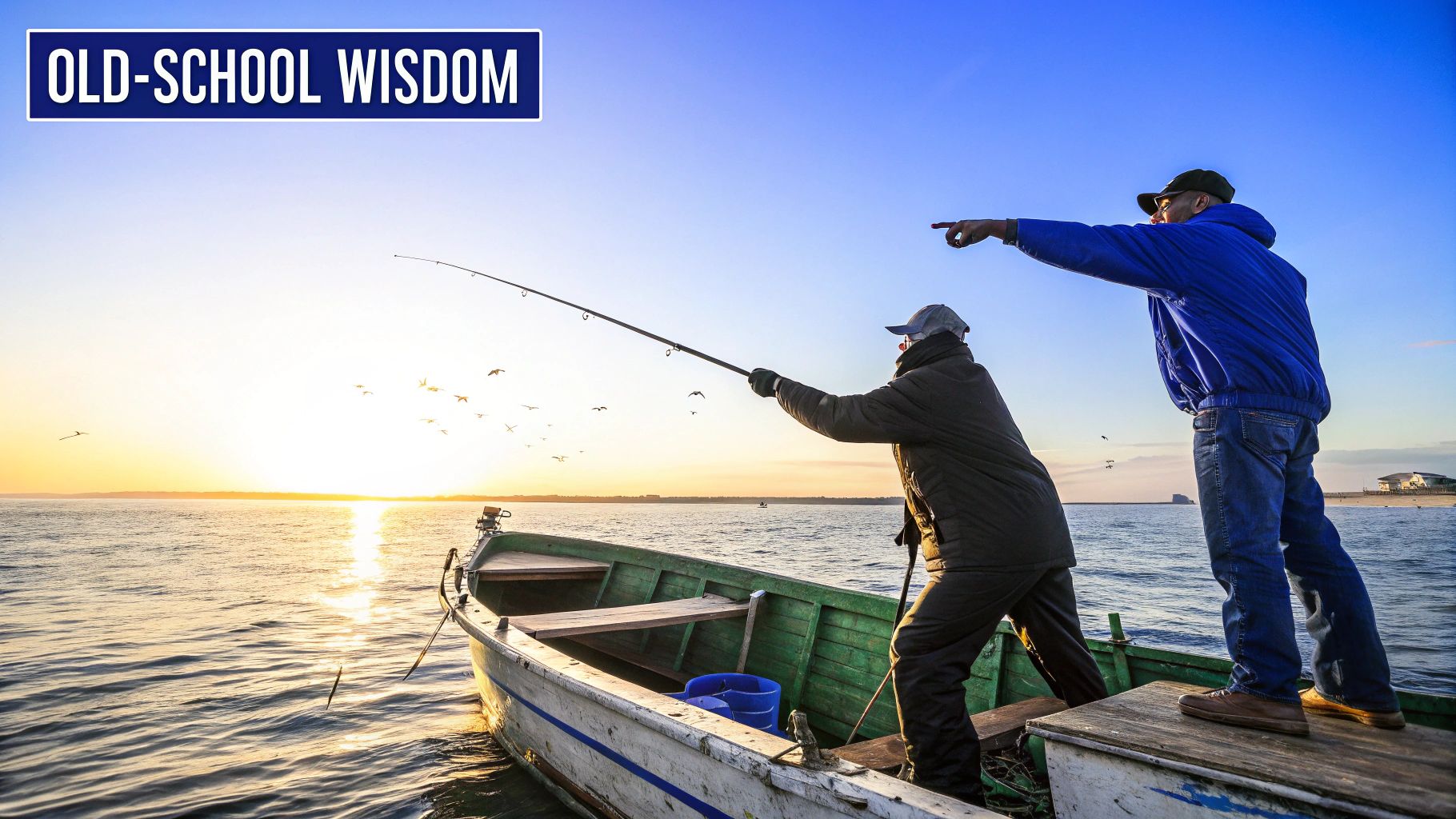
Before the days of high-tech sonar and pinpoint GPS, the old-timers relied on something more primal: pure intuition and a deep-seated feel for the water. This was the golden age of saltwater sportfishing, a time when legends were made by their connection to the sea, not the gear on their boat. Two names that stand out from this era are Ed and Frank Murray.
The Murray Brothers weren't just showing up to the burgeoning saltwater sportfishing tournaments; they were shaping them. As true sportfishing legends, they mastered the art of fishing for tuna by spending countless hours on the water, learning through trial, error, and relentless observation. Their wins in legendary tournaments, like the Cat Cay Tuna Tournament, weren't just luck—they were earned through unparalleled skill and grit.
Reading the Water Like a Legend
For guys like Ed and Frank, the ocean was an open book. Every ripple, current line, or diving bird told a piece of the story. They figured out that finding giant bluefin wasn't about blindly trolling for miles, but about homing in on the exact spots where baitfish would gather. This instinct, honed over years of competition, gave them a serious edge when the pressure was on.
Their whole philosophy boiled down to a few core ideas that are just as critical today:
- Patience and Observation: They'd spend hours just watching, looking for those subtle clues—a patch of nervous water, a flock of birds working a specific area, or a distinct temperature break—that hinted at tuna feeding below.
- Understanding Tides and Currents: The brothers knew that currents were like underwater highways for bait. They learned to position their boat to intercept tuna using these natural pathways, a key strategy in their tournament wins.
- Mastery of Bait Presentation: They were artists when it came to rigging baits. Making a dead bait look alive and irresistible was a skill that often meant the difference between a fish in the boat and going home empty-handed.
Foundational knowledge is what separates the good anglers from the great ones. Technology can point you to where the fish might be, but true watermanship, the kind the Murrays had, teaches you to think like a fish.
A Legacy of Skill and Grit
The tales of Ed and Frank Murray locked in hour-long battles with giant bluefin are legendary. These weren't just fights; they were grueling endurance matches that tested every bit of their skill and every piece of their equipment, often with the stakes of a major sportfishing tournament on the line. They pushed the boundaries of what anyone thought was possible in sportfishing.
Their hard-won experience didn't just help them land fish; it helped shape the tackle and techniques that anglers still use today. By looking back at how they did it, we can get back to the fundamentals that truly matter. You can dive deeper into this rich sportfishing history to see how these essential skills evolved. The biggest lesson from that golden era is simple: the most powerful tool you have on any boat is your own intuition and knowledge.
Building Your Battle-Ready Tuna Arsenal
Landing a true giant starts long before you ever leave the dock. It begins with putting together a fishing arsenal you can trust—a philosophy that sportfishing legends like Ed and Frank Murray lived by. They knew that when you're fishing for tuna, your gear isn't just equipment; it's your lifeline to one of the most powerful fish in the ocean.
The Murray brothers’ approach was never about having the fanciest setup, but the right setup. Every single piece of tackle was picked for a specific job, kept in perfect condition, and proven over countless fights in high-stakes saltwater sportfishing tournaments. That practical, no-nonsense mindset is exactly what you need to build a collection of gear that won’t let you down when a triple-digit bluefin decides to test your will.
The Rod and Reel: Heart of Your Setup
Your rod and reel are the absolute foundation of your entire system. If you get this pairing wrong, you're setting yourself up for a broken rod, a seized reel, or worse, a lost fish. The secret is matching the rod's power and action to the fighting style of the tuna you're after.
For example, a giant bluefin demands a rod with a deep, parabolic bend that flexes right into the blank. Think of it as a giant shock absorber that cushions the brutal, deep dives, keeping immense pressure on the fish without snapping your line. On the other hand, a stiffer, stand-up rod with a faster action is often better for yellowfin, which are famous for their scorching initial runs. You need that extra backbone to turn a fish that's peeling line off your reel at full speed.
The reel has to be an equal partner in this dance. Its drag system is your brake against a freight train.
A reel's drag has to be silky smooth and consistent, with zero hesitation. When a tuna makes a sudden, blistering run, a jerky drag can instantly pop a line. Look for reels built with carbon fiber drag washers—they handle heat better and deliver that crucial, unwavering pressure you need.
Finding the right combination can feel overwhelming, so here’s a quick guide to get you started on matching gear to the most common tuna species.
Tuna Species and Recommended Gear Setups
| Tuna Species | Rod Type & Power | Reel Size & Drag | Line Strength (lb) |
|---|---|---|---|
| Bluefin Tuna | 5'6" - 6' Heavy/Extra Heavy with a parabolic action | 80W - 130W class with 40-60+ lbs of drag | 130 - 200 lb braid with a monofilament topshot |
| Yellowfin Tuna | 6' - 7' Medium-Heavy/Heavy with a fast action | 30W - 50W class with 25-40 lbs of drag | 80 - 130 lb braid |
| Blackfin Tuna | 6'6" - 7' Medium/Medium-Heavy spinning or conventional | 10000 - 20000 size spinning or 20-30 size conventional | 50 - 80 lb braid |
| Albacore Tuna | 7' - 8' Medium-Heavy trolling or casting rod | 25-40 size conventional reel | 40 - 60 lb monofilament or braid |
This table is a great starting point, but always consider the average size of the fish in your local waters and adjust accordingly.
The Critical Connection: Line and Leader
The old debate between monofilament and braided line is still going strong, but honestly, the right choice really just depends on the situation.
Braid gives you incredible strength in a much thinner diameter. This means you can pack way more line onto your spool, which is a massive advantage when a big fish might dump several hundred yards in just a few seconds. Its lack of stretch is also a bonus, as you can feel every headshake and turn.
However, that classic monofilament stretch can be a lifesaver. It acts like a built-in shock absorber, giving you a bit of forgiveness when a fish makes a sudden lunge right at the boat. Many of the best captains I know use a hybrid system: a main line of braid for capacity, connected to a long monofilament "topshot" that provides that critical shock absorption. To really dive deep, you can explore breakdowns of the best saltwater fishing gear and see what makes the most sense for you.
Finally, don't ever skimp on the small stuff. Your leader, hooks, and swivels are the final links in the chain between you and the fish. Using high-quality fluorocarbon leader for its near-invisibility and toughness, paired with wickedly sharp circle hooks, makes all the difference. It ensures your presentation is perfect and your connection is rock-solid. It’s those small, deliberate choices that separate a successful trip from just another story about the one that got away.
Mastering Rigs and Baits That Tuna Cannot Resist
Let's be honest. You can have the best rod and reel money can buy, but if the lure or bait at the end of your line looks fake, you’re just wasting gas. The most expensive setup in the world won't catch a thing if your presentation is off.
This is a lesson guys like Ed and Frank Murray spent a lifetime perfecting. They understood that the secret wasn't just about having strong gear; it was about the subtle art of making a bait look so natural and irresistible that a wary tuna had no choice but to strike. Their whole philosophy was simple: make it easy for the tuna to eat. That means deploying rigs that are not only tough as nails but also nearly invisible, allowing the bait to swim, skip, or flutter just right.
Before we dive into the nitty-gritty of rigging, you need to match your fundamental gear to the type of tuna you're chasing. This chart breaks it down perfectly.
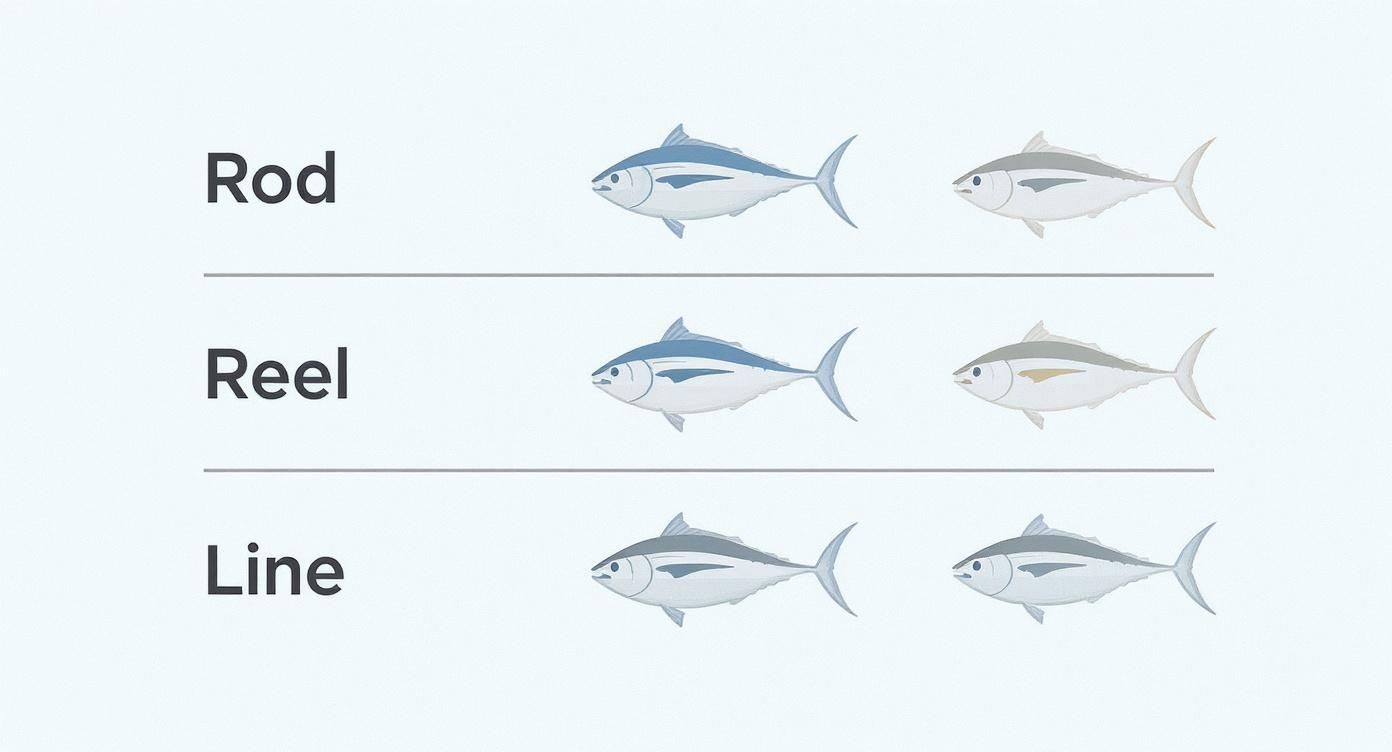
As you can see, you're not tangling with a giant bluefin using the same setup you would for a schoolie yellowfin. It’s all about matching the tackle to the fish.
Getting Your Connections Right: Knots and Leaders
Your connection from the main line to the leader is where many battles are lost. It's a non-negotiable weak point if not done correctly. For this job, the Bimini Twist has been the gold standard for decades. Why? Because this knot creates a loop that maintains nearly 100% of your line's breaking strength. Think of it as a built-in shock absorber that gives you a rock-solid loop for attaching your leader.
From there, many experienced crews use a wind-on leader system. This setup creates a seamless connection, allowing the leader to pass right through the rod guides. It's a huge advantage when the fish is close to the boat, as it means you don't need a wireman to grab the leader by hand. Everything stays smooth and controlled.
A poorly tied knot is the weakest link in your entire setup. It's the number one reason anglers go home with a story about the one that got away instead of a fish in the box.
The Art of Bait Presentation
Rigging bait, whether it's live or dead, is a true art form. When you're pinning a live mackerel, the goal is to place the hook so the bait can swim naturally and panic when a big tuna shows up. A popular method is to bridle the bait using a small rubber band or a piece of rigging floss. This keeps the hook perfectly exposed for a solid set while letting the bait swim completely unhindered.
Then there's chunking, a classic technique for a reason. You're creating a steady trail of scent and food to draw tuna right to your boat. The secret here is all about consistency.
- Uniform Pieces: Cut your chunks to be roughly the same size. This ensures they sink at a steady, predictable rate.
- Keep the Rhythm: Toss a handful of chunks over the side every minute or so. You want an unbroken trail for the fish to follow.
- Hide the Hook: Your hook bait has to look just like every other piece of chunk, sinking at the exact same speed. Any difference will get it ignored.
Building a Trolling Spread That Gets Eaten
Trolling is a game of smoke and mirrors. You’re trying to create the illusion of a panicked school of baitfish to trigger that aggressive, predatory instinct in a tuna. This is where spreader bars and daisy chains really shine, as they create a ton of commotion and look like a whole meal.
To level up your spread, experiment with some of the modern off-shore lures that do an incredible job of mimicking different types of baitfish. By focusing on these rigging fundamentals, you’re not just throwing lines in the water—you’re using proven techniques that will drastically stack the odds in your favor.
How Legendary Anglers Read the Water
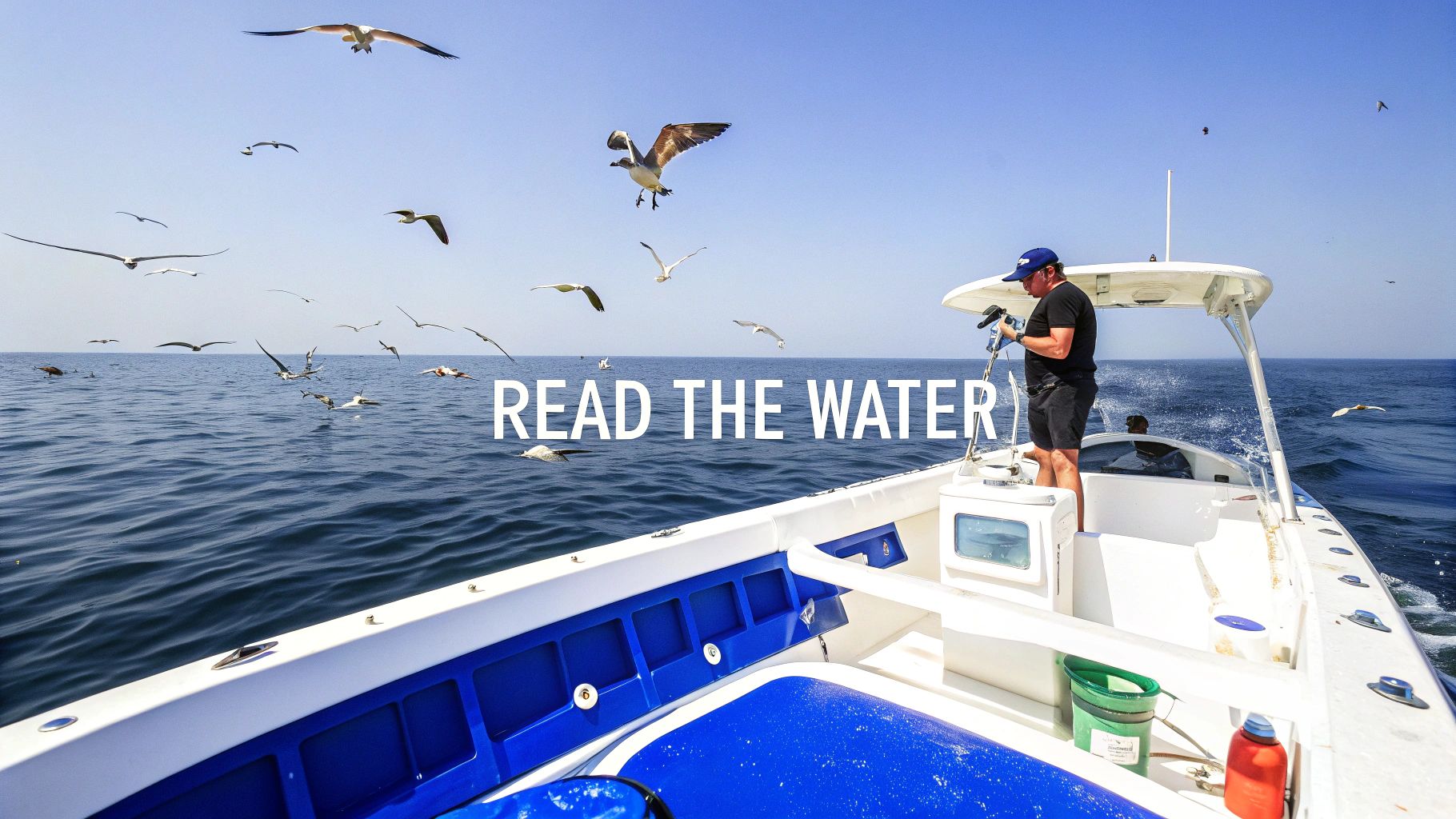
Long before we had GPS and fancy fish finders painting a picture of the bottom, the real legends of the sport, guys like Ed and Frank Murray, found fish by simply speaking the ocean’s language. Their success wasn't about technology. It was earned through thousands of hours on the water, honing an intuition that set them apart from everyone else. This is your chance to start seeing the ocean through their eyes.
The foundation of their strategy was brilliantly simple: find the bait, find the tuna. Tuna are just relentless eating machines, always on the hunt for their next meal. If you can figure out where the baitfish are stacked up, you've already won half the battle. Sure, we have tech to help us now, but the fundamental signs haven't changed one bit.
Interpreting the Ocean's Surface
The surface of the ocean tells a story, but you have to know how to read the language. The old-timers were masters of this, constantly scanning the horizon for tiny clues that screamed "life below." These signs can be gone in a flash, so you need to be sharp and always be watching.
You're looking for signs of life, no matter how small. These are the breadcrumbs that will eventually lead you to a hot bite.
- Diving Birds: This is the classic, can't-miss sign. When you see terns, gannets, or shearwaters dive-bombing the water, it’s a huge indicator that predators—like tuna—are pushing a bait ball to the surface.
- "Nervous Water": Keep an eye out for patches of water that look different. They might shimmer or ripple in a way that just doesn't match the surrounding sea. This subtle disturbance is often a school of terrified baitfish balled up just under the surface, trying to escape something big below.
- Slicks and Debris: Always pay attention to current seams, those visible lines where two currents meet. These spots act like conveyor belts, collecting debris and creating oil-like slicks on the surface. They are natural highways for bait and the tuna that hunt them.
The best anglers don't just look at the water; they look into it. They're constantly asking, "Why is that patch of water different?" That curiosity is what turns a quiet day into a legendary one.
Understanding Undersea Structure
What you can't see is just as important as what you can. The ocean's invisible structure—the ledges, canyons, and temperature changes—is what dictates where tuna will be. The Murray brothers had a sixth sense for how these underwater features funneled fish right to them.
A temperature break, even a shift of just one or two degrees, can be a magnet for life. These thermal edges act like invisible fences that baitfish won't cross, creating the perfect ambush point for hungry tuna. In the same way, offshore humps and ledges force nutrient-rich water up from the deep, kicking off a food chain reaction that draws in everything from bait to bluefin.
Learning to spot these signs is how your approach to fishing for tuna evolves from just searching blindly to hunting with purpose.
The Art of the Fight: Hooking and Landing Giants
https://www.youtube.com/embed/qekxgQta9gw
That first, explosive, reel-screaming strike is just the opening salvo. Now, the real chess match begins—a test of skill, endurance, and strategy against one of the ocean's most formidable predators. For sportfishing legends like Ed and Frank Murray, the fight was everything. It was a brutal, calculated dance where one wrong move could mean losing the fish of a lifetime. They mastered this art over countless hours, learning exactly how to turn the odds in their favor when connected to a true sea monster.
Their success was built on a deep understanding of what happens the moment a tuna eats. Setting the hook isn't a violent, freshwater-style jerk. It’s a smooth, deliberate process. As the fish takes the bait and starts its run, you steadily advance the drag lever to the strike position. This controlled increase in pressure sinks the hook firmly without tearing a massive hole in the tuna's soft mouth—a rookie mistake that all too often results in a pulled hook during a long battle.
Gaining the Upper Hand Early
Once you're tight, the first few minutes are absolutely critical. That initial run is pure, unadulterated power. A fresh tuna can strip hundreds of yards of line off a reel in the blink of an eye. This is where a great captain earns their keep, using the boat itself as a weapon to gain an edge. Instead of just letting the fish run straight out, a skilled skipper will maneuver the boat to keep the line angled away from the stern, which dramatically reduces the chance of a cutoff and helps the angler get precious line back on the spool.
This seamless teamwork between captain and angler is what defined the golden age of fishing for tuna. It's all about anticipating the fish's next move and countering it with boat position and relentless, steady pressure.
The Mechanics of the Battle
Whether you're harnessed into a powerful fighting chair or strapped into a stand-up harness, the principle is the same: use your body, not just your arms, to fight the fish. The Murray brothers learned this lesson the hard way, through sheer grit and experience gained in countless saltwater sportfishing tournaments.
- Fighting Chair Technique: Think of the chair as a lever. You use your legs to push hard against the footrest, leaning back with your body weight to lift the rod tip. Then, as you lower the rod, you reel down, gaining line. It's a rhythmic, powerful motion that applies maximum pressure with minimum fatigue.
- Stand-Up Harness: In a stand-up fight, you are the leverage point. It's crucial to keep your back straight, bend at the knees, and use your legs and core to do the lifting. This method gives you more mobility, but it demands excellent balance and physical conditioning.
Frank Murray famously said, "You don't fight the fish with your back; you fight it with your legs and your head." This simple advice is a masterclass in endurance. It highlights that a long fight is won with smart technique, not just brute force.
Managing your drag isn't a set-it-and-forget-it deal; it's a constant adjustment. When a tuna is on a blistering run, you might need to back off the drag just a touch to avoid pulling the hook or breaking the line. On the flip side, when the fish goes deep and starts doing those stubborn "death circles," you'll need to pour on the pressure to gain line and lift it toward the boat. This is the true art of the fight—knowing exactly when to pull and when to yield, all while maintaining constant, unforgiving pressure that slowly wears the giant down.
Tuna's Place on the World Stage
When you're out on the water, locked in a battle with a massive tuna, it's easy to get lost in the moment. That adrenaline rush connects you to a long line of sportfishing history, echoing the legendary chases of anglers like Ed and Frank Murray in those early saltwater tournaments. But the fish on the end of your line is part of a much bigger, global story.
Taking a step back to see that bigger picture gives you a whole new level of respect for these incredible fish. Whether it's a bluefin, a yellowfin, or any other species, tuna are more than just a prize catch; they're a cornerstone of the marine food web and a massive driver of international economies. That dual role is exactly why sustainable, thoughtful fishing practices are so critical.
It's one thing to love the sport, but understanding the global scale of tuna fisheries changes your perspective. It connects our passion for sportfishing directly to the urgent need for conservation, making sure this tradition—and healthy oceans—are still around for the next generation.
The commercial fishing industry operates on a scale that's hard to wrap your head around. We're talking about a global annual harvest of over 5 million metric tons.
To put that into perspective:
- Skipjack tuna makes up the lion's share, accounting for a staggering 57% of all landings.
- Indonesia stands as the world's top producer, responsible for about 15% of the total global catch.
- Many other Pacific nations also play a massive role in supplying the world's demand.
These numbers aren't just statistics; they represent a vital resource for countless communities worldwide. If you're curious to dive deeper into the data, the folks at Sustainable Fisheries UW have some great information on global tuna sustainability.
Your Top Tuna Fishing Questions Answered
Even the saltiest veterans have questions, and if you're just getting into tuna fishing, you've probably got a boatload of them. Let's tackle some of the most common things I hear from anglers getting ready to chase these incredible fish.
When’s the Best Time of Year to Go?
That’s the million-dollar question, and the answer completely depends on where you are and what kind of tuna you're after. As a general rule, though, summer and early fall are prime time in most of the world's best sportfishing spots.
If you’re dreaming of giant bluefin, you’ll want to be off the coast of New England from June through October. That’s when those brutes make their annual migration up the Atlantic. For yellowfin, they tend to chase the warm water, so you’ll find them lighting up places like the Gulf of Mexico and Southern California during the summer. Before you even think about booking a trip, do yourself a favor and check the local fishing reports and migration charts.
What’s a Tuna Trip Going to Cost Me?
The price tag on a tuna trip can swing pretty wildly. If you're on a budget, you can usually snag a spot on a shared "party boat" or "head boat" for a few hundred bucks.
But if you want a more dedicated, private experience, chartering your own boat for an offshore run is the way to go. You can expect that to run anywhere from $2,000 to $5,000 for a full day. The final cost really depends on the size of the boat, where you're fishing, and the captain's experience.
Just remember, you’re not just paying for a boat ride. You're investing in the captain's hard-won knowledge, thousands of dollars in tackle, fuel, bait, and most importantly, the safety equipment and expertise to get you out there and back.
Do Tuna Populations Change Depending on Where You Are?
Absolutely. Tuna management is a global puzzle, and the populations are completely different from one ocean to the next. That’s why regional oversight is so critical for keeping these fisheries healthy for generations to come.
For example, early data from the Atlantic for 2025 shows yellowfin landings hitting 395.2 metric tons between January and August. Over in the Eastern Pacific, they’ve seen some huge catches of tropical tuna, which has triggered new monitoring programs to keep the stocks in good shape. These differences really show you how interconnected everything is. You can dive deeper into the science behind this by checking out these tuna fishery reports.
Ready to gear up with apparel that’s as legendary as the anglers who inspired it? Murray Brothers Palm Beach offers battle-tested, angler-approved gear built on a legacy of sportfishing excellence. Shop our collection today at https://www.murraybrosretro.com.
Dejar un comentario