

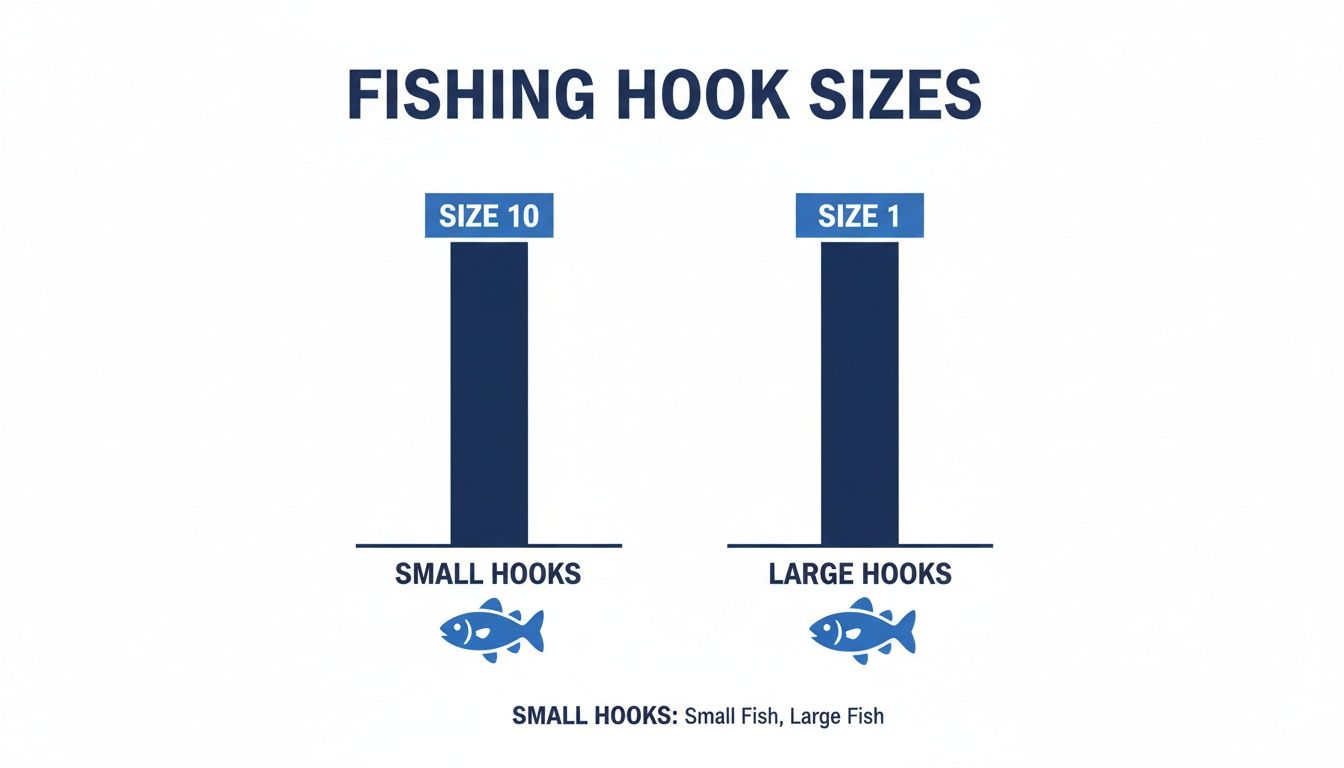
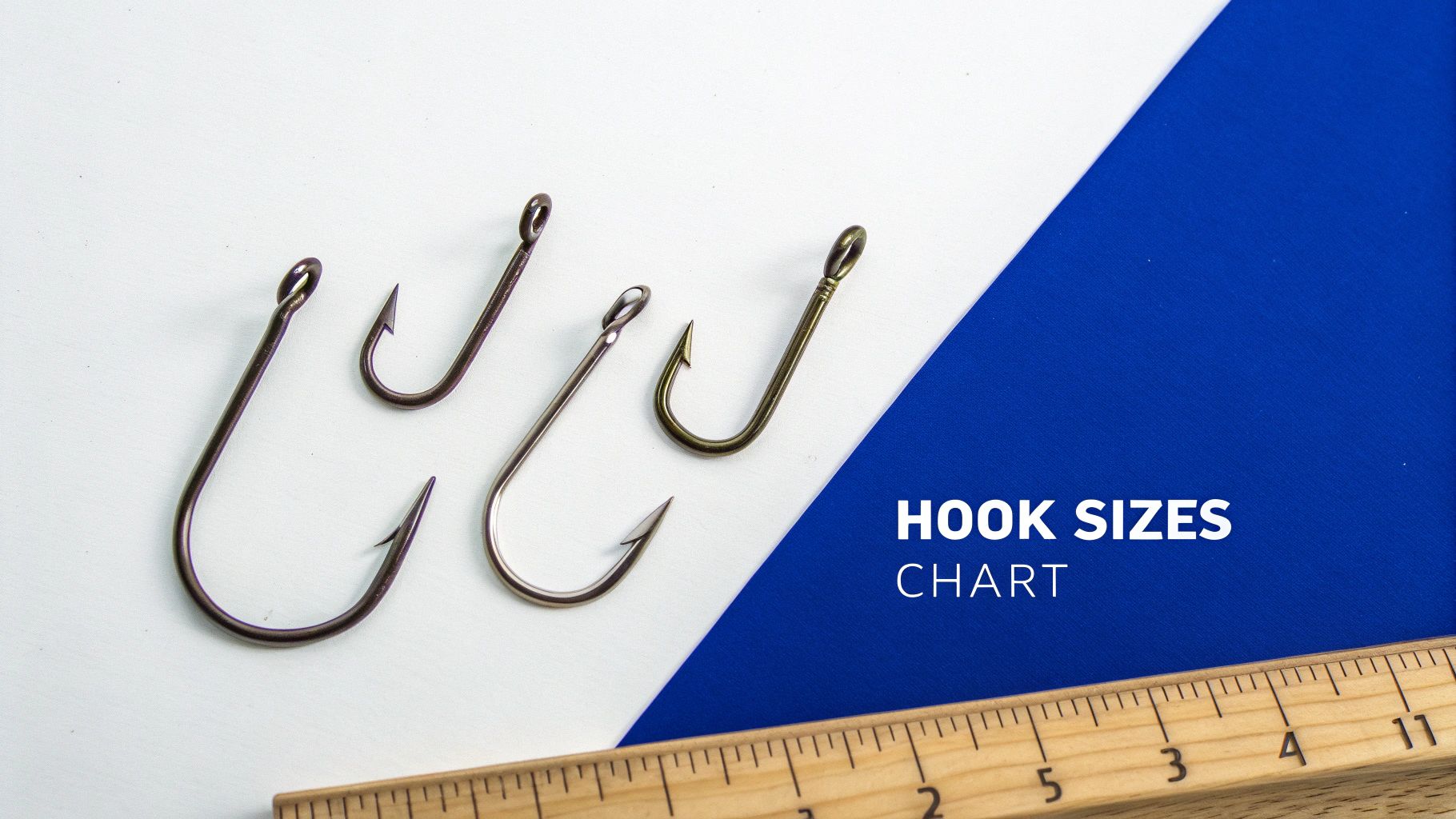
A modern fishing hook sizes chart can seem backwards at first, and that’s because it is. It actually follows two different systems: a standard numbered scale and an "aught" (or /0) scale.
It’s a bit counterintuitive. On the standard scale, the numbers get bigger as the hooks get smaller—a size 16 hook is tiny, while a size 1 is quite large. Once you pass size 1, the system flips to the "aught" scale, where a bigger number means a bigger hook. A 2/0 (two-aught) is smaller than a massive 8/0. Grasping this dual system is the key to picking the right hook for anything you're chasing, from small panfish to giant marlin.
From Tournament Legends to Your Tackle Box
For saltwater sportfishing legends Ed and Frank Murray, choosing the perfect hook was never a small detail; it was the bedrock of every win in high-stakes tournaments. They spent decades battling marlin, tuna, and sailfish, learning firsthand that the subtle difference between a 9/0 and a 10/0 hook could be what separates a championship title from a story about the one that got away.
This kind of hard-won knowledge, gained through countless hours on the water, drives home a critical truth for any angler: success is built on getting the details right.
The Murray Brothers’ experience proves that a simple fishing hook sizes chart is more than just a list of numbers. It’s a road map to better presentation, more power, and pinpoint precision. Their legacy is a testament to knowing your tackle inside and out, a philosophy that's just as important today when you're picking your gear.
A Quick Look at How We Got Here
The sizing convention we use today didn't just appear out of thin air. It evolved over more than a century as hook manufacturing became more industrialized and sportfishing boomed. By the early 1900s, the major hook makers in the U.S. and Europe had mostly settled on the strange system we now know: small hooks get big numbers, large hooks get small numbers, and the really big ones flip to the "/0" scale.
This system was born from the practical needs of anglers. Bluewater and marlin fishermen were already talking in terms of 1/0 through 12/0 sizes for their trolling lures and big-game baits. The industry simply standardized what was already happening on the water, giving every fisherman a reliable standard to work from.
Putting This Knowledge to Work
This guide is all about taking that expertise—from pioneers like the Murrays—and turning it into practical advice you can use on your next trip. Whether you're gearing up for the first time or fine-tuning your setup for a tournament, the core principles don't change.
Matching your hook to the fish you're after and the bait you're using is a fundamental skill. For those just starting out, our guide on the best fishing gear for beginners can help you build a solid kit based on these proven ideas. After all, mastering your gear is the first step toward creating your own fishing stories.
Lessons from Legendary Anglers Ed and Frank Murray
A fishing hook sizes chart gives you the science, but the real art comes from experience on the water. For sportfishing legends Ed and Frank Murray, picking the right hook was never just a small detail—it was the very foundation of their success in high-stakes saltwater tournaments. Their incredible careers, spent battling giants of the deep, offer lessons that go far beyond any simple chart.
From the competitive coast of Florida to the famous fishing grounds of the Bahamas, the Murray Brothers learned that the difference between a tournament win and a devastating loss often hinged on the hook. They knew rigging and presentation were everything. The hook had to be perfectly matched not just to the fish, but also to the bait and even the trolling speed.
The Art of Matching Hook to Bait
For Ed and Frank, a successful day hunting marlin or tuna didn't start when the lines went in. It began with careful, methodical rigging, where choosing the hook was the most important step. They knew a hook that was too big would kill the natural swimming action of a ballyhoo, making it look dead in the water and useless for tempting a cautious billfish. On the other hand, a hook that was too small or had too thin a wire just wouldn't have the muscle for a solid hookup on a big, powerful fish.
Their entire philosophy rested on a few key ideas:
- Balance is Key: The hook's weight has to work with the bait, not against it. This is what creates that natural, irresistible presentation that gets fish to strike.
- Strength Meets Subtlety: You need a hook strong enough for the target, but not so big or clunky that it spooks the fish. It's a delicate balance that often meant using the smallest, strongest hook you could get away with.
- Gap and Point Matter: The hook's gap needed to be wide enough to get past the bait and into the fish's mouth on a strike. And the point? It had to be razor-sharp for immediate penetration.
"In big-game fishing, your terminal tackle is your final connection to the fish. If any part of it fails, the entire effort is wasted. The hook is the most critical point of that connection."
This way of thinking shows why they obsessed over every little thing. A decision that seems minor, like choosing a 9/0 hook instead of a 10/0, could easily be the one thing that determined whether a trophy fish made it to the boat or was lost after a long fight.
Legacy of On-the-Water Expertise
The Murray Brothers' experience is a powerful reminder that while a fishing hook sizes chart is a vital tool, it’s what you do with that knowledge on the water that really matters. Their legacy isn’t just about the tournaments they won; it’s in the profound understanding of tackle they built over thousands of hours at sea. That kind of real-world expertise is what stands behind the gear and advice we trust today, proving the right tackle isn't just another piece of equipment—it's the heart and soul of successful fishing.
How to Read Hook Sizes and Numbers
Figuring out the numbering system on a fishing hook sizes chart is your first hurdle. It can seem a bit backward at first, and that's because it’s really two different sizing scales mashed together. Once you get the hang of it, though, you'll be able to pick the right hook with confidence every time.
These two sizing conventions are the standard numbered system for smaller hooks and the "aught" system for the big stuff. Each has its own logic, but they work in opposite ways. Let's break it down.
The Standard Numbered System
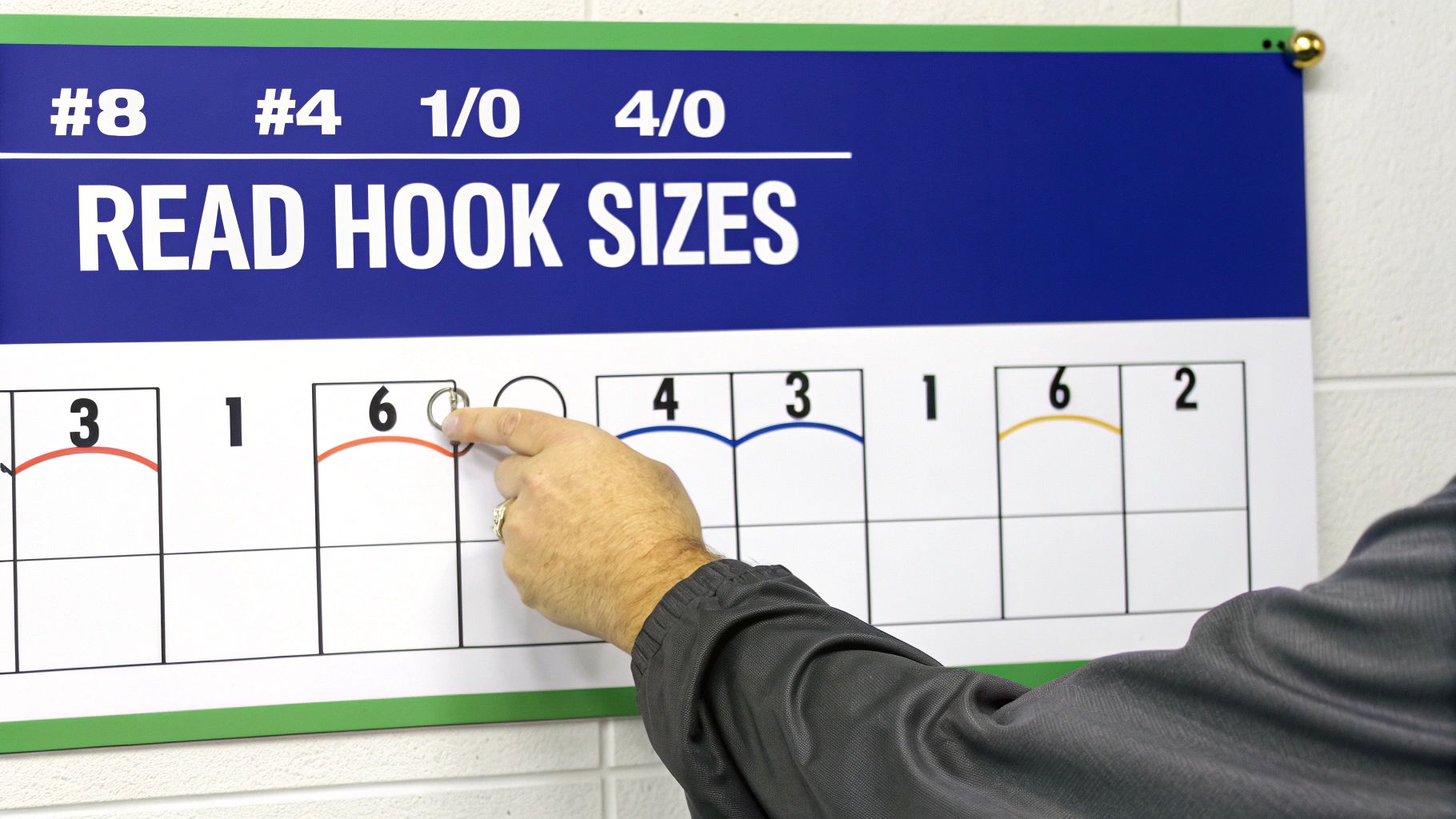
When you're dealing with smaller hooks—the kind you’d use for trout, panfish, or even bass—you're looking at the standard numbered scale. This typically runs from a tiny size #32 all the way up to a #1.
The most important thing to get straight is the inverse relationship: the bigger the number, the smaller the hook. It feels counterintuitive, but you'll get used to it.
- A #8 hook is bigger than a #12 hook.
- A #4 hook is bigger than a #8 hook.
- A #1 hook is the largest size on this scale before everything flips.
It's a lot like how wire gauge works; a smaller number means thicker wire. This is the scale that covers most of your everyday freshwater fishing.
The Aught System For Larger Hooks
Once you get bigger than a size #1 hook, the system switches over to what we call the "aught" scale. You'll see these sizes written with a slash and a zero, like 1/0, 2/0, and so on. These are your heavy-hitters, built for big, powerful fish in both fresh and saltwater.
The aught system is much more straightforward: as the number goes up, the hook gets bigger. Simple as that.
- A 4/0 hook is smaller than an 8/0 hook.
- An 8/0 hook is smaller than a 12/0 hook.
This universal sizing system is a huge reason the global hook market has grown into a massive industry. With North America making up about 45% of hook revenue, having a standard chart means an angler in Florida can buy the exact same 2/0 circle hook as someone in Australia. It creates a common language for fishermen everywhere. You can dive deeper into the global fishing hooks market on dataintelo.com to see just how big it's gotten.
Matching Hook Size to Your Bait or Lure
Any seasoned angler will tell you that a perfect presentation starts with balancing your hook with your bait or lure. This was the secret sauce behind the Murray Brothers’ legendary success in saltwater tournaments. They knew firsthand that the wrong hook could kill the action of the world’s best bait, making it look completely unnatural to a wary trophy fish.
You're looking for that sweet spot: a hook that’s beefy enough to handle your target fish but light enough that it doesn’t hinder your bait's natural movement. This is absolutely critical with live bait. A hook that’s too big and heavy will make a pilchard or goggle-eye give up and die long before a predator fish ever sees it. You lose that frantic swimming that triggers strikes.
It's the same story when rigging trolling lures or soft plastics. The hook has to complement the lure’s intended action, not fight against it. Get the balance right, and you'll maximize the lure's performance and massively increase your hook-up ratio when a fish finally commits.
Live and Natural Bait Pairings
For pros like Ed and Frank Murray, who built their careers perfecting the art of live-baiting for sailfish and marlin, hook selection was practically a science. They understood that the hook’s size, weight, and even its placement could make or break a day on the water. It directly impacted how a bait swam and, ultimately, how many fish they brought into the spread.
Here are some tried-and-true guidelines for pairing hooks with natural bait:
- Small Live Baits (Shrimp, Minnows): Go with small, lightweight hooks, typically from a #2 to a 2/0. This lets the bait swim freely and look alive. A heavy hook will just drag it to the bottom.
- Medium Live Baits (Pilchards, Ballyhoo): When rigging ballyhoo for trolling, a 7/0 to 9/0 J-hook has been the standard for decades. If you’re live-lining baits in this size range, a 4/0 to 6/0 circle hook is often the smarter choice for a solid, self-setting hookup in the corner of the jaw.
- Large Live Baits (Bonito, Mackerel): Chasing giants? You need a hook with serious backbone. Sizes from 8/0 all the way up to 12/0 are common here, giving you the power and gap needed to handle a violent strike and a grueling fight.
Pro Tip: A great rule of thumb is to make sure the hook gap is roughly twice the thickness of the bait where you plan to hook it. This ensures there's plenty of room for the hook point to bite deep into the fish's jaw when you set it.
Matching Hooks to Artificial Lures
Choosing the right hook for an artificial lure is every bit as important as it is for live bait. The hook's size and weight can completely change a lure's designed action. A hook that's too large can kill the subtle wobble of a plug, while one that's too small might not have enough bite to keep a big fish pinned.
- Soft Plastics: Rigging a 7-inch plastic worm, Texas-style? A 3/0 to 5/0 Extra Wide Gap (EWG) hook is the perfect match. That wide gap gives the plastic plenty of room to collapse on a bite, fully exposing the hook point for a solid set.
- Trolling Lures: Big-game trolling lures are typically armed with single or double hook sets from 8/0 to 12/0, depending on the lure head's size. The game here is to match the hook to the lure's profile without strangling its swimming action.
- Plugs and Hard Baits: Most hard baits come rigged with treble hooks right out of the box. If you're swapping them out due to rust or damage, stick to the exact same size or go one size larger at the absolute most. Going too big can cause the hooks to tangle with each other or the lure itself, ruining the action.
If you want to go deeper on lure selection, be sure to check out our detailed guide on the best lures for saltwater fishing, which breaks down top choices for different species and conditions.
Bait and Lure Hook Pairing Guide
To make things even clearer, here’s a quick-reference table to help you match specific hook sizes to some of the most popular baits and lures you'll likely be using.
| Bait or Lure Type | Bait/Lure Size | Recommended Hook Size | Pro Tip for Presentation |
|---|---|---|---|
| Live Shrimp | 3-4 inches | #1 to 2/0 | Hook through the horn or tail to keep it lively and natural. |
| Live Minnow/Pilchard | 4-6 inches | 2/0 to 4/0 | Use a light wire circle hook through the nose for best action. |
| Cut Bait (Mullet) | 2-inch chunks | 4/0 to 6/0 | Ensure the hook point is fully exposed past the bait. |
| Live Ballyhoo | 7-10 inches | 6/0 to 8/0 | For trolling, a J-hook with a pin rig is standard. |
| Soft Plastic Worm | 7-10 inches | 3/0 to 5/0 EWG | Texas rig for a weedless setup in heavy cover. |
| Swimbait | 4-6 inches | 4/0 to 6/0 | Match hook size to the body thickness for a solid hookset. |
| Offshore Trolling Lure | 8-12 inches | 8/0 to 10/0 | Rig with a stiff single or double hook set for best results. |
| Topwater Plug | 4-5 inches | #2 to 1/0 Trebles | Replace with single inline hooks of the same weight to reduce snags. |
This table serves as a solid starting point. Don't be afraid to experiment, as sometimes a slightly smaller or larger hook can make all the difference depending on the conditions and how the fish are biting.
Choosing the Right Hook Type
Beyond just the numbers on a fishing hook sizes chart, the actual shape of the hook is one of the biggest factors in your success. A hook’s design dictates how it sets, how it holds bait, and how well it keeps a fish pinned during the fight. Getting this choice right is every bit as important as matching the size to your target.
While there are dozens of specialized designs out there, most anglers will do just fine by mastering a few of the most common and effective hook types. Each one gives you a distinct advantage in specific situations, and knowing when to reach for which one is a true sign of an experienced angler.
J-Hooks for Versatility and Power
The classic J-hook is what most people picture when they think of a fishing hook, and for good reason. Its shape gives you an excellent combination of quick penetration and solid holding power. When a fish bites, you need to give it a firm, deliberate hookset to drive the point home, which is why it's a favorite for many lure fishing techniques and trolling.
For decades, the Murray Brothers swore by heavy-duty J-hooks while trolling for marlin. The design was perfect for rigging ballyhoo and ensuring a rock-solid connection when a big fish struck. The main drawback, however, is that a J-hook can easily gut-hook a fish, which is often fatal if you plan on releasing your catch.
Circle Hooks for Conservation and Catch-and-Release
Circle hooks have become the gold standard for catch-and-release fishing, especially in saltwater. Their unique design, with the point aimed back toward the shank, is genius—it prevents the hook from lodging deep in a fish’s throat. As the fish swims away with the bait, the hook naturally slides to the corner of the jaw and sets itself. You don't need that aggressive, sweeping hookset.
This self-setting mechanism is precisely why they are now required in many saltwater tournaments and for targeting certain species. They dramatically increase the survival rate of released fish.
For any angler focused on conservation, the circle hook is a non-negotiable piece of terminal tackle. It allows for a clean, safe release, ensuring the fish can fight another day.
Treble Hooks for Lures and Topwater Action
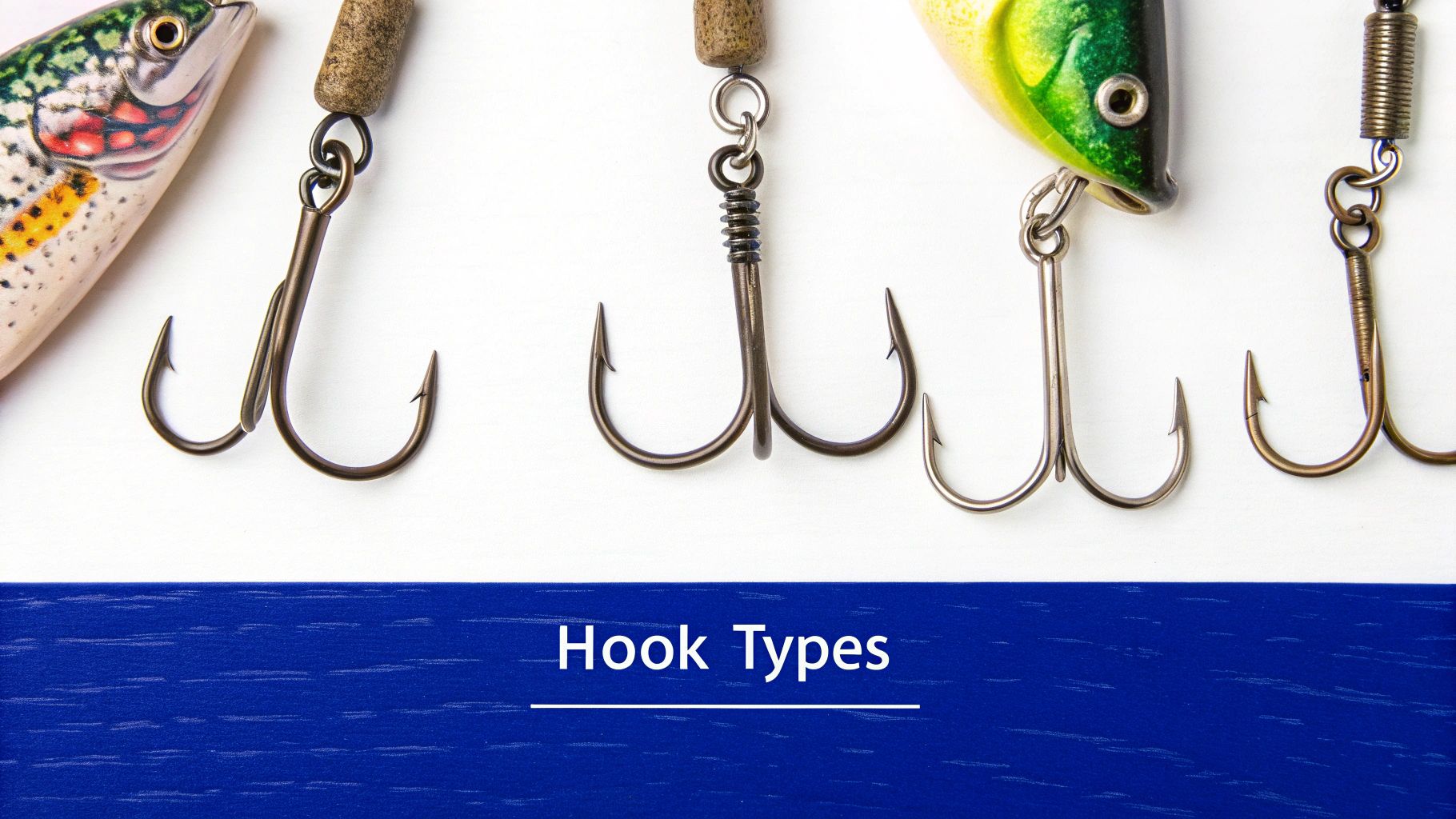
Treble hooks are the three-pronged hooks you see dangling from most hard baits, like crankbaits and topwater plugs. With multiple hook points, they significantly boost your chances of connecting with a fish during a fast, aggressive strike. Once hooked, their design makes it much harder for a thrashing fish to throw the lure.
Of course, they're also notorious for snagging on cover and can cause more damage to a fish. Because of this, many anglers will swap them out for single hooks, especially when fishing in protected waters or practicing catch-and-release.
Specialized Hooks for Finesse Presentations
Finally, you have specialized hooks like Octopus hooks and EWG (Extra Wide Gap) hooks that fill important roles. Octopus hooks have a short shank and a wide gap, making them perfect for nose-hooking delicate live baits without killing them.
The modern fishing hook sizes chart has expanded to reflect this diversity. Charts no longer just list sizes; they now mirror the diversification of hook types—J-hooks, circle hooks, treble hooks, and more—with each category mapping differently. In bass fishing, for example, charts for Texas-rigged plastics are often centered on 3/0–5/0 EWG hooks. As more tournaments mandate circle hooks, these charts have started including regulatory notes. You can explore more about these market trends in fishing hooks on cognitivemarketresearch.com to see how regulations are actively shaping the gear we use.
Common Hook Sizing Mistakes to Avoid
Even the sharpest anglers can get this wrong, but sidestepping a few common mistakes with your hook choice can make a huge difference in your catch rate. Just ask legends like Ed and Frank Murray, whose decades of high-stakes sportfishing taught them that a tiny miscalculation can be the difference between a trophy fish and a story about the one that got away.
It all boils down to avoiding these frequent blunders. Get this right, and you'll rig with confidence every time, perfectly balancing the hook's size and strength with your bait and target species.
Mistake 1: Using a Hook That Is Too Large
This is probably the most common slip-up I see: overpowering the bait with a hook that's way too big and heavy. A bulky hook will kill the natural action of live bait, making it look dead in the water. Wary trophy fish will spot that unnatural presentation from a mile away and turn their noses up at it.
For instance, trying to rig a live pilchard on a clunky 8/0 hook when a lightweight 4/0 is all you need is a classic mistake. The bait will tire out and sink instead of swimming frantically—that very action is what triggers a strike from predators like kingfish or tuna.
Pro Tip: Your goal should always be to use the smallest, lightest hook you can get away with that still has the muscle for the job. Let the bait be the star of the show, not the hardware.
Mistake 2: Choosing a Hook That Is Too Small
On the flip side, going too small for your target is a surefire way to get a bad hook-up ratio. The problem here is the hook's gap—the space between the point and the shank. If that gap is too narrow, it simply can't get around the bait and sink into the tough, bony jaw of a big fish.
Picture this: you're using a nice chunk of bonito to tempt a big grouper, but you've rigged it on a little 3/0 hook. Even if the fish inhales the bait, that tiny hook point will probably just bounce off or fail to get a solid hold in its powerful mouth. The result? A pulled hook just seconds into the fight.
Mistake 3: Mismatching the Wire Gauge
Finally, many anglers completely forget about the hook's wire gauge, or its thickness. A heavy-gauge hook is your best friend when fighting powerful fish, but it’s total overkill for smaller targets. And using a light-wire hook on a big fish? That's just asking for it to straighten out.
- Heavy Gauge: You need this for big game like marlin. It provides the raw strength to keep the hook from bending or breaking under extreme pressure.
- Light Gauge: Perfect for delicate live baits or smaller fish. It allows for much better bait action and penetrates easily with a light hookset.
Trying to use a fine-wire hook designed for bass to catch a giant tarpon is a recipe for heartbreak. That hook will bend out almost instantly, and you'll be left watching the fish of a lifetime swim away. When in doubt, check a fishing hook sizes chart and always match the wire strength to your quarry.
Your Top Questions About Hook Sizes
Even with a good fishing hook sizes chart tacked to your wall, questions always pop up when you're actually on the water. Getting straight answers to these common hang-ups is what really builds confidence in your tackle choices. We've pulled together the questions we hear most often, answered with decades of real-world fishing experience.
Think of this as your quick-reference guide for those moments of doubt. Whether you're rigging up for bass in a local pond or trolling for giants offshore, these answers will help you make the right call.
What Is the Biggest Fishing Hook Size?
For sportfishing, commercially made hooks can get massive, going up to a 20/0 or even larger for targeting things like giant sharks or goliath grouper. For big-game anglers like the Murray Brothers, who chased marlin for a living, hooks in the 10/0 to 12/0 range were standard issue for rigging big baits and lures.
Just remember how the 'aught' (/0) system works: the bigger the number, the bigger the hook. A 20/0 hook is a serious piece of hardware, dwarfing a 10/0.
Is a Size 4 or a Size 6 Hook Bigger?
A size 4 hook is bigger than a size 6. This is easily one of the most confusing things for new anglers to wrap their heads around. For the smaller hooks (the ones without the '/0'), the numbering system is backward—the smaller the number, the larger the hook.
Here’s an easy way to think about it:
- A size 1 is the largest hook in this standard series.
- A size 32 is one of the smallest, basically a speck of metal used for tiny flies.
This inverted system is an old relic from early manufacturing, but it’s still the standard today. Understanding this is key to reading any fishing hook sizes chart correctly.
What Hook Size Is Best for Bass Fishing?
There's no single "best" hook for bass fishing; it all comes down to your technique and the bait you're throwing. For a classic Texas-rigged 7-inch plastic worm, a 3/0 or 4/0 Extra Wide Gap (EWG) hook is a perfect place to start.
But if you pivot to a finesse rig like a drop shot with a small plastic, you'll want to downsize significantly to a size 1 or 1/0 hook. Fishing with live shiners? A 2/0 to 4/0 circle hook is tough to beat. The golden rule is to always match the hook to your bait's size and the presentation you're trying to achieve.
Does Hook Color Matter for Saltwater Fish?
You bet it can, especially in clear water where fish get a good look at everything. Less visible finishes like bronze, black, or camo are great for fooling line-shy species. On the other hand, plenty of anglers swear by red hooks, believing the flash of red mimics a wounded baitfish and triggers an aggressive bite.
Once you get into deep water or start trolling big lures that hide the hook, color becomes far less important than size, strength, and sharpness. The most critical part is the connection itself, which all starts with a solid knot. To make sure your rig is bulletproof, you can learn more about how to tie fishing knots in our detailed guide.
At Murray Brothers Palm Beach, we offer the legendary, battle-tested gear that turns fishing trips into lifelong memories. Explore our full collection of apparel and tackle, all built on a foundation of real-world tournament success.
Dejar un comentario