

If you've ever wanted to get into mahi mahi fishing, you're in for a treat. It's a fantastic blend of speed, smart tactics, and the pure excitement of an offshore chase. The secret sauce, perfected over decades by sportfishing legends like Ed and Frank Murray, is simple on the surface: find floating stuff like weedlines or debris in warm ocean currents, troll a mix of baits and lures around 5-7 knots, and then hang on for the wild, acrobatic fight they're famous for.
Learning From a Sportfishing Legacy
Before you even think about setting a line, it helps to understand where the best techniques come from. This isn't just another checklist of tips; it's a guide built on the real-world, hard-won experience of Ed and Frank Murray—legends who honed their skills in the heat of competitive saltwater sportfishing tournaments. We're going to get past the generic advice and dig into the kind of bluewater wisdom that only comes from decades of consistently putting fish in the boat when everything is on the line.
This is about more than just a day on the water. It's about getting into the mindset of anglers who dedicated their lives to figuring out these incredible offshore acrobats. Learning how to catch mahi mahi the right way means you start thinking like a predator and really paying attention to the subtle clues the ocean gives you—a skill the Murray Brothers turned into a tournament-winning advantage.
A Heritage Forged on the Water
The Murray Brothers weren't just fishing for fun; they were innovators at the forefront of the sportfishing world. Winning high-stakes saltwater tournaments wasn't about luck. It came down to obsessive preparation, a profound respect for the marine environment, and a constant push to be better. For them, every trip was a classroom, a chance to refine the very techniques that many of us now consider standard practice in modern sportfishing.
At the heart of their strategy was one simple idea: the details matter. Everything from the way a ballyhoo swims behind the boat to the slightest shift in water color was a clue. That kind of awareness is what separates the consistently successful tournament anglers from everyone else.
This guide is our way of passing that legacy on to you with practical, actionable advice. You'll be learning the strategies that came directly from these pioneers who elevated mahi fishing to an art form. If you want to go even deeper, you can explore more about the history of sportfishing to see how these traditions shaped the sport we love today.
Their whole philosophy can be boiled down to a few core principles:
- Preparation is Paramount: A successful day begins long before you leave the dock. It means having perfectly rigged baits, tackle that's organized and ready, and a solid game plan for the day—a non-negotiable for any serious tournament contender.
- Adaptability Wins: The ocean is never the same twice. The best anglers are the ones who can read the conditions in the moment—the currents, the wind, the water clarity—and aren't afraid to switch things up.
- Respect the Quarry: To consistently catch any fish, you have to understand it. Knowing its habits, what it eats, and how it fights is the key to outsmarting it, a lesson learned through thousands of hours on the water.
How to Find Mahi Mahi Like a Pro
Finding mahi mahi is where a great day offshore truly begins. Sure, anyone can tell you to "look for weedlines," but the real experts—guys like the Murray Brothers—know it’s about so much more. It's about learning to read the ocean, seeing it not as a big blue desert but as a living map full of clues that lead straight to hungry fish, a skill that consistently put them on the leaderboard in saltwater sportfishing tournaments.
This skill is more important than ever because mahi are a global obsession. From the Atlantic to the Gulf and the Caribbean, they’re one of the most popular bluewater targets. In fact, recreational anglers landed around 9 million pounds in 2023, absolutely dwarfing the 100,000 pounds brought in commercially.
What does that tell you? It means sport fishermen, rigging up just like you, are the ones dialing in these fish. You can dig into more of these numbers with these mahi mahi fishing statistics on Wikipedia. But all that fishing pressure also means the fish are getting smarter. You need an edge, and that comes from seeing the little things that most people miss.
Reading the Water Beyond Weedlines
Weedlines are the classic starting point, and for good reason. But not all sargassum is created equal. A patch of old, dead, brown weed is a ghost town compared to a vibrant, golden-green line that’s full of life. That’s the stuff that holds bait, and where there's bait, there are mahi.
The real trick, though, is finding fish when there are no obvious weedlines in sight. This is where the tournament-level experience of Ed and Frank Murray pays off. Seasoned captains are constantly scanning their electronics and the water's surface for subtle hints.
- Temperature Breaks: Sometimes, a temperature change of just half a degree is enough to stack up baitfish. These "temp breaks" show up on modern chartplotters and trolling along them is a proven tournament-winning tactic.
- Current Rips: Keep an eye out for a visible change in the water's texture. It might look like a line of choppy water or a slick calm streak. That’s a "rip," where two currents meet, pushing nutrients and bait right to the surface. It’s a natural feeding lane.
- Floating Debris: Out here, any piece of trash can be treasure. A single five-gallon bucket, a log, or a discarded shipping pallet can create its own little ecosystem, holding an entire school of mahi. Always approach flotsam with stealth—your first pass is your best shot.
Let the Birds Be Your Guide
Birds are your eyes in the sky, and they see things you can't. Frigate birds, or "man-o'-war birds," are the absolute best at spotting mahi from way up high. If you see a lone frigate circling with purpose, you need to pay attention. The Murray Brothers learned early on that trusting the birds was one of the fastest ways to locate fish in a vast ocean.
A frigate bird that’s hovering and dipping is practically a neon sign pointing to fish. It’s almost guaranteed that mahi are pushing bait to the surface right below it. Don’t just troll past that spot; work it over good. In a tournament, finding a sign like this can be the difference between winning and losing.
The other dead giveaway? Flying fish scattering across the surface. When you see showers of flyers erupting from the water, it’s a five-alarm fire. Something big and fast is hot on their tails. Your job is to get your boat in front of the fleeing bait and get ready for a spectacular strike. Mastering these visual cues is what separates a long, quiet boat ride from an unforgettable day of catching.
Choosing the Right Gear for Offshore Battles
Having the right tackle for an offshore battle isn't just a small detail; it's the foundation of your success. For sportfishing legends like Ed and Frank Murray, meticulous preparation meant having specific gear setups that could handle any situation. It’s a philosophy born from high-stakes saltwater sportfishing tournaments where a single gear failure could cost a victory.
Your primary trolling outfits are your workhorses. We're talking conventional reels in the 30- to 50-pound class, spooled up with quality monofilament or braided line. Match these reels with stout 6- to 7-foot rods that have enough backbone to wrestle a powerful bull mahi but a tip that's sensitive enough to let the bait swim naturally. A typical trolling spread usually involves four to six of these setups, letting you cover a wide swath of water and present multiple options to the fish.
Having Multiple Setups Is Non-Negotiable
A key strategy that separates the weekend warriors from the pros is having different types of rigs ready to go at a moment's notice. The Murray Brothers perfected this approach, knowing firsthand that opportunities offshore are fleeting. When you hook one mahi, you’ve likely found the entire school, and in a tournament setting, capitalizing on that moment is everything.
The biggest mistake you can make is not being prepared for the chaos that follows the first strike. That's when the "bailing" setups come into play—lighter spinning rods ready with chunk bait or jigs. As soon as a fish is hooked on a trolled line, another angler should be casting to the school to keep the frenzy going.
This multi-rod approach is how you turn a single hookup into a boat full of fish. The moment the action starts, there’s simply no time to start rigging gear.
- Trolling Outfits: Have 4-6 conventional rods (30-50lb class) ready for your main spread.
- Bailing Setups: Keep 2-3 medium-heavy spinning combos (20-30lb class) rigged and accessible for casting to schooled fish.
- Pitch Bait Rod: A dedicated conventional or spinning rod with a rigged ballyhoo or live bait is absolutely essential for sight-casting to a big fish that suddenly appears in the spread.
For a deeper dive into outfitting your vessel, our guide on the best saltwater fishing gear offers a comprehensive look at what the pros use. This level of preparation isn't overkill; it's exactly how tournaments are won.
Selecting the Right Bait and Lures
Mahi mahi are aggressive, opportunistic feeders, but don't let that fool you into thinking they'll eat just anything. Your bait and lure selection should always match the conditions and the specific technique you’re using. Rigging baits perfectly is a craft in itself, one that was a cornerstone of the Murray Brothers' tournament success.
A poorly swimming ballyhoo, for instance, won't get a second look from a discerning bull mahi. Your bait has to swim upright and look natural, not spin or drag sideways through the water. This is especially true when trolling, as your presentation is everything.
Similarly, your lure choice matters a great deal. Bright colors like pink, chartreuse, and blue are classic mahi attractors, often run behind a chugger or jet head lure to create more commotion and an enticing bubble trail. When you get a school fired up right next to the boat, a simple bucktail jig or a soft plastic can be devastatingly effective.
Here's a quick guide to help you make the right call on the water.
Mahi Mahi Bait and Lure Selection Guide
| Technique | Primary Choice | Secondary Choice | Best Conditions |
|---|---|---|---|
| Trolling | Rigged Ballyhoo | Skirted Lures (Chuggers) | Searching for fish, covering ground |
| Bailing | Cut Bait (Sardines, squid) | Bucktail Jigs | When a school is boatside |
| Pitch Baiting | Live Pinfish or Pilchard | Rigged Ballyhoo | Sight-casting to a large, visible fish |
| Casting to Debris | Soft Plastic Jerkbaits | Small Spoons | Working weed lines or floating structure |
The goal is to have an arsenal of options ready so you can quickly adapt to what the fish want on that particular day. Having the right gear, from rods to rigs, is central to your success.
Mastering Trolling and Bailing Like the Pros
Alright, you've got the boat, you've got the gear—now it's time to put it all into motion. When you talk to seasoned saltwater pros like Ed and Frank Murray, you quickly learn that tournament wins and consistently full fish boxes come down to two fundamental skills: trolling and bailing. These aren't just fishing terms; they're a one-two punch for turning a long day of searching into a full-blown mahi blitz.
First, you troll to find them. Then, you bail to catch every last one you can. The diagram below breaks down how your gear should be staged for this exact flow of action.
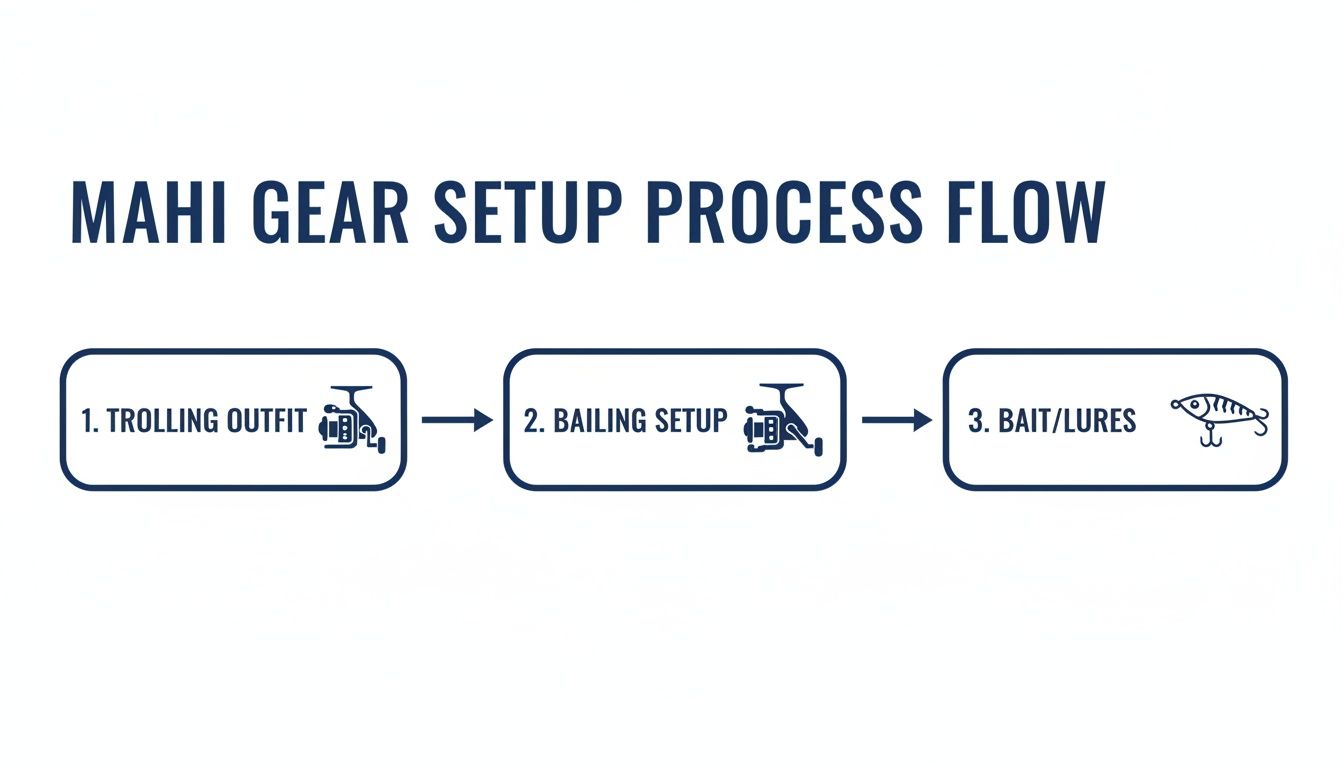
This is the system: your heavy-duty trolling setups are your search party, and your lighter spinning combos are your rapid-response team, ready to capitalize the second you find a hungry school.
The Art of a Productive Trolling Spread
Trolling is your number one tool for covering huge tracts of open water and hunting down fish. But don't just toss some lines out and hope for the best. A truly effective spread is a carefully crafted illusion, meant to look like a panicked little school of baitfish just waiting to be ambushed. Getting this right is a skill the Murray Brothers honed over countless hours in saltwater sportfishing tournaments.
Most tournament-level spreads run between four and six lines, all set at different distances from the transom. The idea is to create a staggered pattern that covers the clean water alleys just outside the prop wash and also reaches way back for those warier fish hanging behind the commotion. To get a deeper dive into the mechanics, check out our guide on what trolling in fishing is all about.
A golden rule for mahi trolling, especially after that first hookup: never stop the boat. Keep chugging along at your trolling speed. This single move, perfected on the tournament circuit, is often what triggers the rest of the school into a competitive feeding frenzy, turning one bite into three or four.
Executing the Perfect Bailing Frenzy
"Bailing" is what happens in the minutes of controlled chaos right after you find the fish. The second a mahi hits a trolled line, the game completely changes. This is the moment your pre-rigged spinning outfits become the most important tools on the boat, a tactic that turns a single fish into a tournament-winning haul.
As one person battles the hooked fish, everyone else grabs a spinning rod and starts "bailing"—casting chunks of cut bait or small jigs into the water around the boat.
This technique is a game-changer for two big reasons:
- It keeps the school close. Tossing out freebies holds the other mahi right by the boat, whipping them into a frenzy.
- It maximizes your shot. You can pull multiple fish out of a single school before they lose interest and sound.
It’s a team sport, really. You might have one angler on the reel with a big bull while two others are casting to and hooking up with smaller schoolies. It requires everyone to be ready and communicate—the very definition of a well-oiled tournament crew.
Tactics Inspired by Commercial Success
It's always smart to see how the commercial guys do it. In the Pacific, most mahi are caught commercially using troll and handlines—basically, the same techniques we use, just scaled up. But look at the Atlantic, and the numbers tell an incredible story. In 2023, recreational anglers landed an estimated 9 million pounds of mahi, while the commercial fleet took in only about 100,000 pounds.
That means recreational boats account for over 98% of the U.S. Atlantic mahi harvest. What this tells you is that the tactics refined by charter captains and sportfishing tournament teams are incredibly effective. The data backs up the playbook: get on the right structure, troll your baits, and be ready with stand-up gear when you find them. You can dig into these fishery statistics on NOAA.gov yourself. Following these proven methods is the surest way to put more mahi on the deck.
Winning the Fight and Landing Your Catch
The strike is just the beginning. That screaming drag and explosive first run is pure chaos, but landing a big mahi is where real skill comes into play. Ed and Frank Murray learned this lesson the hard way, fishing countless saltwater sportfishing tournaments where every single fish in the boat mattered. Mahi are famous for their acrobatic jumps and powerful, blistering runs—all designed to throw the hook or pop your leader.
Your first move after the hookup is crucial: keep steady pressure on the line. When you sense a mahi is about to launch itself out of the water, and you'll feel it as the line starts angling up towards the surface, drop your rod tip down low. This is called "bowing to the fish." It gives just enough slack to absorb the shock of a violent headshake mid-air, preventing the hook from being thrown. It’s a simple, subtle move that makes all the difference.
Bringing the Fish to the Boat
After that initial mayhem, it's time to settle in and work the fish. You want to gain line smoothly and consistently, not by horsing the fish with jerky, aggressive motions. Let the rod do the heavy lifting. Use the classic "pump and reel" technique: lift the rod tip firmly to pull the fish toward you, then quickly reel as you lower the tip back down. This tires the fish out without putting too much strain on you or your gear.
As the mahi gets closer to the boat, its runs will get shorter but they can still be incredibly strong. Be ready for these last-ditch efforts. A classic rookie mistake is to crank the drag down tight when the fish is boatside, which is a surefire way to cause a heartbreaking break-off.
A "green" fish is a dangerous fish. Never, ever try to gaff or net a mahi that's still thrashing wildly on the surface. Rushing it will only spook the fish into one last powerful dive or cause it to go crazy on deck, potentially breaking the line or even injuring someone. This is a lesson you learn quickly in competitive fishing.
Gaff vs. Net: The Final Move
How you bring the fish aboard depends entirely on its size.
For most schoolie-sized mahi, say anything up to about 15 pounds, a big landing net is your best friend. It’s cleaner, safer for everyone involved, and less damaging to the fish if you plan on releasing it. Just lead the tired mahi headfirst right into the hoop and hoist it over the rail in one fluid motion.
Now, for a big bull, you're going to need a gaff. This is a moment that calls for good communication and a steady hand. The angler’s job is to lead the fish alongside the boat, giving the person with the gaff a clear, easy shot. Aim for the solid meat right behind the head. Once you've got a solid hold, swing the fish directly from the water into the fish box to contain the thrashing. This is how you secure that trophy catch and keep the cockpit safe.
Your Mahi Mahi Fishing Questions Answered
Even after decades on the water, some questions always seem to surface. The sportfishing legacy of guys like Ed and Frank Murray was built on figuring this stuff out in the heat of the moment during high-stakes tournaments. So, let's tackle some of the most common questions about mahi mahi fishing with answers forged from that kind of real-world experience.
What Is the Best Time of Day to Catch Mahi Mahi?
Sure, you can catch mahi any time of day, but things really tend to heat up in the early morning and late afternoon. Those low-light conditions get baitfish moving around near the surface, and that’s like ringing the dinner bell for predators.
That said, a core principle in tournament fishing is to never let your guard down. A killer bite can happen in the middle of a blazing hot afternoon if you stumble across the right weedline or a piece of floating debris holding a fired-up school. You just have to be ready.
How Can I Tell the Difference Between a Bull and a Cow Mahi Mahi?
It’s pretty easy once you’ve seen a few, especially on the bigger fish. The difference is all in the head.
- Bulls (males) get that classic, blunt forehead that looks almost vertical. It gives their head a very distinct, squared-off shape.
- Cows (females) have a much more rounded, sloped forehead that tapers down gently to the mouth.
This difference gets way more obvious as the fish get older. As a rule, bulls also tend to grow bigger than cows of the same age.
In the competitive world of saltwater sportfishing, being able to spot a big bull in a flash is a critical skill. It’s usually the larger, more aggressive male leading the charge, and getting him hooked first can ignite the entire school into a feeding frenzy.
What Should I Do If the Mahi Mahi Suddenly Stop Biting?
When a hot bite just shuts down, it's time to switch things up. This is what separates the consistently successful anglers from the pack. First, change your presentation. If you were pulling artificial lures, try swapping over to a rigged ballyhoo or start tossing chunks of cut bait.
Next, play with your trolling speed or change your direction. Maybe a slight zig-zag pattern will trigger a strike. If you were bailing a school that suddenly sounded, try dropping a vertical jig down to their depth and see if you can coax them back to the surface. If you’ve tried a few things and are still coming up empty, don't waste time—move on and find new water. The very next piece of structure could be holding an even bigger school.
How Far Offshore Do I Need to Go to Find Mahi Mahi?
There's no magic number here. How far you need to run really depends on where you're fishing and what the conditions are like that day. Mahi are pelagic fish, meaning they're always on the move, chasing warm ocean currents like the Gulf Stream. Down in South Florida, that can put them just a few miles off the beach.
In other parts of the country, you might be looking at a run of 20, 30, or even 50+ miles offshore. The key isn't the distance itself, but finding that perfect recipe: warm, clean water, noticeable temperature breaks, and some kind of floating structure that’s holding bait.
Ready to gear up with apparel that comes from a true fishing heritage? At Murray Brothers Palm Beach, we offer legendary, battle-tested gear designed by anglers, for anglers.
Dejar un comentario