

How to Tie Boat Knots Like Sportfishing Legends Ed & Frank Murray
When you're out on the water, knowing how to tie a few essential boat knots is more than just a skill—it's a lifeline. It all boils down to mastering a handful of time-tested techniques and practicing them until they become pure muscle memory. For saltwater anglers, this means focusing on knots that are strong, reliable under load, and easy to tie when the wind and waves are working against you. This is the bedrock of true seamanship, the kind sportfishing legends Ed and Frank Murray built their careers on.
The Unbreakable Knots of Sportfishing Legends
In the high-stakes world of saltwater sportfishing tournaments, success is measured by more than just the size of the catch. It’s built on a foundation of absolute reliability, where every single piece of gear has to perform flawlessly under immense pressure. For legendary anglers like Ed and Frank Murray, that foundation always started with a few critical boat knots.
This skill isn’t just a nice-to-have; it's a non-negotiable part of seamanship passed down through generations. The ability to tie the right knot at precisely the right time gives you the deep-seated confidence you need to secure your vessel, manage your gear, and ensure everyone's safety miles from shore. When a tournament win or the fish of a lifetime is on the line, you simply can't afford to second-guess your connections.
Why Knot Proficiency Is Everything
For the Murray Brothers, tying knots was never just about making loops in a rope. It was about creating an unbreakable chain of trust between the angler, the gear, and the boat. This deep understanding, honed over decades of competing in saltwater sportfishing tournaments, translates directly into better fishing and, more importantly, safer boating.
- Safety on the Line: A properly tied cleat hitch keeps your boat exactly where you left it at the dock. A strong bowline can be a literal lifesaver in an emergency.
- Protect Your Gear: Whether you're securing fenders or rigging an anchor line, the right knot prevents costly losses and frustrating equipment failures.
- Efficiency Under Pressure: Fumbling with a line during a critical moment can be the difference between landing that trophy fish and telling a story about the one that got away. You need that muscle memory.
The hard truth is, your entire setup is only as strong as its weakest link. In many cases, that weak link is a poorly chosen or improperly tied knot. It's a small detail that separates the prepared angler from everyone else.
The Murray Brothers' Toolkit
Throughout their legendary careers, Ed and Frank relied on a core set of knots that covered nearly every situation they ever faced on the water. These weren't some obscure or overly complex knots. They were the proven workhorses of the maritime world, chosen for one reason: they work. You'll quickly find that a small, well-mastered selection is far more valuable than knowing dozens of knots you can't tie correctly under pressure.
To give you a head start, here's a quick look at the core knots we'll cover, the very same ones that became staples for the Murray Brothers.
Essential Knots From the Murray Brothers' Toolkit
| Knot Name | Primary Use on a Boat | Why It's a Must-Know |
|---|---|---|
| Bowline | Creating a fixed loop at the end of a line | The king of knots; strong, secure, and won't jam. |
| Cleat Hitch | Securing your boat to a dock cleat | The only way to properly tie off at the dock. Fast and secure. |
| Clove Hitch | Temporarily tying a line to a rail or post | Quick to tie and easy to adjust, but not for heavy loads. |
| Figure-Eight | A stopper knot to prevent a line from slipping through | Simple, effective, and won't bind up like an overhand knot. |
| Sheet Bend | Joining two ropes of different diameters or materials | The go-to for securely connecting two different lines. |
| Rolling Hitch | Attaching a line to another line or a pole | Grips tight and won't slip under a parallel pull. |
| Slipknot | Creating an adjustable loop | Handy for temporary holds where quick release is needed. |
This guide will move beyond simple diagrams. We're going to dive into the specific knots that became staples in the Murray Brothers' toolkit, explaining their critical roles with insights drawn from decades of real-world experience.
Of course, even the best knots need the right rope. To learn more about equipping your vessel for success, check out our guide on the best saltwater fishing gear, which covers everything from lines to lures.
Mastering the Bowline: The King of All Knots
If you ask any seasoned mariner, from sportfishing legends like Ed and Frank Murray to old salts who've seen it all, they'll tell you knowing your knots is less a skill and more an instinct. And in that essential toolkit, one knot stands above the rest: the bowline. It's often called the 'king of knots,' and for good reason. Its genius is in its perfect marriage of incredible strength and elegant simplicity.
This isn't just a knot you learn from a diagram. For experienced anglers, tying a bowline is pure muscle memory—something you can do blindfolded, on a heaving deck, with a squall kicking up. It’s the knot you trust with your boat, your gear, and sometimes, your life.
What makes the bowline so indispensable? It creates a fixed loop at the end of a line that absolutely will not slip, jam, or bind, no matter how much tension you put on it. But here’s the magic: even after taking the strain of a heavy boat fighting a surging tide, a simple flick of the wrist is all it takes to untie it. That dual personality is what makes it a must-know.
Where the Bowline Shines on a Fishing Boat
On a fishing boat, the need for a reliable, fixed loop is constant. The Murray Brothers would have turned to the bowline in countless situations where there was simply no room for error.
- Dock Lines: This is the bowline's bread and butter. Tossing a perfectly sized loop over a piling or cleat for a secure connection is its most critical, everyday job.
- Improvised Harness: In a scary man-overboard situation, a bowline tied quickly around someone's chest can serve as a secure, temporary rescue harness.
- Lashing Down Gear: When the weather turns nasty, you need to lash down coolers, tackle boxes, and other valuable gear. A bowline won't vibrate loose, keeping everything exactly where you put it.
- Emergency Tow Line: While you hope you never need it, a bowline can form a strong loop for attaching a tow line to another vessel in a pinch.
Frank and Ed Murray built their success on a foundation of meticulous preparation and absolute trust in their equipment. The bowline was a critical part of that foundation. They knew that in the heat of a tournament, with big money on the line, a failing knot is the last thing you can afford.
"The bowline is your best friend out there. It's the one knot that has never let me down, from securing the boat in a storm to rigging a critical piece of gear. It’s the knot you bet your day on." - An Old Salt's Wisdom
From Clumsy Fingers to Muscle Memory
You’ve probably heard the classic mnemonic for tying a bowline: "the rabbit comes out of the hole, goes around the tree, and back down the hole." It's a great starting point, but true mastery only comes when your hands take over and your brain can focus on other things.
The trick is to practice everywhere, not just in your living room. Tie it on a cleat. Tie it around a railing. Try it with wet, cold hands. Your goal is to make the process so automatic you can do it while dealing with a screaming reel or navigating a crowded marina.
One of the most overlooked steps is "dressing" the knot. After you form the loop, you need to tighten it by pulling on the standing part and the loop at the same time. This snugs everything down neatly, ensuring no lines cross over each other incorrectly. A sloppy, undressed bowline is a weak bowline.
Why Its Strength Is No Myth
The bowline's reputation for reliability isn't just talk; the numbers back it up. A properly tied bowline retains an impressive 75-80% of the rope's original breaking strength. That's a huge deal, since every knot you tie inherently weakens the line.
Its importance is universally recognized. In a survey by the Royal Yachting Association (RYA), a staggering 98% of 5,000 sailors named the bowline as the single most essential knot to know. They pointed to its unwavering reliability in high-stress situations. You can learn more about its place among the most common and reliable sailing knots to see just how vital it is.
This is exactly why it was a staple for competitors like the Murrays. When you're pushing your gear to the absolute limit, every percentage point of strength counts. Knowing your connection point is as strong as it can be gives you the confidence to focus on landing the fish, not worrying about your knot.
Securing Your Vessel with Docking Knots
Tying up your boat properly is one of the most fundamental skills in boating, and it’s a clear sign of an experienced hand. In the high-stakes world of saltwater sportfishing tournaments, where legends like Ed and Frank Murray cut their teeth, a quick and secure docking isn't just about looking good—it’s about protecting your investment when time is of the essence.
We're going to focus on two absolute workhorse knots for any docking situation: the Cleat Hitch and the Clove Hitch.
For anglers like the Murrays, who spent decades navigating busy marinas from Palm Beach to the Bahamas, these knots were second nature. They knew a poorly tied line could lead to a damaged hull or a lost fender. The goal is always a stress-free experience, knowing your boat will stay put, no matter what the wind and current throw at you.
The Undisputed Champion: The Cleat Hitch
Let's be clear: the cleat hitch is the only knot you should use to tie your boat to a dock cleat. It's fast, incredibly secure, and—just as important—easy to untie even after it's been under a heavy load. A badly tied cleat hitch is one of the biggest rookie mistakes, something a seasoned boater can spot from a hundred yards away.
The secret to a perfect cleat hitch is a clean technique that won't jam. Start with a full wrap around the base of the cleat; this takes the initial strain and stops the line from slipping while you finish the knot. Next, make a figure-eight pattern over the horns of the cleat.
Now for the critical part: the finish. You'll make a final half hitch, but with the line turned under itself. The free end should end up pointing back along the main line, creating a clean, locked finish. This simple flip is what prevents the knot from jamming and ensures you can get it undone in a hurry.
A correctly tied cleat hitch is both strong and elegant. It tells other boaters that you know what you're doing. There's no need for dozens of messy wraps; a proper hitch is simple, clean, and completely reliable.
The most common mistake is wrapping the line around the horns too many times or finishing with a simple overhand knot, which will almost certainly jam tight. In a tournament setting where every second counts, fighting with a jammed knot is a rookie move you can't afford. The Murray Brothers’ philosophy was all about efficiency and reliability, and that applies perfectly here.
The Versatile Clove Hitch for Temporary Tasks
Next up is the Clove Hitch. While the cleat hitch is for securing the boat, the clove hitch is your go-to for quick, temporary jobs around the dock. Its number one job? Hanging fenders. It’s incredibly fast to tie and just as easy to adjust, which lets you set your fenders at the perfect height to protect your hull against a piling or dock.
To tie it, just take one wrap around a rail or post, cross over the standing part of the line, and make a second wrap. Tuck the working end under that second wrap, and pull it tight. It’s a simple, effective knot for tasks that don’t involve a heavy or constant load.
But—and this is a big but—experienced anglers like Frank and Ed Murray knew its limits. The Clove Hitch is a friction hitch, meaning it can slip or even come undone under constant rocking and vibration. For this reason, it should never be used for permanent mooring. Think of it as a temporary tool for a specific job. If you need to leave a fender tied with a clove hitch for a while, add one or two half-hitches on top of it for some crucial extra security.
A recent global boating insurance review found that clove hitches were used in 18% of minor fender tie-offs, with a 92% success rate when not under a constant pull. It's a great knot, but you have to respect its tendency to slip. You can learn more about this and other essential knots from Craftinsure.com.
This simple infographic breaks down the process for tying another essential knot, the Bowline, into three clear steps: creating the loop, passing the line through, and wrapping it around.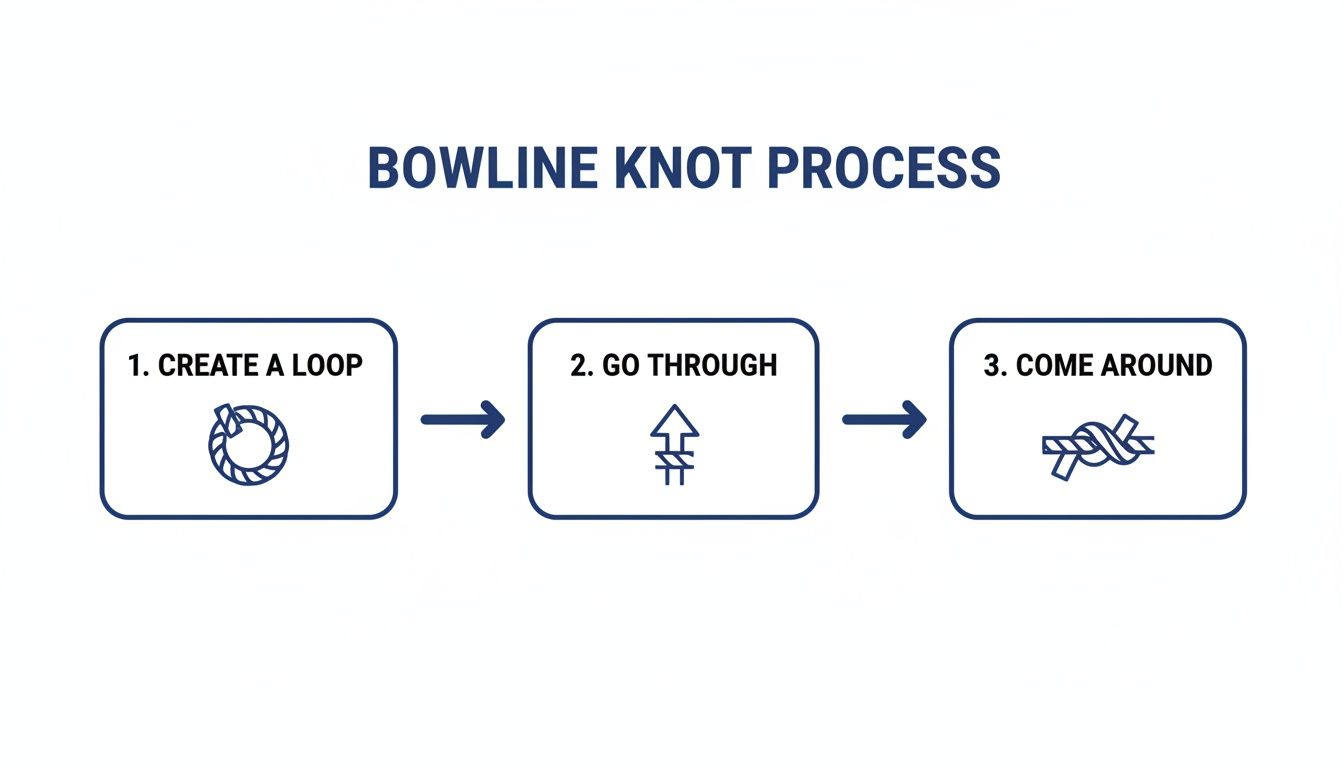
The visual flow highlights the famous "rabbit and tree" method, making it easier to commit this critical knot to muscle memory.
Mastering these docking knots turns a potentially stressful moment into a smooth, controlled operation.
Choosing the Right Knot for the Job
Not all knots are created equal. Some are incredibly strong but will jam under load, while others are quick to tie but can slip. Knowing which knot to use in a specific situation is what separates novices from seasoned boaters.
This table breaks down the key characteristics of the knots we've covered, helping you pick the right one every time.
| Knot Name | Line Strength Retention | Best Use Case | Ease of Untying |
|---|---|---|---|
| Bowline | ~60% | Forming a fixed loop for mooring or rescue | Very Easy |
| Cleat Hitch | ~85% | Securing a boat to a dock cleat | Very Easy |
| Clove Hitch | ~60% | Temporarily tying off fenders or gear | Easy (can slip) |
| Figure-Eight | ~80% | A stopper knot to prevent a line from running out | Easy |
| Sheet Bend | ~55% | Joining two ropes of different diameters | Moderate |
| Rolling Hitch | ~70% | Attaching a line to another line or post under tension | Moderate |
| Slipknot | ~50% | A temporary hitch that releases quickly | Very Easy |
Understanding these differences is key. You wouldn't use a slipknot for mooring, and you wouldn't use a sheet bend to tie up to a cleat. Practice them, learn their strengths and weaknesses, and you'll be prepared for anything on the water.
Specialty Knots for Critical Situations
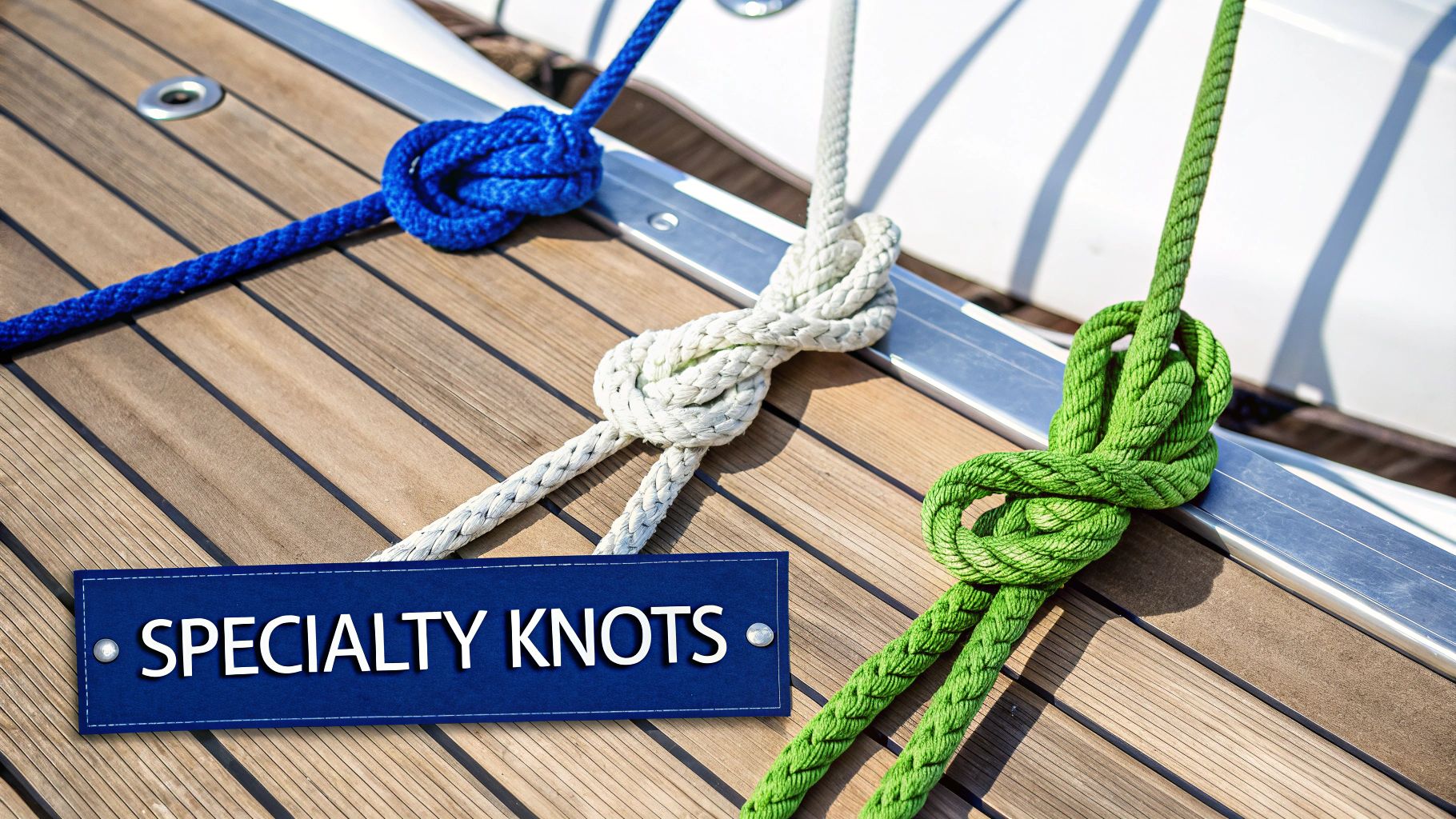
Sure, the bowline and cleat hitch handle the daily grind, but true seamanship shines when the unexpected hits. Sportfishing legends Ed and Frank Murray knew that a pro’s toolkit goes beyond the basics to include knots for specific, high-stakes situations. These aren't the knots you'll tie every day. But when you need them, you really need them.
In the heat of a saltwater tournament, a small problem can spiral into a day-ending disaster. Knowing a few specialty boat knots can be the difference between a frustrating failure and a legendary story. We're going to cover three of these problem-solvers: the Figure-Eight, the Sheet Bend, and the Rolling Hitch.
The Simple Stopper That Saves the Day
Let’s start with the humble Figure-Eight knot. It almost seems too simple to be a "specialty" knot, but don't underestimate its importance. Its main job is to act as a stopper knot—to keep a line from pulling all the way through a block, pulley, or fairlead.
Think about the outrigger lines on your sportfishing boat. If one of those lines accidentally pulls clean through its guide, re-rigging it in rolling seas is a time-consuming, frustrating, and even dangerous task. A simple Figure-Eight tied at the end of the line makes that scenario impossible. It's a tiny detail that prevents a massive headache.
The Murray Brothers were meticulous about preparation. For them, every line that could potentially run free got a Figure-Eight at the end. It was a non-negotiable part of their setup, a bit of insurance that cost nothing but a few seconds. This small knot is also far better than a simple overhand knot, which can jam so tight under load it becomes a permanent part of the rope.
The Figure-Eight is the definition of proactive seamanship. You tie it not because you need it right now, but to prevent a headache later. It's a classic example of thinking two steps ahead—a hallmark of any great angler.
The knot’s value isn’t just anecdotal. The Figure-Eight is a reliable stopper, holding onto about 70% of a line's strength under load. Incredibly, one study of over 3,200 boating incidents showed that using Figure-Eight stoppers properly led to an 85% reduction in line-runaway failures.
Joining Forces with the Sheet Bend
Now, imagine you’re miles offshore and a critical line snaps. You have another piece of rope, but it’s a different size. This is where the Sheet Bend becomes a true hero. Its sole purpose is to join two ropes together, especially when they have different diameters or are made of different materials.
This is a non-negotiable skill for any emergency repair. Trying to join two different-sized ropes with a square knot is a recipe for disaster; it will almost certainly slip when a real load is applied. The Sheet Bend, however, is built for this exact challenge, weaving the lines together to create a secure, non-slip connection.
Frank Murray once told a story about a tournament where an anchor line chafed through on a reef. To reset their position, they had to quickly extend the line with a smaller spare rope they had on board. The Sheet Bend created a fast, reliable connection that held for the rest of the day, ultimately leading to a winning catch. This is a perfect example of how knowing one specific boat knot can salvage a trip. For more stories from the water, you can read our article about the thrill of fishing for blue marlin.
The Rolling Hitch: A Gripping Solution
Finally, there’s the Rolling Hitch. This is a brilliant friction hitch designed to attach one line to another that is already under tension. It’s a knot that grips like a vise when pulled in one direction but slides easily along the line in the other, making it perfect for a few tricky situations.
One of its best uses for anglers is creating a snubber for an anchor line. In choppy seas, an all-chain rode can make for a jarring, noisy experience. By attaching a stretchy nylon line to the anchor chain with a Rolling Hitch, you can build a shock absorber that smooths out the ride. The hitch grabs the chain securely, transferring the load to the nylon line without slipping.
This knot is also a lifesaver if a line gets jammed in a winch. You can attach a second line with a Rolling Hitch ahead of the jam, take the strain off the winch, and then safely clear the problem. It’s a specialist, but for the jobs it was designed for, there is simply no substitute. These three knots—the Figure-Eight, Sheet Bend, and Rolling Hitch—take you to the next level of knot mastery, preparing you for those moments when skill and resourcefulness win the day.
Choosing and Caring for Your Lines
In the high-stakes world of sportfishing, legends like Ed and Frank Murray built their entire careers on meticulous preparation. They knew a fundamental truth that’s easy to overlook: a perfectly tied knot is useless if the line itself is ready to fail. Your ropes—or lines, as they’re called on the water—are the critical link between your skill and your boat's safety.
This is the kind of insider knowledge that separates the pros from the amateurs. It’s all about creating a system you can trust, where every single piece of gear is ready to perform under pressure. You wouldn't fish with a rusty hook, so why would you trust a worn-out line?
Selecting the Right Line Material
The material of your rope completely dictates its performance. It affects everything from raw strength to how it holds up under the blazing sun. There’s no single "best" material; the right choice always depends on what you need it to do. Getting this right is the foundation of a reliable setup.
-
Nylon: Hands down, this is the top choice for anchor rodes and dock lines. Why? Because it has superior strength and, crucially, elasticity. That stretch acts like a shock absorber against waves and wind, taking the brutal strain off your boat's hardware. The trade-off is that it weakens just a bit when wet and UV rays will eventually take their toll.
-
Polyester: Nearly as strong as nylon, but with very little stretch. Polyester shines when you need a line that won't give. It has excellent resistance to abrasion and UV, making it perfect for rigging like jib sheets or mainsheets.
-
Polypropylene: This stuff is lightweight and it floats, so you’ll often see it used for ski ropes, dinghy painters, or rescue heaving lines. It’s the most affordable option, but it's also the weakest of the bunch and degrades pretty quickly in direct sunlight.
Choosing the right line is a huge first step, but it needs to be paired with other quality components. If you're an angler building a dependable setup from scratch, our guide on the best fishing gear for beginners is a great place to start for picking tackle that’s built to last.
A Practical Guide to Rope Maintenance
A good line is an investment. Taking proper care of it will dramatically extend its life and, more importantly, preserve its strength. The Murray Brothers treated their lines with the same respect as their custom rods and reels, because they knew that neglect could lead to disaster when a trophy fish was on.
Regular inspection is absolutely non-negotiable. Before every single trip, run your hands along the length of your main lines. You’re feeling for any signs of chafe, fraying, or stiff sections that signal internal wear. If you find a line with visible damage or that’s faded and discolored from the sun, it’s time to retire it. No questions asked.
"Your lines are your boat's lifeline to the dock and its anchor. Treat them with respect. A clean, properly coiled rope is a sign of a sharp skipper who leaves nothing to chance." - A Murray Brothers' Seamanship Principle
Coiling and Storing Your Lines
Learning to coil a line properly will save you from the frustrating kinks and tangles that actively weaken a rope’s fibers. The trick is to always coil your lines in their natural lay—that’s usually clockwise for a right-laid rope. This simple technique ensures the line will run out smoothly the next time you need it, without twisting up on you.
When the day is done, a little cleaning goes a long way. Rinse your ropes with fresh water to get rid of salt crystals, which are surprisingly abrasive and will slowly saw away at the fibers from the inside. Let them dry completely, but out of direct sunlight, before stowing them in a cool, dry place like a rope locker. It's a simple routine, but it's one that protects your gear and makes sure your lines are ready for action when you are.
Boat Knots: Your Questions Answered
Even with clear instructions, tying knots can feel a bit awkward at first. You're not alone. Below, I’ll tackle some of the most common questions that come up, pulling from the kind of practical wisdom you’d get from lifelong watermen like Ed and Frank Murray, who built their legends on getting the little details right.
What’s the one boat knot I absolutely must learn first?
If you ask any seasoned boater, you'll almost always get the same answer: the Bowline. It’s the king of knots for good reason. It creates a fixed loop at the end of a line that absolutely will not slip, no matter how much strain you put on it.
And the best part? Even after taking a heavy load, it’s remarkably easy to untie. From securing a mooring line to lashing down precious gear when the weather turns, the Bowline is the dependable workhorse you’ll use constantly. If you're only going to master one, make it this one. For guys like the Murray brothers, a solid Bowline was non-negotiable—the bedrock of safety on their boat.
My knots keep coming loose. What am I doing wrong?
A knot that won't stay put usually comes down to one of three things: you've picked the wrong knot for the task, you haven't tied it quite right, or you didn't "dress" it properly. Dressing a knot is a crucial final step; it just means making sure all the loops and turns are neat, tidy, and sitting correctly before you pull it tight.
A messy knot is a weak knot, plain and simple. It's far more likely to slip or fail when things get serious. If you're using a temporary knot that's known to slip, like a Clove Hitch, just add an extra half-hitch as an insurance policy. It's a quick move that adds a ton of security.
The secret to a reliable knot isn't how complicated it is—it's precision. A well-dressed knot, pulled tight and clean, is a knot you can count on when it matters most. That was a core belief in how the Murray brothers ran their operation.
Can't I just use the same knot for everything?
That’s a common shortcut, but it's a dangerous one. Relying on one or two knots for every single job on a boat just isn't safe or effective. Every knot is a specialized tool, designed with specific strengths and weaknesses.
For example, a Bowline is fantastic for making a loop, but it’s a terrible and unsafe choice for joining two ropes together. That's what the Sheet Bend was invented for. Likewise, using a Clove Hitch to permanently moor your boat is asking for trouble, as it can easily work itself loose with the constant rocking of the waves. True seamanship, the kind guys like Frank and Ed Murray embodied, is about knowing which of the 5-7 essential knots is the right tool for the job in front of you.
Why do I need to practice tying knots on land?
Practicing on shore is where you build the muscle memory that will save you when things get chaotic. Trust me, when you're on a pitching deck, with the wind roaring and waves crashing, you won't have the luxury of time to remember which way "the rabbit goes around the tree."
Your hands have to know what to do without your brain getting in the way. The Murray brothers were famous for their skill, but they’d be the first to tell you it wasn't magic—it was the result of thousands of repetitions. That’s the kind of practice that lets you tie the perfect knot in seconds, a skill that's absolutely fundamental to staying safe out there.
When you've honed your skills, you need gear that can keep up. Discover the battle-tested, angler-approved apparel and accessories at Murray Brothers Palm Beach. Our gear is built on a deep fishing heritage, offering the quality you demand for every adventure. See the whole collection at https://www.murraybrosretro.com.
Dejar un comentario