

A good mens fishing rain suit isn’t just some waterproof fabric you throw on. It’s your armor, the one piece of gear that lets you stand your ground when a calm day suddenly turns into a battle against the elements. It’s what keeps you focused on the fish, not the downpour, turning what could be a miserable, soggy memory into a story of sportfishing legend.
Forged in the Salt and Squalls
Long before we had fancy technical fabrics and lab-tested specs, the need for a truly reliable fishing rain suit was born out of pure, hard-won experience. Just ask sportfishing legends Ed and Frank Murray. For them, chasing marlin and tuna in grueling saltwater sportfishing tournaments off the coast of Palm Beach wasn't a casual weekend hobby. It was an all-out war against monster fish, brutal squalls, and the constant, corrosive sting of sea spray.
Their days on the water were a high-stakes gamble, pitting them against both the fish and the weather. One minute it was calm, the next a squall line would turn the deck into a treacherous, windswept arena. In those moments, staying dry wasn't a luxury. It was about pure survival and having the grit to stay in the fight after hours of struggle.
The Murray Brothers' Standard
The Murrays' time battling giants in those legendary tournaments forged a simple, unbreakable philosophy that still defines the best fishing gear: it has to work. Every single piece of equipment, from the hook to the rain jacket, had to be absolutely bombproof. The unforgiving conditions they faced became the ultimate proving ground, setting a new standard for apparel that had to perform under the most extreme pressure imaginable.
Their legacy drives home a few key truths every angler should live by:
- Endurance Matters: The longer you can comfortably withstand the weather, the more time you have to find the fish. In a tournament, that's everything.
- Focus is Everything: You can’t track a bite or manage your line when you’re shivering and soaked. Good gear keeps your head in the game.
- Safety is Non-Negotiable: Staying dry helps regulate your core temperature, keeping you sharp and preventing the dangerous onset of hypothermia.
The best gear isn't designed in a sterile lab. It's born from thousands of hours spent staring down the raw power of the ocean. True performance is proven, not just promised.
This history, forged in the crucible of deep-sea sportfishing, is the very foundation of the modern mens fishing rain suit. It's not just another piece of clothing; it's a critical tool. It’s your confidence to face whatever the ocean decides to throw at you. Choosing the right suit is an investment in that legacy of grit and preparedness, making sure you’re always ready for what’s next.
The Science Of Staying Dry And Comfortable
When you’re looking at a men's fishing rain suit, the tags are often full of technical jargon. Numbers like ‘10,000mm waterproof’ or ‘15,000g breathability’ can feel like a different language. But getting a handle on these two ratings is the secret to staying comfortable on the water all day long.
It's a constant battle out there. You need to keep the driving rain out, but you also have to let your own body heat and sweat escape.
Think of your gear as your armor against the elements—a barrier between you and the forces of nature so you can focus on the fishing.
Waterproof Ratings: Your Shield Against The Storm
Your suit's waterproof rating is its first line of defense. Think of it like a shield. The number, measured in millimeters (mm), tells you how much water pressure the fabric can take before it starts to leak. A bigger number means a tougher shield, capable of handling heavier, more persistent downpours.
It's a critical spec for any angler who doesn't pack it in the second the sky turns gray.
Here’s a simple breakdown of what those numbers actually mean out on the water:
- 5,000mm: This is your basic protection. It’s perfect for light rain or a quick, passing shower. If you’re a fair-weather angler who just needs something in case of a surprise squall, this will do the trick.
- 10,000mm - 15,000mm: Now we're talking serious fishing gear. This is the sweet spot for most anglers, offering solid, reliable protection against moderate to heavy rain that lasts for hours. It’s what you want for a long day of casting in wet conditions.
- 20,000mm+: This is expedition-grade stuff. If you're heading offshore for a tournament or battling foul weather and constant sea spray, this is the level of protection you need. It's built for the harshest conditions imaginable.
Breathability: Your Secret Weapon Against Sweat
Staying dry from the rain is only half the battle. If your gear doesn't breathe, you'll end up soaked in your own sweat, which can make you just as cold and miserable as the rain itself. This is where breathability comes in.
Imagine a pot of boiling water with a tight lid on it—steam and pressure build up inside. Now, imagine tiny vents in that lid that let the steam out without letting any water in. That's exactly what a breathable fabric does for your body heat and perspiration.
This is measured in grams (g/m²/24h), which tells you how much water vapor can escape through a square meter of the fabric in a 24-hour period. The higher the number, the better the fabric is at letting you vent heat and moisture.
The perfect men's fishing rain suit strikes that crucial balance: it has to be an impenetrable fortress against rain while still letting your body breathe. Get one without the other, and your comfort is shot.
The demand for high-performance gear is growing fast. The fishing apparel market was valued at US$54 million in 2024 and is projected to hit US$62.8 million by 2031. With 57% of men in recent outdoor surveys citing weather protection as their number one priority, a quality rain suit is more than just practical—it’s a game-changer.
To make it even clearer, this table breaks down the common ratings so you can match the gear to your fishing style.
Waterproof vs Breathability Ratings Explained
| Rating Level | Waterproof Rating (mm) | Breathability Rating (g/m²/24h) | Best For |
|---|---|---|---|
| Light Duty | 5,000 | 5,000 | Quick showers, light mist, and low-exertion activities. |
| All-Around | 10,000 - 15,000 | 10,000 - 15,000 | All-day rain, active casting, and variable conditions. |
| Heavy Duty | 20,000+ | 20,000+ | Torrential downpours, high-exertion hiking, and offshore trips. |
Ultimately, understanding these numbers puts the power in your hands. You can choose the gear that truly fits your needs, ensuring you stay focused on the fight, not the forecast.
For a deeper dive into all the features that make for great rainwear, be sure to check out our complete guide on what to look for in waterproof fishing gear.
Key Features of a Top-Tier Fishing Rain Suit
A high-performance fabric is the heart of a great mens fishing rain suit, but the devil is truly in the details. It's the small construction choices that take a rain suit from good to legendary. These are the non-negotiable features separating gear that just works from gear that excels when you're getting hammered by wind and waves.
Think of it like this: the best waterproof fabric is like having a fortress with impenetrable walls. But if the gates are flimsy or there are cracks in the mortar, the fortress is useless. The same goes for your rain gear. Features like seams, zippers, and cuffs are what truly complete the system and keep you dry.
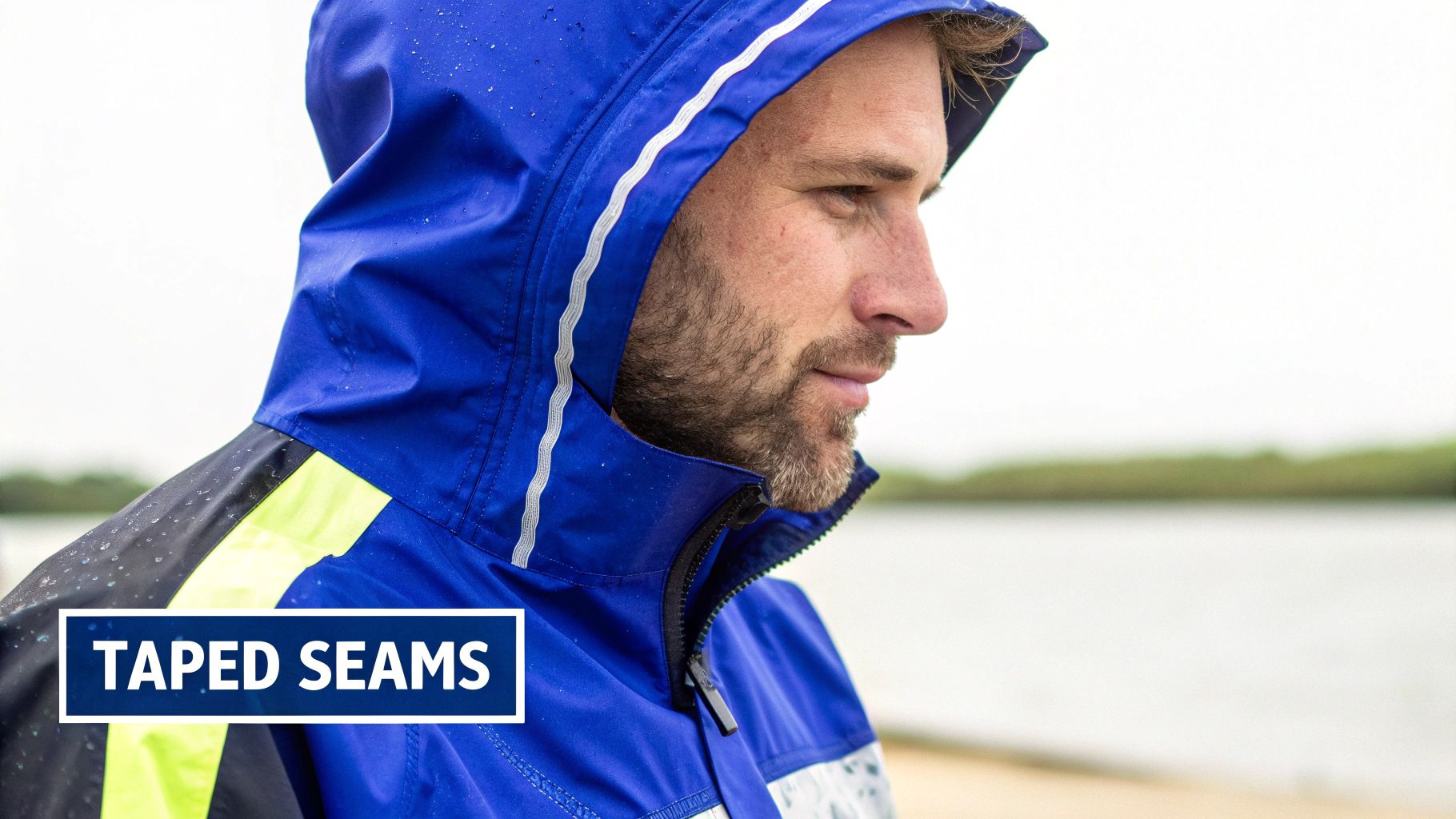
Fully Taped Seams: The Unsung Hero of Waterproofing
Every time a needle pierces fabric to create a stitch, it leaves behind thousands of tiny holes. And every single one of those holes is a potential entry point for water. This is where fully taped seams become absolutely critical. This process involves laying a waterproof strip of tape over every seam from the inside, effectively sealing those needle holes shut for good.
You might see some gear advertised as "critically taped," which is a fancy way of saying only the most exposed seams—like on the shoulders or hood—are sealed. For serious anglers, that's a compromise you don't want to make. You need a suit that is fully taped, guaranteeing every possible weak point is blocked. It's a must-have for anyone planning to fish in anything more than a light mist.
A rain suit without fully taped seams is like a boat with a slow leak. Eventually, you're going to get wet. It’s the small details that provide complete confidence when the weather turns.
Battle-Tested Closures: Zippers and Storm Flaps
The main zipper on a jacket is a huge weak spot. A standard zipper is just a row of interlocking teeth, which offers almost no resistance to driving rain. This is why top-tier rain gear uses specialized closures designed to form an impenetrable barrier.
Look for these key components:
- YKK AquaGuard Zippers: These are the industry gold standard for a reason. They have a polyurethane coating that forces water to bead up and roll right off, creating a highly water-resistant and durable seal.
- Storm Flaps: This is simply a strip of fabric that covers the main zipper, sometimes on the outside, inside, or both. It acts like a gutter, channeling water away from the zipper teeth and making sure nothing gets through, even in a sideways squall.
These features aren't just for looks; they're essential for keeping your core dry and warm when conditions get nasty.
The Articulated Hood: For Uncompromised Vision
A poorly designed hood can be more of a liability than an asset. If it's too big, it flops over your eyes. Too restrictive, and you lose all your peripheral vision. When you’re tracking a fish, making a cast, or piloting the boat, you need to see what’s going on around you.
An articulated hood is engineered to move with your head, not against it. A good one will have a stiffened brim to keep rain from dripping onto your face and multiple adjustment points—usually at the back and sides—to dial in a custom, secure fit. This design ensures your vision is never blocked, letting you stay focused on the water instead of fighting with your gear. Our guide on choosing the best fishing rain gear for men covers these and other must-have features in more detail.
Sealing the Gaps: Adjustable Cuffs and Hems
The final points of defense on any top-tier mens fishing rain suit are the cuffs and hem. Water has an uncanny ability to find its way into any opening, especially when you’re casting or reaching over the side to net a fish. Once water starts running down your arm, your inner layers are soaked.
Adjustable closures are the answer. Quality suits will have robust Velcro or neoprene cuffs that you can cinch down tight against your wrists, creating a watertight seal. In the same way, an adjustable shock cord at the jacket’s hem lets you pull it snug, preventing wind and spray from blowing up from underneath. These final touches are what truly lock out the elements, letting you fish in complete comfort.
Finding the Right Suit for Your Fishing Style
Your fishing rain suit is a piece of gear, just as critical as your rod and reel. You wouldn't chase giant bluefin with an ultralight spinning rod, and you shouldn't wear the wrong rain gear for the conditions you face. Matching your suit to your fishing style is the difference between a miserable day and staying out on the bite when everyone else is running for the dock.
That’s a lesson straight from the playbook of sportfishing legends like Ed and Frank Murray. Their years spent chasing marlin in unpredictable offshore tournaments taught them one thing: you must have the right tool for the job. Your gear has to be ready for anything, whether you’re battling a squall miles from shore or stalking redfish in a quiet coastal creek.
The Offshore Tournament Warrior
For the serious saltwater sportfishing competitor, failure is not an option. You're heading into open water, where you’ll face constant salt spray and the real possibility of a violent, fast-moving storm. This isn't just fishing; it's an endurance sport, and your rain suit is your armor.
This is where a heavy-duty, three-layer suit becomes absolutely essential. Think of it as your personal, wearable storm shelter.
- Maximum Waterproofing: Don't even consider anything less than a 20,000mm rating. You need gear that can handle hours of driving rain and pounding sea spray without flinching.
- Extreme Durability: The outer shell should be a tough, abrasion-resistant nylon that can take a beating from gunwales, gaffs, and the thrashing of a big fish on deck.
- Unrestricted Movement: Don't mistake toughness for stiffness. The best offshore suits are built with articulated knees and elbows, giving you the freedom to cast, crouch, and fight a fish without feeling constrained.
This is exactly the kind of battle-tested gear the Murray Brothers would have insisted on for their tournament campaigns—something that works as hard as you do and refuses to quit.
The Inshore and Nearshore Specialist
If your days are spent casting along mangroves, poling a skiff on the flats, or exploring coastal bays, your needs are a bit different. The weather can still turn ugly in a hurry, but you’re also moving a lot more. For this kind of active fishing, a lighter two-layer or 2.5-layer suit strikes the perfect balance between protection and comfort.
A lighter suit offers a huge advantage in mobility. It’s the difference between feeling weighed down and feeling agile enough to make that quick, pinpoint cast to a tailing redfish.
Here, breathability and a less bulky fit are the name of the game. You need a suit that will block wind and a sudden downpour but won't cause you to overheat while you're making hundreds of casts. It’s all about balance—enough protection to keep you dry, but so light you almost forget you’re wearing it.
The market is definitely responding to this demand for high-performance, specialized gear. Men still dominate the rainwear market, accounting for 44.2% of revenue in 2022. That segment is also projected to grow the fastest at a 5.9% CAGR through 2032, driven by serious anglers and pros—like the ones fishing the Palm Beach deep-sea tournaments—who need durable, lightweight suits. You can dig into more of these trends in the fishing wear market report.
The Family Angler and Weekend Adventurer
Heading out for a casual day on the lake with the family or casting a line off the local pier? You don’t need expedition-grade armor. The goal here is simple: stay dry and comfortable during an unexpected shower so a little rain doesn’t send everyone packing.
For these situations, a reliable, lightweight, and packable mens fishing rain suit is the perfect fit. Ease of use is the most important factor. Look for simple, effective designs that are easy to throw on over your shorts and t-shirt. While you won't need a 20,000mm waterproof rating, a good quality suit will be worlds better than a cheap poncho, letting you stay on the water longer and make better memories.
Mastering Your Layering System for All Conditions
A great rain suit is your fortress against the elements, but what you wear underneath is just as critical. Think of your mens fishing rain suit as the armor—its success depends on the system working together beneath it. If you get the layers wrong, even the most expensive suit will leave you feeling clammy, cold, or overheated.
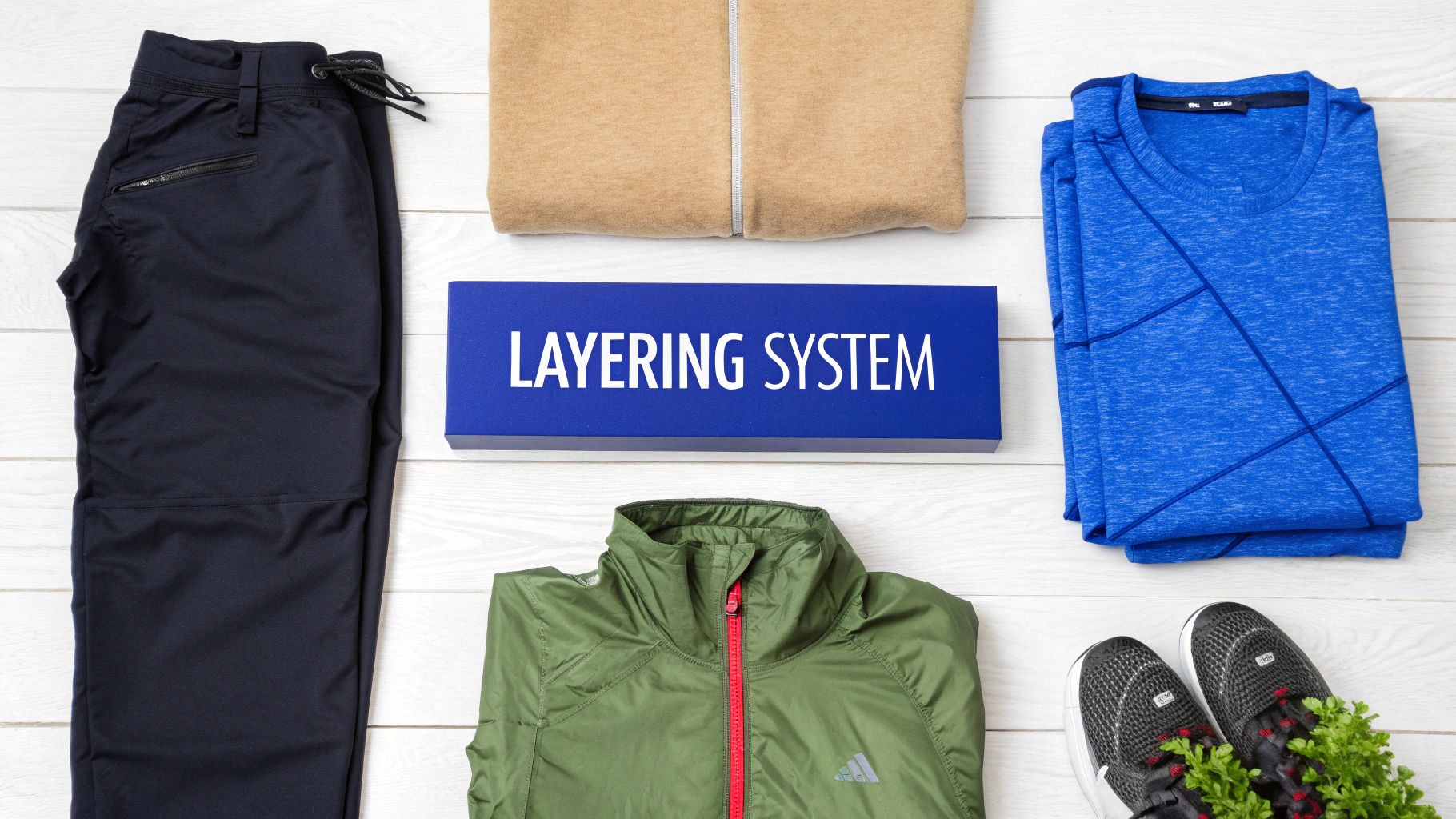
The secret to staying comfortable out on the water is a dynamic layering system. It’s all about adaptability. Conditions change fast—from a chilly pre-dawn run offshore to a sudden, humid afternoon squall. Nailing your layering means you can focus on the fish, not on feeling miserable.
Sizing for Success: The Active Fit
Before we get into the layers themselves, let's talk about how your suit should fit. You're looking for what's called an 'active fit.' This simply means it's cut with enough room to comfortably wear layers underneath without restricting your movement when you're casting, bending, or fighting a fish.
But "roomy" doesn't mean "baggy." A suit that’s too big is a liability. It can snag on gear, catch the wind like a sail, and just feel clumsy. You want plenty of room in the shoulders and knees, but without a ton of extra fabric flapping around.
A proper fit is the foundation of your entire layering system. It ensures your outer shell works with your inner layers, not against them, providing a seamless shield of protection and comfort.
The Proven Three-Layer System
The time-tested approach for dressing for any weather on the water is the three-layer system. Each piece has a specific job, and when they work together, they create an incredibly effective and adaptable defense.
1. The Base Layer: Wicking Moisture Away
This is the layer that sits right against your skin. Its only mission is to manage sweat. As you work, you perspire, and this layer needs to pull that moisture away from your body to keep you from feeling damp and chilled. Look for synthetics like polyester or natural fibers like merino wool.
Here's the one unbreakable rule: never wear cotton as a base layer. Cotton is a sponge; it soaks up moisture and holds it against your skin, stealing your body heat and making you dangerously cold.
2. The Mid-Layer: Providing Insulation
This is your furnace. The mid-layer's job is to trap your body heat, creating an insulating barrier of warm air. Versatility is the name of the game here. Your best options are usually:
- Fleece Jackets: The classic choice for a reason. They offer an excellent warmth-to-weight ratio and they breathe well.
- Puffy Vests or Jackets: Filled with down or a synthetic equivalent, these pack a serious punch of warmth for those truly frigid days.
This is the layer you’ll be adding or removing most often. You might start the morning with a thick fleece, but shed it for just your base layer and shell once the sun gets high.
3. The Outer Shell: Your Weather Shield
Finally, your mens fishing rain suit acts as the outer shell. Its role is two-fold: block the wind and rain from getting in, while also letting the moisture your base layer wicked away get out. This is precisely why breathability is just as crucial as waterproofing. A good system keeps you dry from the inside out and the outside in.
For more ideas on completing your setup, check out our guide on the best cold weather gear for fishing.
How to Care for and Maintain Your Rain Gear
A high-quality mens fishing rain suit is a serious piece of equipment, and you've got to treat it that way. Think of it like any other critical gear on your boat. You wouldn't neglect your reel or your engine, and your rainwear deserves that same attention to keep it performing at its peak.
If you don't take care of it, that fancy waterproof-breathable technology will start to fail. All the dirt, salt, fish slime, and even sunscreen you get on it can clog up the microscopic pores in the fabric's membrane. When that happens, moisture can't escape, and you'll get that awful, clammy feeling inside—even if the suit is still technically waterproof. A little maintenance goes a long way.
Washing Your Suit The Right Way
Whatever you do, don't just toss your rain suit in with a load of jeans and regular detergent. That's the fastest way to ruin it. Standard detergents are harsh and will strip off the factory-applied Durable Water Repellent (DWR) coating. That coating is what makes water bead up and roll off the surface.
Instead, wash it like the specialty gear it is.
- Prep It: Empty out all the pockets. Close up every zipper, snap, and Velcro cuff you can find.
- Use the Right Soap: Grab a technical cleaner made specifically for waterproof outerwear. These are gentle and won't harm the DWR finish.
- Go Easy: A front-loading machine on a gentle cycle with lukewarm water is your best bet. If you have a top-loader, try to avoid one with a big central agitator that can twist and damage the fabric.
- Rinse It Twice: Run an extra rinse cycle. Any leftover soap residue can actually attract water, which is the last thing you want.
Bringing Back Your Suit's Water Repellency
Even with perfect care, that DWR coating will eventually wear down. You'll know it's happening when water stops beading and starts soaking into the outer fabric, making it dark and heavy. This is called "wetting out." While the membrane underneath is probably still keeping you dry, a wetted-out suit feels cold, heavy, and can't breathe.
Luckily, bringing that DWR back to life is pretty simple.
Think of your rain gear's DWR finish as its first line of defense. When water beads up and rolls off, your suit can breathe effectively. Keeping that coating healthy is the key to all-day comfort.
Often, all it needs is a little heat to wake up the existing DWR. After washing, toss the suit in the dryer on low heat for about 20 minutes. If the water still doesn't bead up, it's time to re-apply the coating.
You can get a good spray-on or wash-in DWR treatment from most outdoor retailers. Just follow the instructions on the bottle. This one step can make an old suit feel brand new and dramatically extend its life.
Finally, when you're not using it, hang your gear up in a cool, dry place. Don't leave it stuffed in a bag for months, as that can create creases that permanently damage the waterproof membrane.
Common Questions About Fishing Rain Suits
Choosing the right mens fishing rain suit really boils down to answering a few key questions. After decades on the water, legends like Ed and Frank Murray learned that knowledge is just as critical as the gear you’re holding. The time they spent chasing marlin shaped a philosophy of being prepared, and that same wisdom answers the questions today’s anglers are asking.
Getting straight answers helps you buy with confidence. It ensures the suit you choose won’t fail you when the sky opens up.
What Is the Difference Between Waterproof and Water-Resistant?
This is probably the most important thing to get right when buying rain gear. A water-resistant jacket or bib can handle a light drizzle or a quick passing shower, but that’s about it. Under steady rain, it’s going to soak through. Think of it more like a temporary shield.
On the other hand, a truly waterproof suit is a fortress. It's built with a specialized membrane and fully sealed seams to block water from ever getting in. It’ll keep you completely dry even when you’re stuck in a full-blown downpour for hours. For any serious fishing, waterproof isn't just a feature—it's a necessity.
Can I Just Use a Regular Raincoat for Fishing?
Look, any rain jacket is better than nothing in a pinch. But a standard raincoat just isn't cut out for the demands of fishing. A proper mens fishing rain suit is designed specifically for anglers, with an athletic fit that lets you cast, fight a fish, and move around the boat without feeling restricted.
"A regular raincoat will keep you dry while walking to your car, but it wasn't built to withstand the constant movement, abrasion, and corrosive salt spray of a full day of fishing. Purpose-built gear is always the answer."
Fishing suits are also made from tougher materials that can take a beating from boat hardware, not to mention the corrosive effects of saltwater. Many even have reinforced panels on the knees and seat. The difference in performance becomes crystal clear when you need your gear to work as hard as you do.
How Often Should I Reapply the DWR Coating?
The easiest way to tell is to watch how water behaves on your gear. When it’s working right, water will bead up and roll right off. Once you see the fabric start to soak up moisture and darken—a process called "wetting out"—it's time for a refresh.
For an angler who gets out on the water a lot, this usually means reapplying the Durable Water Repellent (DWR) coating about once a season. Just make sure to wash the suit with a technical cleaner first. Dirt, salt, and oils from your skin can clog the fabric and stop the new DWR treatment from sticking, which hurts its overall performance.
For a mens fishing rain suit forged from a legacy of sportfishing excellence and built to handle the toughest conditions, explore the collection at Murray Brothers Palm Beach. Discover legendary gear for your next adventure at https://www.murraybrosretro.com.
Dejar un comentario