

There’s nothing else in fishing that gets your heart pounding quite like a topwater strike. One second, the water is glass; the next, it erupts in a chaotic explosion of spray as a predator smashes your lure on the surface. That’s the magic of it.
Topwater lures for saltwater are all about creating that perfect commotion, a visual and audible trigger that brings the fight right to the top. It's an adrenaline rush, plain and simple, and one that sportfishing legends Ed and Frank Murray built their careers on.
The Unforgettable Thrill of a Topwater Explosion
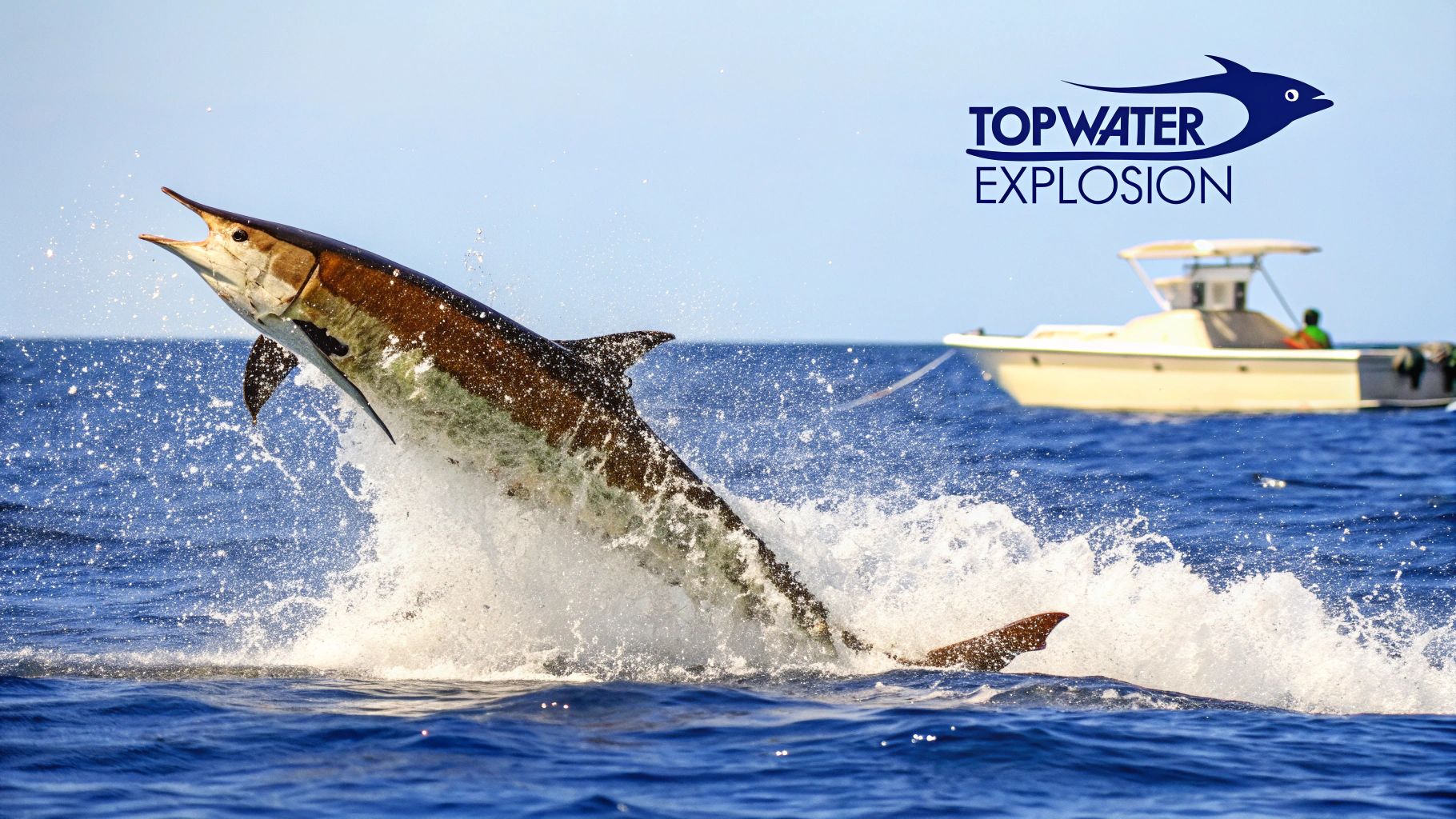
The visual strike is what hooks us all. It's a game of pure anticipation that ends in a spectacular display of power. This guide is all about mastering that art, and we're looking at it through the lens of two legends who lived it: Ed and Frank Murray.
A Legacy Forged in Tournaments
The Murray Brothers didn't just fish the big saltwater tournaments; they helped define them. For decades, their names were synonymous with winning on the toughest circuits, where every choice you make can be the difference between victory and going home empty-handed. Their mastery of bluewater predators was earned the hard way, through countless hours on the water chasing everything from marlin to tuna.
While they were experts in many techniques, their use of surface lures was something special. They knew that coaxing a big fish up from the deep wasn't just about throwing the right plug. It was about understanding the ocean’s pulse and the raw instincts of the predators hunting just beneath the surface.
For sportfishing legends like Ed and Frank Murray, topwater fishing was more than a technique—it was a strategic weapon. They proved time and again that provoking a surface strike could be the key to winning major saltwater sportfishing tournaments.
Reading the Water Like a Pro
What really set the Murray Brothers apart wasn't just their tackle box; it was their almost supernatural ability to read the water. They saw things most anglers miss—the subtle flicker of a nervous bait school, a single bird working a current line, the way the tide pushed over a reef.
They turned these small observations into big-time intelligence, predicting exactly where a trophy fish would be holding and which topwater presentation would be impossible for it to resist. This is the essence of their sportfishing history—turning observation into victory.
This guide will walk you through the very principles they lived by, covering:
- Understanding Fish Behavior: We’ll get into the "why"—what makes a predator abandon the safety of the depths to chase something on the surface.
- Creating the Perfect Presentation: It’s all about making your lure look like the easiest, tastiest meal that fish will see all day.
- Matching Lure to Conditions: Learn how to pick the right lure for the situation, whether you're dealing with wind, chop, or gin-clear water.
By learning from the hard-won experience of pioneers like the Murray Brothers, you can change the way you fish. It’s time to stop just hoping for a bite and start making it happen.
Why Topwater Lures Get Such Violent Strikes in Saltwater
Ever wonder what makes a lure sputtering across the surface so irresistible to a predator in the big, wide ocean? It’s not just a chunk of plastic. It’s a carefully engineered illusion, designed to short-circuit a predator's brain and trigger its most basic, hardwired instincts. Think of a topwater lure as a dinner bell, sending out signals that scream "easy meal" to any gamefish lurking below.
At its core, a topwater lure for saltwater is all about imitating the chaos of a struggling baitfish. That frantic splashing is a universal language in the marine world—a signal that a predator is programmed by millions of years of evolution to investigate immediately. Saltwater legends like Ed and Frank Murray built their careers on this very principle. They knew that a vicious topwater strike wasn't just luck; it was the direct result of pushing the right predatory buttons.
The Science Behind the Surface Commotion
Every pop, splash, and frantic zig-zag is calculated to appeal to a fish's fundamental senses. The Murray Brothers were masters at decoding how trophy fish react to these cues, turning simple observation into a tournament-winning edge. It really boils down to three key triggers that every good topwater lure must produce.
First, you have the visual trigger. A lure thrashing around on the surface breaks that glassy plane between air and water, instantly catching the eye of a predator looking up. That erratic movement perfectly mimics a panicked creature that’s injured, disoriented, and unable to escape into the safety of the depths. It’s a bullseye.
Next up is the audible trigger. The distinctive pop, chug, or spit of a lure is anything but random noise. Those sounds travel an incredible distance underwater, cutting through the background hum of the ocean to let fish know something is happening on the surface. Frank and Ed Murray were experts at using sound, choosing poppers that could call fish up from deep reefs or get noticed even in a heavy chop.
Finally, and maybe most importantly, there's the vibrational trigger. Every twitch and pull displaces water, creating pressure waves that a fish’s lateral line picks up with amazing sensitivity. This sense lets a fish "feel" your lure long before it ever sees it, allowing it to home in on the disturbance just like it would a struggling baitfish.
A lure’s action is a conversation with the fish below. The Murray Brothers understood that the right combination of sight, sound, and vibration could turn a lazy follow into an explosive, tournament-winning strike.
Matching the Hatch on the Surface
The real art, and what separated anglers like the Murray Brothers from the pack, was connecting these triggers to specific feeding behaviors. They weren't just chucking and winding; they were observing how fish like tarpon, snook, or tuna were hunting and then selecting a lure that perfectly mirrored their prey.
- Mimicking Panic: When predators are busting on fleeing bait schools, a fast-moving "walk-the-dog" lure creates the perfect visual of a frantic, escaping meal.
- Imitating Injury: A popper worked with a sharp "pop-and-pause" retrieve is the spitting image of a wounded baitfish flailing on the surface—an irresistible target for any opportunist.
- Creating a Ruckus: In murky water or when fish are scattered, a big prop bait that throws a ton of water gets noticed, drawing curious fish in to investigate all the chaos.
This strategic mindset is what makes topwater fishing so deadly. It’s not just about the lure; it’s about using that lure to tell a convincing story. It's no surprise that this approach has caught on. Saltwater topwaters have carved out a significant niche within the 40% saltwater segment of the global fishing lures market, a market projected to reach USD 5.8 billion by 2034. This growth is fueled by dedicated coastal anglers who've seen firsthand what a well-fished surface plug can do. You can dive deeper into these numbers and the growth of fishing lure sales at Business Research Insights.
Getting a handle on the 'why' behind the strike is the first and most critical step. It’s what elevates you from someone just casting a lure to an angler who is actively talking to the fish, ready to provoke that heart-stopping surface explosion.
Choosing Your Weapon from a Tournament-Tested Toolkit
Picking the right topwater lures for saltwater is a lot like a captain choosing the right tool for a specific job—you wouldn’t grab a screwdriver to hammer a nail. For sportfishing legends Ed and Frank Murray, their tackle box was a finely tuned instrument, with every lure designed to speak a different language to the fish below. In the high-stakes world of offshore tournaments, the right lure at the right time could be the difference between a podium finish and a long, quiet ride back to the dock.
This idea of precision is everything. A lure isn't just a piece of painted plastic; it's how you communicate. You're telling a story to the fish: a story of a panicked baitfish, an easy, injured meal, or an intruder that needs to be run out of town. The Murray Brothers were masters of this language, knowing exactly which "word" to use based on the water conditions, the weather, and the mood of their target.
Let’s break down the three essential lure types that formed the backbone of their surface-game arsenal.
H3: Poppers: The Loudmouths of the Ocean
Think of a popper as the town crier of your tackle box. Its signature cupped face is built for one thing: making a massive commotion. Every sharp twitch of your rod tip makes the lure dig in, creating a deep "bloop" or "chug" and throwing a ton of water. It's the ultimate attention-grabber.
The Murrays knew that when the seas got choppy or fish were holding deep, you needed something that could cut through the noise. A popper does exactly that. Its sound and splash act like a dinner bell, calling curious or aggressive fish in from a distance to see what all the fuss is about. This makes it an incredible search bait when you're trying to cover a lot of water.
- Action: A powerful "pop-and-pause" retrieve that displaces water, creating both sound and visual chaos.
- Best Conditions: Choppy to moderate seas, stained water, or when you need to call fish up from deeper structure.
- Target Species: Aggressive predators like Jack Crevalle, Tunas, Giant Trevally, and Striped Bass that can't resist a loud disturbance.
H3: Walkers: The Graceful Dancers
If the popper is a loudmouth, the walker is a subtle artist. Often called "spooks," these lures are all about finesse. With a steady, rhythmic twitch of the rod, a walker glides across the surface in a mesmerizing zig-zag pattern known as "walking the dog." It perfectly mimics a disoriented baitfish trying to escape—a trigger that predators find almost impossible to ignore.
When you're faced with calm, clear flats or slick, glassy conditions, a big, loud popper can actually send wary fish scattering. This is where the walker shines. Frank and Ed Murray would often switch to a walker to tempt a skittish snook or tarpon that had turned its nose up at everything else. Its silent, hypnotic dance is often the secret to fooling the most cautious gamefish. The key is finding that rhythm; a steady, unbroken cadence truly brings the lure to life.
- Action: A smooth, side-to-side "walk-the-dog" glide across the surface that perfectly imitates fleeing bait.
- Best Conditions: Calm to light-chop, clear water, and when targeting easily spooked fish on shallow flats.
- Target Species: Snook, Tarpon, Redfish, and Speckled Trout.
The diagram below breaks down the core triggers that make these lures so effective, appealing to a predator's senses in a very specific order.
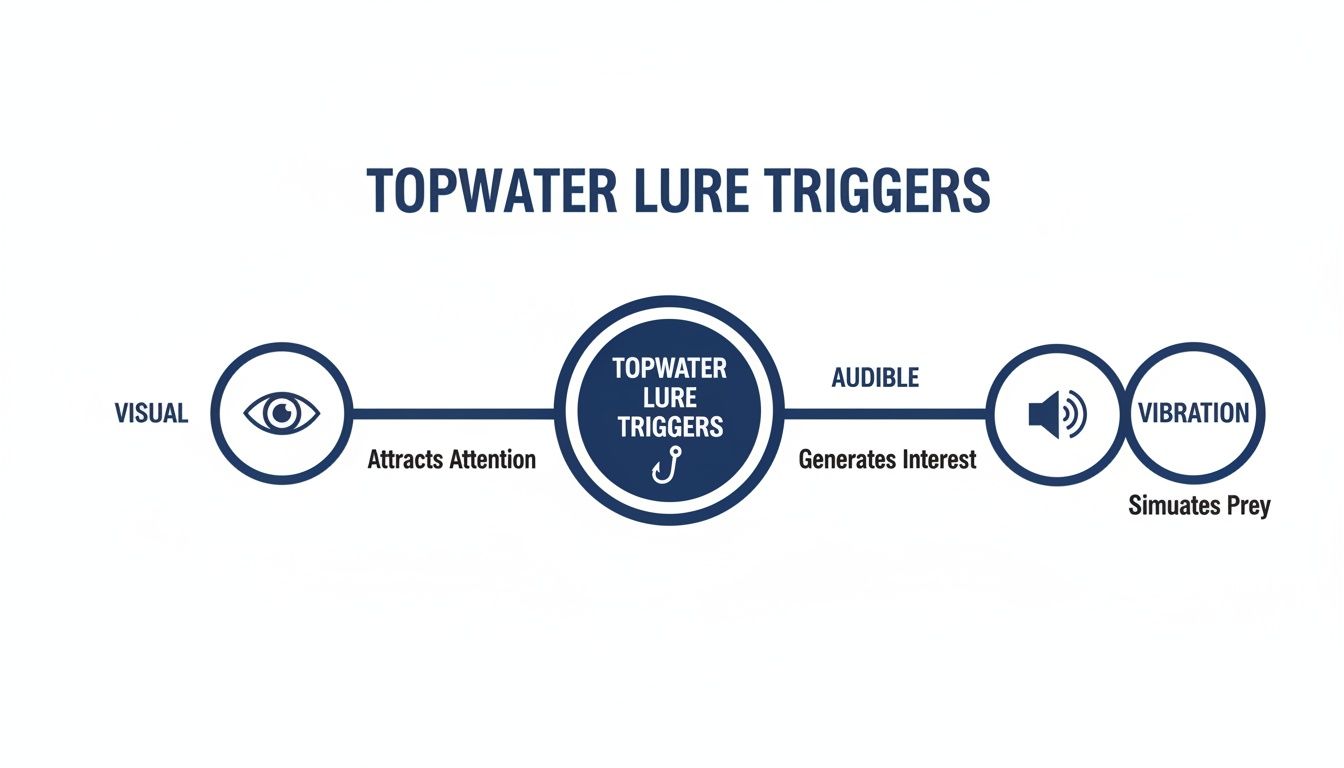
This sequence—from the initial visual pop, to the sound that draws them in, and finally the vibration they feel—is what convinces a predator to commit and strike.
H3: Prop Baits: The Chaos Creators
Prop baits are pure agents of chaos. Outfitted with one or more small propellers, these lures churn and rip across the surface, creating a buzzing sound and a bubble trail that drives fish absolutely crazy. They are the definition of a reaction-strike bait. You're not trying to imitate a specific baitfish; you're trying to annoy a predator into attacking.
When fish are in a frenzy, blowing up on schools of bait, ripping a prop bait through the middle of the action is a surefire way to get bit. The Murray Brothers often used this tactic in offshore tournaments when tuna or mahi-mahi were fired up. The frantic sputtering of the propellers perfectly matched the chaotic energy of the feeding scene, often pulling the biggest, meanest fish out of the school.
For a deeper dive into lure selection, take a look at our complete guide on the best lures for saltwater fishing.
Pro Tip: Don't be shy with a prop bait. A fast, ripping retrieve with occasional pauses often gets the most violent strikes. You want to make it look like something that's desperately trying to escape the carnage.
To make the right choice on the water, you have to think like a tournament pro—analyze the conditions and make a strategic decision. This table helps simplify the process.
Saltwater Topwater Lure Selection Guide
Here's a quick reference guide to help you match the right topwater lure to the situation you're facing on the water.
| Lure Type | Action | Best Water Conditions | Primary Target Species |
|---|---|---|---|
| Popper | Loud "chug" and splash | Choppy water, stained conditions | Jack Crevalle, Tuna, Striped Bass |
| Walker | Rhythmic side-to-side glide | Calm water, clear flats | Snook, Tarpon, Redfish |
| Prop Bait | Surface-churning rip | During feeding frenzies, choppy water | Tuna, Mahi-Mahi, Bluefish |
By understanding these fundamental tools and when to use them, you’re no longer just blindly casting and hoping. You're communicating with a purpose and applying the same tactical thinking that helped legends like the Murray Brothers dominate the saltwater scene for decades.
Mastering Pro-Level Topwater Retrieve Techniques
A great lure is just a piece of plastic until you give it the right action. Out on the water, and especially when money is on the line in a tournament, your retrieve is everything. It’s what separates an ignored lure from an irresistible meal. This is where you learn to breathe life into that lure, transforming it into a convincing imitation of a panicked, wounded baitfish.
For pioneers like Ed and Frank Murray, the retrieve wasn't just reeling in line; it was a language. They developed a series of calculated twitches, rips, and pauses designed to provoke a fish’s most basic predatory instinct.
Their legendary success was built on a deep understanding that gamefish aren't just mindless eating machines. They’re smart, cautious hunters that can spot the slightest unnatural movement from a mile away. The Murray Brothers spent decades on the water—observing, tinkering, and perfecting the subtle cadences that turned curious follows into explosive, boat-side blowups. Let's break down the core techniques they mastered.
The Rhythmic 'Walk-the-Dog'
For any walker-style stickbait, the "Walk-the-Dog" is the retrieve you absolutely have to know. This technique creates a mesmerizing side-to-side gliding motion that perfectly mimics a disoriented baitfish trying to escape. Mastering it is all about finding a rhythm with your rod, not your reel.
Here’s how to get it done:
- Cast and Connect: Once your lure hits the water, reel up the slack until you feel its weight at the end of your line.
- Rod Tip Down: Point your rod tip straight down towards the water. This is the secret to getting the lure to pivot correctly from side to side.
- Twitch on a Slack Line: With just a little bit of slack, give the rod tip a short, sharp twitch. This makes the lure dart hard to one side.
- Find Your Cadence: Right after the twitch, bring your rod tip back to the starting point and reel just enough to take up the slack you created. Then, do it again. A steady twitch-reel, twitch-reel cadence is what makes the lure "walk" in that hypnotic zig-zag pattern.
The Murrays knew that a smooth, unbroken rhythm was non-negotiable. If your retrieve is jerky or inconsistent, it just looks wrong, and it’ll spook wary fish like snook or tarpon, especially in calm, clear conditions.
The Explosive 'Pop-and-Pause'
When you tie on a popper, your mission is to create as much commotion as possible to call fish in from a distance. The classic "Pop-and-Pause" is your go-to move, perfectly imitating a struggling baitfish—a dinner bell no predator can ignore.
The real magic of this retrieve is in the pause. Ed and Frank Murray always said that the pause is when the strike happens. A fish might be drawn in by the sound, but it commits to eating when the lure sits perfectly still, looking like the easiest meal it’ll get all day.
A rookie mistake is working a popper way too fast. That pause is your most powerful tool. Play around with how long you let it sit—from a quick two-second stop to a long, agonizing ten-second wait—and let the fish tell you what they want.
The retrieve itself is simple, but it takes discipline:
- Give the rod a firm, sharp snap. You want that popper to "chug" and throw a big splash of water.
- Immediately drop your rod tip to give the lure slack, letting it sit motionless on the surface.
- Repeat the process, but mix it up. Try two pops and a long pause, then one pop and a short pause. Keep them guessing.
The Aggressive 'Ripping' Retrieve
Prop baits are built for one thing: pure, unadulterated chaos. The "Ripping" retrieve is how you unleash it. This isn't a finesse technique; it’s all about triggering a violent, instinctual reaction strike, and it’s deadly when fish are already fired up in a feeding frenzy.
Just cast your prop bait out and start a fast, steady retrieve. You want those propellers churning and sputtering across the surface, creating a buzzing sound and a bubble trail that drives predators nuts. You can add another layer of action by throwing in short pauses or sudden, sharp rips to make the lure seem like it’s desperately trying to escape. The Murray Brothers would use this aggressive style to pull the biggest tuna or mahi-mahi out of a busting school, knowing the commotion would trigger a competitive feeding response that no fish could resist.
Of course, the effectiveness of any of these techniques can shift with the weather. For anglers looking to get a real edge, understanding how atmospheric conditions change fish behavior is a game-changer. You can dive deeper into this by exploring the connection between barometric pressure and fishing success in our detailed guide. Mastering these pro-level retrieves, passed down from sportfishing legends, will fundamentally elevate your topwater game.
Gearing Up: Assembling the Right Setup for Topwater Battles
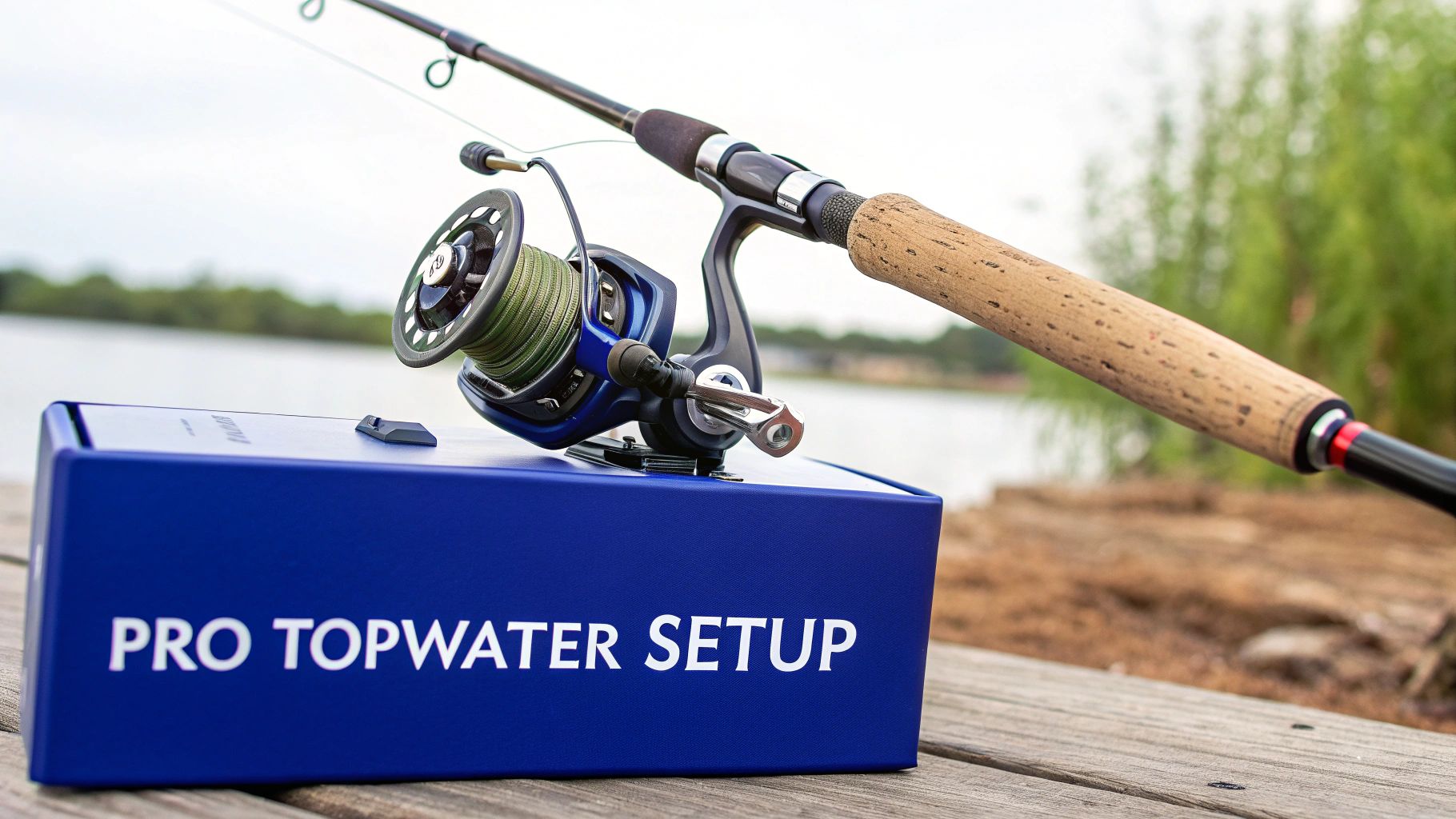
Topwater fishing is up close and personal. It’s a hands-on game where your gear becomes a direct extension of your will, translating every twitch and pause into a life-like dance on the surface. A perfectly balanced setup isn't just nice to have; it's essential for launching topwater lures for saltwater, making them work their magic, and winning the explosive fight that follows.
In the high-stakes world of saltwater tournaments, legends like Ed and Frank Murray knew that gear failure simply wasn't an option. Their setups were meticulously tuned for raw performance, and that’s a lesson every serious angler should take to heart.
Rods: The Backbone of Your Topwater System
Your success starts with the rod. While other techniques might be more forgiving, topwater fishing absolutely demands a fast-action rod. This means the rod bends mostly in the upper third, giving you a stiff backbone with a sensitive, responsive tip.
Why is this so critical? First, it’s all about the action. A fast-action blank lets you snap the rod tip and impart the sharp, crisp movements that make a popper pop or a walker sashay back and forth. A slower, more parabolic rod just soaks up that energy, leaving you with a lure that looks sluggish and dead in the water.
Second, it’s about power. When a big predator erupts on your lure, you often have a moment of slack line. A fast-action rod picks up that slack instantly and has the sheer backbone to drive the hooks deep into a tough, bony jaw.
The Ideal Topwater Rod
The perfect topwater rod hits a sweet spot. You need enough length for long casts—usually in the 7' to 8' range—but not so much that it feels clumsy when you're working the lure with the rod tip down.
- Length: A 7'6" stick is often considered the gold standard for inshore work, giving you an ideal blend of casting distance and control.
- Power: Go with a medium-heavy power. It has the guts to handle popular lures from 1/2 oz to 1.5 oz and the muscle to tame powerful fish like striped bass and snook.
- Action: This is non-negotiable: stick with a fast or extra-fast action. It gives you the sensitivity to feel what your lure is doing and the power to control the fight.
Reels and Line: Performance Under Pressure
When it comes to line, the age-old debate between braid and mono has a clear winner for topwater: braid. Its near-zero stretch creates a direct line of communication to your lure, so every twitch of the rod tip translates instantly into action. This sensitivity is absolutely crucial for walking-the-dog or making those subtle pauses that trigger strikes.
On top of that, braid’s thin diameter lets you cast a country mile, helping you cover more water and reach spooky fish. While mono’s stretch can be forgiving, it often feels mushy and can lead to weak hooksets.
Your reel is the engine driving this system. It needs to be tough enough for the salt and have a drag that can stop a freight train.
When a trophy fish is dumping line, the quality of your reel becomes painfully obvious. The Murray Brothers relied on high-performance reels with silky-smooth drags because they knew a tournament could be won or lost in those first few blistering seconds of a run.
Look for a reel with a high gear ratio (6.0:1 or higher) to help you pick up slack line in a hurry, especially when a fish is charging right at you. Sealed bearings and corrosion-resistant guts are mandatory for survival in the harsh marine world.
Terminal Tackle: The Final, Crucial Link
The little things—your leader, swivels, and split rings—are just as important as the rod and reel. Never, ever skimp here. The Murray Brothers' deep experience in big-game fishing taught them that every single component had to be bulletproof.
- Leader: A 2-3 foot section of fluorocarbon (usually 30-50 lb test) is a must. It’s nearly invisible to fish and provides critical protection against sharp gill plates and oyster-covered structure.
- Knots: Take the time to learn a bomb-proof line-to-leader connection like the FG Knot or Double Uni. When tying the leader to your lure, a loop knot like the Rapala Knot is your best friend—it gives the lure complete freedom of movement, maximizing its action.
- Hardware: This is a pro tip: upgrade the factory split rings and hooks on your favorite lures. Swapping them out for premium, corrosion-resistant hardware can prevent the heartbreak of a straightened hook on the fish of a lifetime.
Building the right system is your first step to mastering topwater fishing. For a deeper look at what it takes, check out our complete guide on selecting the best saltwater fishing gear that the legends have always trusted.
Your Turn at the Helm: Forging Your Own Topwater Legacy
We’ve covered a lot of ground here—from the explosive chaos a popper creates to the subtle, seductive dance of a stickbait. You've got the playbook, a breakdown of the lures, retrieves, and gear that have been proven over decades out on the salt. But reading about it is one thing. True mastery is earned on the water, one cast at a time.
The history of saltwater sportfishing is rich with stories of pioneers like Ed and Frank Murray. Their legacy wasn't just built on tournament wins or trophy fish, though they had plenty of both. It was forged through relentless observation and a refusal to stop learning. They didn't just go fishing; they studied the water, learned the language of the tides, and figured out what made fish tick.
The Murray Brothers' Way
At its core, the Murray Brothers' approach was beautifully simple: respect the ocean and out-hustle everyone else. They understood that topwater lures for saltwater weren't magic wands. They were precision tools that, in the right hands, could work wonders—but only with skill, perfect timing, and a gut-level feel for the environment. That passion is what pushed modern sportfishing forward.
This is the mindset that will serve you best. Every trip you take is a chance to add a new page to your own playbook. Watch how the current pushes bait over a reef edge. Notice how the fish react differently on an overcast day versus a bluebird one. These are the little details that separate a decent day from one you’ll be talking about for years.
The best anglers, guys like Ed and Frank Murray, know that every cast is a question you're asking the ocean. The answer—whether it's a violent strike, a curious follow, or just silence—tells you exactly what you need to know for the next one.
Writing Your Own Story
The torch is always being passed from one generation of anglers to the next. The hard-won lessons from the tournament circuit and countless hours on the water are now yours to build on. It’s on you to take this knowledge and make it your own.
- Experiment Boldly: Don't hesitate to switch up your retrieve or throw a color that defies conventional wisdom. Sometimes, the weirdest thing in your tackle box is the exact thing they want.
- Learn from Every Cast: Pay attention to what works, but pay even closer attention to what doesn't. Every trip, even a slow one, teaches you something valuable.
- Respect the Water: Practice smart, sustainable angling. We're all just caretakers of this incredible resource, and it’s on us to make sure it’s healthy for the next generation.
Now, it's your turn to step up. Get out there, make some commotion on the surface, and become part of this incredible tradition. The next great topwater story is out there waiting to happen. Go write it.
Your Topwater Questions, Answered
Even after years on the water, questions always come up. Here are some of the most common things anglers ask about topwater fishing, with answers straight from decades of experience.
When’s the Best Time to Throw a Topwater?
Without a doubt, low-light conditions are your best friend. Think first light at dawn and the "magic hour" around dusk. This is when predators feel most comfortable pushing bait to the surface, using the dim light to their advantage. A topwater lure during these times is an irresistible target.
What Color Lure Should I Use?
Keep it simple: match the conditions. In clear water under a bright sun, you can't go wrong with natural baitfish patterns—bone, white, or silver are classics for a reason.
But when you're dealing with stained water or heavy cloud cover, you need something that pops. High-contrast colors like chartreuse, hot pink, or a wild "parrot" pattern will help fish find your lure when visibility is low.
The right lure makes all the difference, which is why topwater plugs are such a big deal. Saltwater lures make up a solid 32% of the global fishing lure market, and topwater designs are a huge piece of that pie. They're built to trigger that aggressive, surface-feeding instinct. You can dig into more industry details by checking out this fishing lures market report.
How Do I Stop Fish From Missing My Lure?
This is the hardest lesson in topwater fishing: don't react to the explosion. Every angler's first instinct is to jerk back the second they see the water erupt, but that just pulls the lure away from the fish.
Wait until you feel the weight. Let the fish fully commit and turn with the lure. Reel down to get tight, then give it a solid, sweeping hookset.
That split-second of discipline will dramatically increase your hookup ratio. It's all about feeling the fish, not just seeing the strike.
For legendary gear that can handle the most brutal topwater battles, check out the collection at Murray Brothers Palm Beach.
Dejar un comentario