

Catching a big snook isn't just about what's at the end of your line; it's about getting inside the fish's head. You have to think like a predator. That means knowing their habits, reading the water like a book, and making a perfect presentation, especially when they're tucked under mangroves or holding tight to bridge pilings on a moving tide. It's the difference between fishing and hunting—a philosophy honed over decades of high-stakes saltwater sportfishing tournaments by legends like Ed and Frank Murray.
The Murray Brothers Philosophy on Catching Snook
Before we get into the nitty-gritty of how to catch snook, you need to understand the mindset of the guys who wrote the playbook. For legendary anglers Ed and Frank Murray, catching wasn't about luck. It was about a battle-tested philosophy they sharpened over decades of winning saltwater tournaments, from the Bahamas to Mexico. They didn't just fish for snook; they out-strategized them, applying lessons learned from chasing marlin and tuna to the inshore battleground.
The Murray brothers built their reputation on one thing: relentless observation. Their deep history in sportfishing taught them a profound respect for the fish and the environment, and they knew the real work started long before they ever made a cast. It was all about putting in the time to learn snook behavior, pick up on the subtle clues the water gives you, and mentally prepare for the brutal fight you knew was coming.
Adopting a Tournament-Winning Mindset
There's a reason the pros consistently find fish. The Murrays treated every single trip like a tournament, where precision and efficiency were everything. They lived by the idea that patience and persistence were more powerful tools than any rod or reel you could buy. This is about elevating your game from a casual pastime to a focused, strategic pursuit—the same approach that made them sportfishing legends.
A few core beliefs they lived by:
- Patience Above All: They'd wait for the perfect tide, the right current, and the best light instead of just burning casts. Tournament fishing taught them that one perfect cast is better than a hundred random ones.
- Obsessive Observation: They studied everything—how baitfish spooked, where shadows created cover, and how the current set up the perfect ambush point.
- Mental Rehearsal: They played the fight out in their heads, from feeling that first "thump" to turning a big fish's head away from a pylon—a skill essential in both big game and inshore tournaments.
The best anglers I've ever known will tell you that 90% of the work is done before you even pick up a rod. It's all in the prep, the observation, and the strategy that puts you in the right place at the right time.
This way of thinking is the bedrock for every technique we're about to cover. When you learn to think like the Murrays, you stop hoping for a bite and start making your own luck. Their impact on angling is a direct result of this disciplined approach, and you can learn more by reading about the evolution of modern sportfishing. This is the kind of hard-won knowledge that truly separates the consistently successful anglers from everyone else.
Assembling Your Snook Fishing Tackle
When you're trying to figure out how to catch snook—especially the big, powerful linesiders that live to break you off in heavy cover—your gear is everything. It's your lifeline. A cheap, off-the-shelf combo might feel okay when you're casting in open water, but it will absolutely fail you the moment a 40-inch snook decides to smoke you around a barnacle-encrusted piling. Legends like Ed and Frank Murray built their tournament success on a foundation of meticulously chosen, battle-tested tackle that left nothing to chance.
This is the core of the Murray Brothers' philosophy: a simple, three-part approach. You have to understand the environment, observe what the fish are doing, and then prepare your gear for that specific challenge.
It all starts in your head, long before you even make a cast. When your gear is perfectly matched to the situation, you can fish with total confidence.
Building the Ideal Snook Rod and Reel Combo
Think of your rod and reel as the engine and transmission of your setup. For true all-around versatility, whether you're casting live pilchards along a seawall or skipping a lure deep under a mangrove branch, a 7-foot, medium-heavy power, fast-action spinning rod is the gold standard. It gives you the backbone to turn a freight-training fish away from structure but still has the sensitivity to feel the most subtle take.
You'll want to pair that rod with a quality 3000 to 4000-series spinning reel. Pay close attention to the drag system; it needs to be smooth and sealed. A jerky, inconsistent drag is the number one cause of broken lines and lost fish, especially during a snook's signature blistering first run. You need a reel that can handle the saltwater and apply steady, reliable pressure from hookset to landing.
The right rod action is non-negotiable. A "fast-action" tip means just the top third of the rod flexes, which is critical for quick, pinpoint casts and generating the power to drive a hook through a snook's bony, unforgiving mouth. A slow, whippy rod just won't cut it.
The Critical Connection: Line and Leader
Your fancy rod and reel are useless without the right line and leader. Honestly, this is where so many anglers go wrong, and it costs them the fish of a lifetime. The modern standard for snook fishing is braided line, and for good reason—it has an incredible strength-to-diameter ratio and zero stretch.
Go ahead and spool your reel with 20-30 lb test braided line. Its thin diameter lets you cast a country mile and gives you an unmatched feel for what your lure is doing. More importantly, that lack of stretch means you get an instant, rock-solid hookset, even at the end of a long cast. The catch? Braid is highly visible underwater, so you have to connect it to a leader that isn't.
A 30-50 lb fluorocarbon leader is absolutely essential for fooling wary snook, especially in clear water. The right size depends entirely on where you're fishing:
- 30 lb Leader: Perfect for open water flats, beaches, and areas with little to no structure.
- 40 lb Leader: Your go-to, all-around choice for fishing near docks, bridges, and mangroves.
- 50 lb Leader: Mandatory when you're targeting big fish in heavy, abrasive structure. Don't even think about going lighter.
Your connection knot is the weakest link in the chain, so it has to be perfect. Learning to tie a strong, slim knot like the FG knot or a solid double-uni is a skill that separates serious anglers from everyone else. The FG is famously strong and so slim it slides through your rod guides without a click, making it a favorite for high-stakes situations.
Choosing the right components is the first step toward winning the battle. For a deeper look at putting together a complete arsenal, check out our guide to the best saltwater fishing gear, which covers everything you’ll need on the water. With your tackle dialed in, you're ready to start presenting your bait with confidence.
Mastering Bait and Lure Presentation Techniques
Having the right tackle is the price of admission, but it won’t guarantee a bite. Snook are smart, spooky predators, and your presentation—how you offer your bait or lure—is what seals the deal. A perfect presentation looks like an easy meal, but a clumsy one sends a wary linesider running for cover. This is where the art of fishing, honed through decades of experience by anglers like the Murrays, really comes into play.

Whether you’re throwing live bait or artificials, the goal is always the same: make it look like wounded or confused prey. A snook is an opportunist, and a baitfish struggling in the current is a dinner bell it just can't ignore.
The Art of Presenting Live Bait
When you're fishing with live bait, "natural" is the only word that matters. Snook see thousands of baitfish every single day; they know what a healthy one looks like. Your job is to present one that looks vulnerable without seeming fake.
Pilchards (whitebait), mullet, and shrimp are my go-to choices. The secret is all in how you rig and present them. For instance, when I’m fishing bridges and passes with a heavy current, free-lining is an absolutely deadly technique. It’s simple: hook a pilchard lightly through the nose or back and let it drift with the tide, using little to no weight.
Let the current do the work for you. Cast your bait well up-current from where you think a snook is hiding—say, a bridge piling or a deep dock shadow—and let it sweep past the structure naturally. This takes patience, but it’s how you trick the biggest, smartest fish in the area.
Dominating with Artificial Lures
Artificial lures give you the power to cover a ton of water and trigger those aggressive, instinctive strikes. The trick isn't just picking the right lure; it's about the action you give it with your rod tip and retrieve. You're trying to breathe life into a piece of plastic.
Different spots call for different tactics:
- Flair Hawk Jigs: These are the undisputed kings for night fishing around bridge shadow lines and dock lights. A slow, steady retrieve that "swings" the jig through the light into the darkness is often all it takes.
- Soft Plastic Swimbaits: These are incredibly versatile for probing mangrove shorelines and grass flats. I like to rig them weedless and mix up my retrieve—sometimes a steady swim, other times a few sharp twitches followed by a pause to mimic a wounded baitfish.
- Topwater Plugs: There’s nothing like the explosion of a snook hitting a topwater lure. Use a "walk-the-dog" retrieve with a Zara Spook at dawn or dusk for some truly heart-stopping action.
The biggest mistake I see anglers make with artificials is a boring, monotonous retrieve. Real baitfish are erratic. They dart, they pause, they flutter. Your lure has to do the same to be convincing. That pause is often what triggers the bite.
If you want to dive deeper into lure selection, check out our guide on the best lures for saltwater fishing. It's a great resource for building out your tackle box.
Matching Your Presentation to the Environment
You have to adapt your presentation to the conditions. If the water's murky, a lure with more vibration or a bigger profile, like a paddle tail swimbait, helps snook find it. In crystal-clear water, I'll often downsize my lure and switch to a more subtle, natural-colored soft plastic.
This idea of adapting extends to conservation, too. A good presentation leads to a solid hookset in the corner of the mouth, which makes for a much healthier release. This is critical for the future of our fishery. Data from Florida's Atlantic coast reveals that a shocking 35% of snook harvest mortality comes from catch-and-release efforts alone. With about 62% of caught snook being undersized, mastering techniques that ensure a safe release is every angler's responsibility.
Ultimately, a great presentation comes down to observation and reaction. Pay attention to the current, watch where the bait is schooling, and see what the snook are reacting to. When you learn to turn your lure into an irresistible meal, you stop just casting and start truly hunting.
How to Find Snook in Any Body of Water
The guys who consistently catch snook aren't just getting lucky. They're hunting, not just fishing. They’ve learned how to read the water and pinpoint the exact spots a snook will use to its advantage before they even think about making a cast.
It all boils down to one simple fact: snook are ambush predators. They almost always hug some kind of structure—anything that breaks the current and gives them a place to hide and wait for a meal to swim by. Understanding this is everything. They use these spots to get out of the main flow, save energy, and pounce on unsuspecting baitfish. This is why a handful of specific structures are absolute snook magnets.
Decoding Prime Snook Habitats
You have to start thinking like a predator. Where would you set up for an easy meal without burning a ton of calories? The answer is always going to be near structure that offers both cover and a steady food supply.
- Mangrove Shorelines: Those tangled root systems are an underwater jungle. Snook will push way back into the shadowy pockets, just waiting for a shrimp or small fish to wander past.
- Dock Pilings: Docks are perfect. They create shade, break the current, and form textbook ambush points. You'll find snook sitting on the down-current side of a piling, just waiting for the tide to serve them dinner.
- Jetties and Passes: These are the highways for bait moving between the ocean and the backwaters. Snook stack up along the rocks, using the eddies and current seams like a conveyor belt for food.
- Bridges: Like jetties on steroids, bridges create massive current breaks and deep shadow lines. The pilings are hotspots, especially at night when lights draw in bait, creating a concentrated feeding frenzy.
One of the biggest lessons from legendary anglers like the Murray brothers is to fish the structure within the structure. Don't just cast at a random dock. Look for that one piling with the deepest shadow or the sharpest current break. That’s where the big one is sitting.
Following the Tides and Currents
If structure is where snook live, the tide is what rings the dinner bell. Moving water is your best friend. It gets baitfish disoriented and flushes them out of their hiding spots, creating predictable feeding lanes that snook are built to exploit.
An outgoing tide is famous for a reason. As the water pours out of the flats, creeks, and mangroves, it carries a buffet of baitfish, crabs, and shrimp with it. Snook set up shop at the mouths of these creeks or along drop-offs, facing into the current to intercept anything that comes their way. This is often when they feed with the most aggression.
But don't ever write off a strong incoming tide. In the passes and inlets, that clean ocean water pushes fresh bait inshore, and snook will simply set up on the opposite side of the structure to cash in. The main thing is moving water. A slack tide almost always means a slow bite.
Optimal Snook Fishing Conditions
To really dial in your approach, you need to understand how all the environmental factors come together. This table breaks down what to look for when planning your next trip.
| Factor | Optimal Condition | Why It Works |
|---|---|---|
| Tide | Moving water (either incoming or outgoing) | Moving water dislodges bait and creates predictable feeding lanes for snook. |
| Water Temperature | 70-85°F | Snook are most active and aggressive in warmer water; they become lethargic when it gets too cold. |
| Time of Day | Dawn, dusk, and nighttime | Low-light conditions give snook a predatory advantage and they often feed more boldly. |
| Season | Spring and Fall | These transitional seasons trigger major feeding periods as snook prepare for spawning or winter. |
| Barometric Pressure | Falling pressure (before a front) | A drop in pressure often signals an impending storm, triggering an aggressive feeding response. |
| Wind | Wind blowing bait towards a shoreline or structure | Wind-driven currents concentrate baitfish, making it easy for snook to pin them against a bank or seawall. |
Focusing on these windows when conditions align dramatically increases your odds of not just finding snook, but finding them when they’re ready to eat.
Reading the Subtle Cues
The best anglers see things on the water that most people miss. Once you know the right types of spots to check, you can start training your eyes to pick up on the little clues that scream "snook here!" It’s like being a detective, piecing together the evidence to find your suspect.
Keep your eyes peeled for these dead giveaways:
- Nervous Water: See a school of mullet or pilchards suddenly get jumpy or bust on the surface? That’s a classic sign a predator is stalking them from below.
- Current Eddies: Look for the calm pocket of water that forms on the down-current side of a piling, rock, or point. Snook love to sit in that "lazy" water and let the current bring the food right to them.
- Shadow Lines: This is crucial at night. The hard line between light and dark created by a bridge or dock light is a five-star restaurant for snook. They patrol the dark edge and ambush anything that swims through the light.
Developing this ability to read the water is what turns a day of hopeful casting into a calculated hunt. The fish are there—you just have to learn their language. This ecological knowledge also hammers home why conservation is so critical. Recent studies have shown that snook populations are resilient but closely tied to environmental factors like salinity and water levels, which often peak in the late-dry seasons. You can learn more about these findings on snook populations and see why protecting these habitats is so important.
Winning the Fight and Releasing Snook Safely
Getting the bite is one thing, but the real test starts the second a snook detonates on your line. Winning a battle against one of the saltwater world’s toughest inshore predators takes a blend of raw power and quick thinking. Even more important is a deep respect for the fish itself—a core belief held by sportfishing legends like the Murray brothers that ensures the future of this amazing sport.
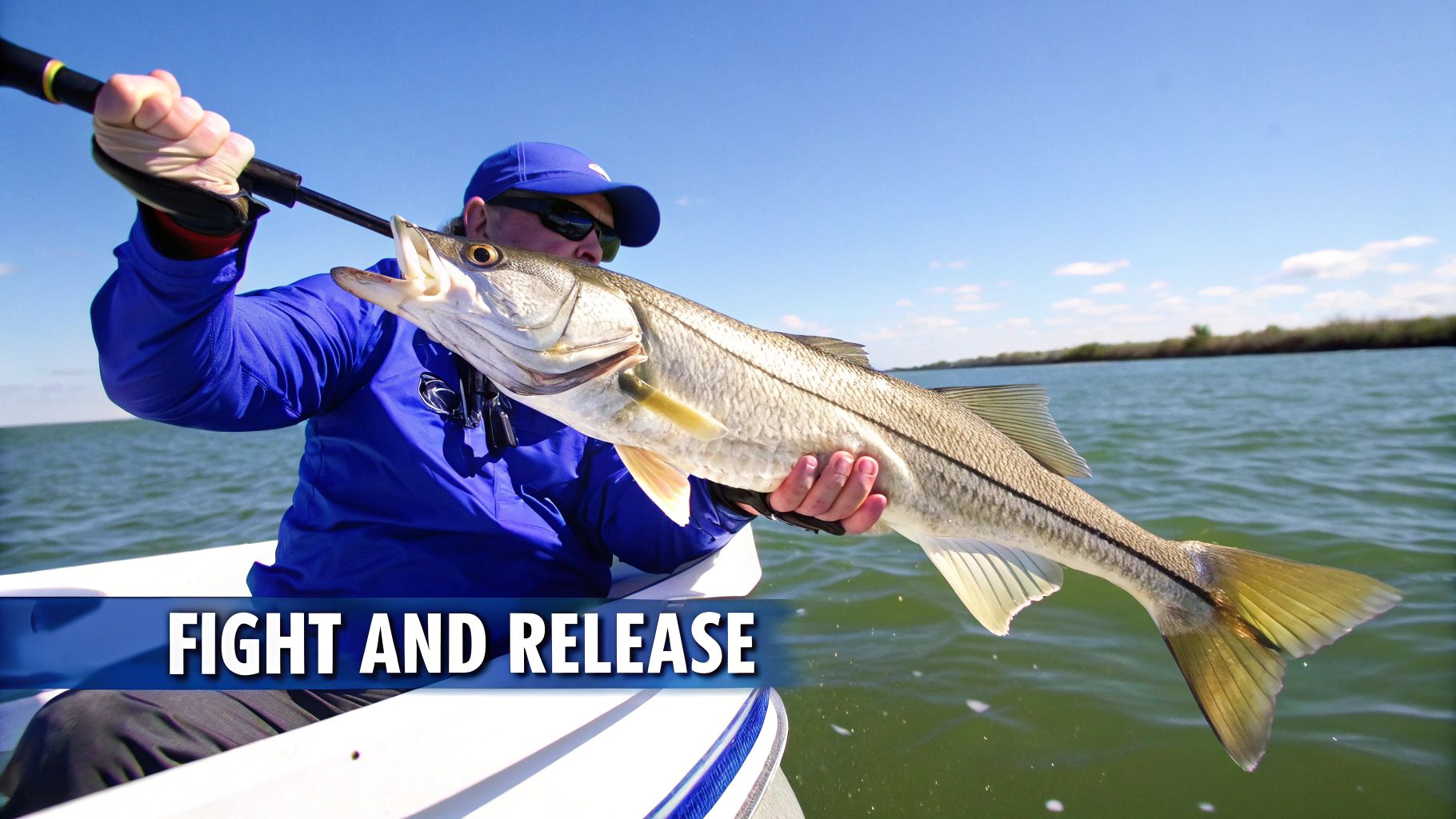
This isn't just about landing a trophy; it's about honoring the fight and making sure that powerful animal swims away strong. The battle and the release are two sides of the same coin, and mastering both is what truly sets a great angler apart.
The First Five Seconds: The Hookset and the Turn
Those first few seconds after a snook hits are everything. Your immediate reaction decides whether you land the fish or go home with a story about the one that got away. When you feel that unmistakable thump, fight the instinct to immediately yank back on the rod.
Instead, reel down fast to get rid of any slack, then give it a firm, powerful hookset. It's not a wild jerk—think of it as a solid, upward pull to drive the hook home.
Once you're connected, your next move is non-negotiable: you have to turn the snook's head. A big linesider knows exactly where the nearest dock piling, mangrove root, or razor-sharp oyster bar is, and it will use every ounce of its explosive power to get there in a flash.
Apply heavy, steady pressure right away. This is where that medium-heavy rod and stout leader prove their worth. Don't be timid. You have to be the boss from the get-go.
Managing the Fight: Long Runs and Headshakes
Once you survive the initial chaos and guide the fish toward open water, the fight shifts. A snook will usually make several long, drag-screaming runs, often broken up by violent, gill-rattling headshakes. The key here is to keep constant pressure while letting your rod absorb the shock.
- During a Run: Let the fish take line, but keep your rod tip high. This maintains tension and stops the hook from shaking loose. Don't try to clamp down on the drag; trust it to do its job.
- During a Headshake: This is when a lot of fish are lost. To counter it, lower your rod tip slightly—a move often called "bowing to the fish"—to create a little slack and cushion those violent jerks. It’s a simple technique that will save you countless fish.
Just keep the pressure on and patiently work the fish back toward you. Your goal is to tire it out, but do it as efficiently as you can to minimize stress on the animal.
The fight is a dance. You lead, but you also have to react to your partner's moves. When the snook runs, you give line. When it shakes, you bow. When it rests, you gain line. It’s a constant give-and-take.
The Art of the Release: A Conservationist's Duty
Landing a snook is a victory, but the true mark of an expert angler is how they handle the release. This is where conservation becomes critical. In a single year, Gulf Coast anglers hooked an incredible 1.335 million snook. While over 97% were released, a shocking 43% of harvested fish were lost to what’s known as cryptic mortality—hidden deaths caused by improper handling after the release. You can learn more about this vital issue by exploring the FWC's research on cryptic mortality.
Your actions in those few minutes determine if that fish survives to fight another day. Follow these best practices to ensure a healthy release, every single time.
Essential Catch-and-Release Practices
- Wet Your Hands: Never, ever touch a fish with dry hands. It strips away their protective slime coat, which is their primary defense against infection.
- Support the Fish Horizontally: Always use two hands to support a snook's body—one under its belly and the other gently gripping the lower jaw. Holding a big fish straight up and down can damage its internal organs.
- Use a Dehooking Tool: For a fish that’s hooked deep, a dehooker or long-nosed pliers are a must-have. They let you remove the hook quickly and cleanly with minimal harm.
- Limit Air Exposure: A good rule of thumb is to never keep a fish out of the water for longer than you can hold your own breath. If you're going for a quick photo, get the camera ready before you lift the fish.
- Proper Revival: After a tough fight, a snook is going to be exhausted. Gently hold it by the tail in the water, making sure it’s facing into the current. Move it in a slow figure-eight pattern to get water flowing back over its gills. Don't let go until you feel it kick hard and try to swim away on its own power.
Answering Your Top Snook Questions
Even when you've got the best gear and a perfect tide, questions pop up. Snook are smart, powerful fish, and figuring them out is a lifelong game. We've compiled some of the most common questions we hear, with answers straight from the playbook of guys who've spent decades on the water, like Ed and Frank Murray.
Think of this as your back-pocket guide to solving those specific problems that can make or break a day of fishing.
What's the Best Time of Year to Catch Snook in Florida?
While you can technically find snook year-round in South Florida, the action really heats up during two key windows: the spring (March-May) and the fall (September-November). These seasons are all about major transitions for snook, and if you understand their mindset, you'll be ahead of the game.
- Spring: As the water warms, snook push out of their cozy winter spots in backwaters and canals. They start staging near passes, inlets, and along the beaches for their summer spawn, and they are feeding hard along the way.
- Fall: This is a personal favorite among tournament anglers. Snook can feel winter coming and they go on a feeding frenzy to bulk up. They tend to be less picky and will absolutely crush a well-presented lure.
Summer still offers incredible fishing, especially at night around the lights of bridges and docks. Winter is definitely the toughest season, but if you're willing to put in the time, you can still find them holding in the warmer, deeper water of residential canals and upriver holes.
Is an Outgoing or Incoming Tide Better for Snook?
This is one of the oldest debates in snook fishing, but legendary anglers like the Murray brothers built their careers on one simple truth: an outgoing tide is usually your best bet.
It's all about an easy meal. The falling water flushes baitfish, shrimp, and crabs right out of the mangroves and off the oyster bars, creating a natural conveyor belt of food. Snook are lazy geniuses; they'll set up on ambush points, like the down-current side of a piling or a creek mouth, and just wait for dinner to come to them.
But don't ever write off a strong incoming tide. In big inlets and passes, that fresh, clean ocean water can trigger a bite that's just as intense. The real takeaway here is that moving water is everything. A slack tide, whether it's dead high or dead low, is almost always a slow time for snook.
What Are the Current Snook Regulations in Florida?
Snook are a carefully managed species, and the rules are there to protect the fishery for all of us. These regulations change, and they often vary depending on where you are (Atlantic vs. Gulf) and the time of year.
Your most important job before you even leave the dock is to check the latest rules directly from the Florida Fish and Wildlife Conservation Commission (FWC) website. Seriously. "I didn't know" won't fly with a game warden.
You'll need to know the specifics on:
- Slot Limits: The legal size range you can keep (e.g., 28 to 33 inches). Anything smaller or larger goes back.
- Bag Limits: How many you can keep, which is typically one per person.
- Closed Seasons: Times of the year when harvest is prohibited, usually around the summer spawn.
Always go straight to the source: visit the official FWC website for Snook Regulations for up-to-the-minute information.
How Do I Stop a Snook from Cutting Me Off on Its Gill Plate?
Ah, the dreaded gill plate cutoff. Those things are razor sharp and have cost anglers countless trophy fish. Beating them comes down to two things: the right leader and a smart fight.
Your best defense is a heavy fluorocarbon leader, somewhere in the 30 to 50 lb test range. When you get a bite, especially near structure, your first move is to apply immediate, heavy pressure to turn the snook's head away from anything it can wrap you around.
Once you have the fish boatside, the best way to land it is by firmly gripping its lower jaw—what we call "lipping" it. This gives you total control, calms the fish down, and most importantly, keeps your hands and your line far away from those dangerous gill plates.
For any angler dedicated to chasing legendary fish, having the right gear is part of the ritual. Murray Brothers Palm Beach was born from a rich fishing heritage, offering performance apparel that keeps you comfortable and protected trip after trip. You can explore the full collection of battle-tested, angler-approved gear at https://www.murraybrosretro.com.
Leave a comment