

Best Rain Gear for Men Fishing by Murray Brothers Sportfishing Legends
Looking for rain gear for men fishing that stands up to salt spray and sudden Florida squalls? Ed and Frank Murray discovered the hard way that ordinary oilskins simply didn’t cut it. After getting drenched on offshore marlin runs, they set out to build gear tough enough for any storm—and those early trials still influence today’s fishing jackets and bibs. As sportfishing legends who dominated saltwater tournaments from the 1960s onward, their hands-on experience in record-breaking marlin and kingfish events shaped every design choice.
Rise Of Ed And Frank Murray
In the 1960s, two brothers set out on a 20-foot skiff off Palm Beach with one goal: catch fish. At the dawn of the modern sportfishing era, they learned from pioneers and quickly carved their own legend in saltwater tournaments. By 1968, they’d won their first local tournament, hauling in a record kingfish amid pounding wind and rain. This victory was one of many as they went on to claim titles at the Palm Beach International Marlin Tournament and set multiple records for catch size and speed. That win drove home one truth: when every second on deck counts, staying dry isn’t a luxury—it’s a necessity.
Frank often jokes about waking up cold and soaked after an overnight downpour. Instead of focusing on the next drift, he was scrambling for warmth. It became clear that full-seam taped jackets, adjustable storm hoods, and durable shells had to be part of every serious angler’s kit.
Over countless offshore trips and World Billfish Series showdowns, their boat turned into a floating workshop. Every splash and spray revealed a new design flaw to fix.
- Early Flaws
- Waxed cotton cracked under icy spray
- Seams leaked when the wind shifted
- Bulky layers slowed down each cast
“We’d see water trickling in at the seams just when we needed dry hands.”
— Frank Murray, recalling a 1972 offshore tournament finish
Those brutal conditions pushed Ed and Frank into fabric mills and rope lofts. They experimented with PFC-free DWR treatments and advanced seam-sealing on back-to-back marlin tournaments, chasing one goal: zero leaks. They became fixtures on the tournament circuit, competing alongside the sport’s biggest names and sharing tales of storms, fish, and innovation.
Innovations In Rainwear Fabrics
Their breakthrough came with three-layer membranes that marry waterproofing and moisture wicking. Imagine a shell that stops rain on the outside while letting sweat escape—no more clammy discomfort on a 12-hour grind. Durability tests were just as extreme: jackets dragged over deck cleats and live wells to prove they’d last season after season.
They didn’t stop at the fabric. YKK Aquaguard zippers became standard for reliable closures, and ergonomic details like articulated elbows and reinforced knees borrowed inspiration from years spent battling billfish under squalls.
- Key Contributions
- Pioneered seam taping methods
- Advocated for adjustable cuffs and storm flaps
- Integrated safety loops for tethers and whistles
By demanding gear that kept pace with tournament-level fishing, Ed and Frank Murray laid the blueprint for modern rainwear. Their legacy sails on every time an angler pulls on a shell built to handle wind, waves, and the unexpected. Learn more about their impact in our article on The History Of Sportfishing.
Rain Gear Essentials And Performance Ratings
Fishing in the rain means trusting your gear to keep you dry without leaving you overheated. Membranes, DWR coatings, seam taping and breathability figures each play a vital role in performance.
Understanding waterproof versus water-resistant ratings can save you from a soaked-out day. A 20 000 MM rating is like a tiny dam against heavy spray, while breathability (measured in g/m²/24h) tells you how quickly sweat vapor can escape.
Waterproof Membranes Explained
Waterproof membranes sit between outer and inner layers to block water on impact. Common options include:
- PU Laminates: Budget-friendly, flexible, with 5 000 MM protection
- Three-Layer Shells: Built for rough saltwater spray and typically rated 20 000 MM
- Pro Membranes: Think Gore-Tex-style performance at 28 000 MM, designed to endure years of use
Add a PFC-Free DWR finish on top, and water beads off before it soaks in. Give your jacket a quick touch-up of DWR after each season to keep that beading action alive.
“Seam taping turns every stitch into a seal, stopping leaks at their source.”
— Rain Gear Specialist
Rain Gear Performance Ratings
Below is a snapshot comparison of waterproof ratings versus breathability levels in popular rain gear membranes. Use it to match your fishing style to the right gear.
| Feature | Waterproof Rating (MM) | Breathability (g/m²/24h) |
|---|---|---|
| Basic PU Shell | 5 000 | 5 000 |
| Mid-Tier Three-Layer | 10 000 | 10 000 |
| High-Performance Shell | 20 000 | 15 000 |
| Premium Pro Membrane | 28 000 | 20 000 |
As this table shows, inshore anglers often find 10 000 MM shells sufficient, while offshore trips demand closer to 20 000 MM or more.
Breathability Ratings Demystified
A jacket rated 15 000 g/m²/24h moves moisture vapor efficiently—imagine a sponge that lets water out faster than it soaks in. Proper airflow stops clammy layers from forming under your shell.
Look for these features to boost ventilation:
- Underarm vents with zip closures
- Adjustable hoods that tuck away when not needed
- Strategic mesh liners directing air across your back
Seam Taping And Zippers
Every stitched seam is a potential leak point—full-length, heat-applied tape seals those edges completely. Combine that with quality closures and you’ve got a watertight setup.
- Full-seam tape on interior joins for guaranteed protection
- Waterproof YKK Aquaguard zippers to block spray
- External storm flaps that snap over closures in heavy downpours
“A sealed zipper is the last line of defense against soaking winds.”
— Gear Engineer
The history of these sealing methods is traced in the following infographic.
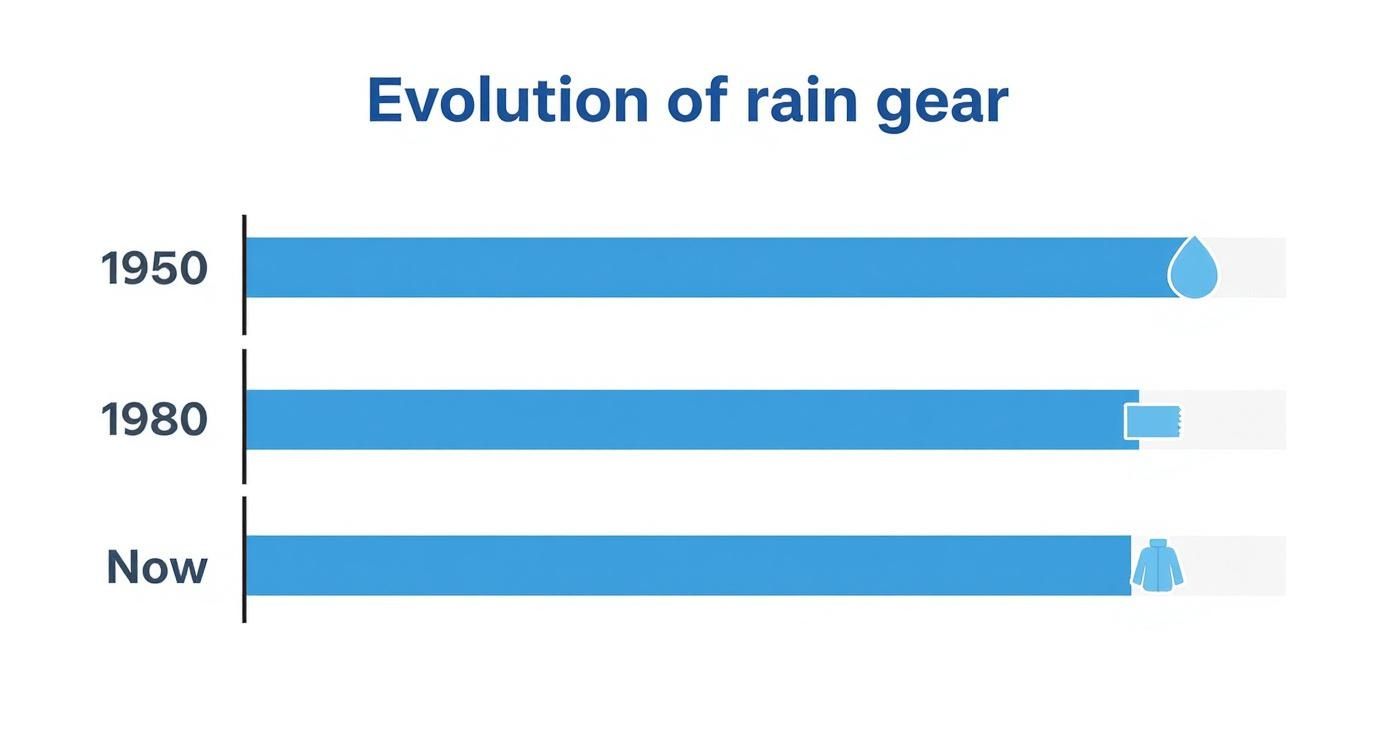
This visual timeline highlights innovations from simple drop icons in 1950 to today’s rugged jacket designs. Advances in materials and seam taping have steadily upped the ante on protection and longevity.
A notable market shift underscores this growth: the global rainwear market reached USD 4.07 billion in 2024 and is on track for USD 6.25 billion by 2033 at a 4.64% CAGR. Men accounted for 45.4% of that share in 2024. Learn more about these market insights on IMARC Group
Select gear wisely. By breaking down membranes, DWR treatments, seam taping and breathability, you’ll find the balance between protection, mobility and comfort for every fishing condition.
Key Rain Gear Features And Safety Elements
Getting caught in a sudden squall or slipping on a wet deck can turn any fishing trip sideways. You need gear that not only keeps you dry but also moves with you.
The Murray Brothers insisted on PFC-Free DWR finishes and contrast seam taping so you spot wear before it becomes a leak. Frank Murray also champions storm cuffs that lock out spray. Check out our guide on waterproof fishing gear for a closer look at membrane performance.
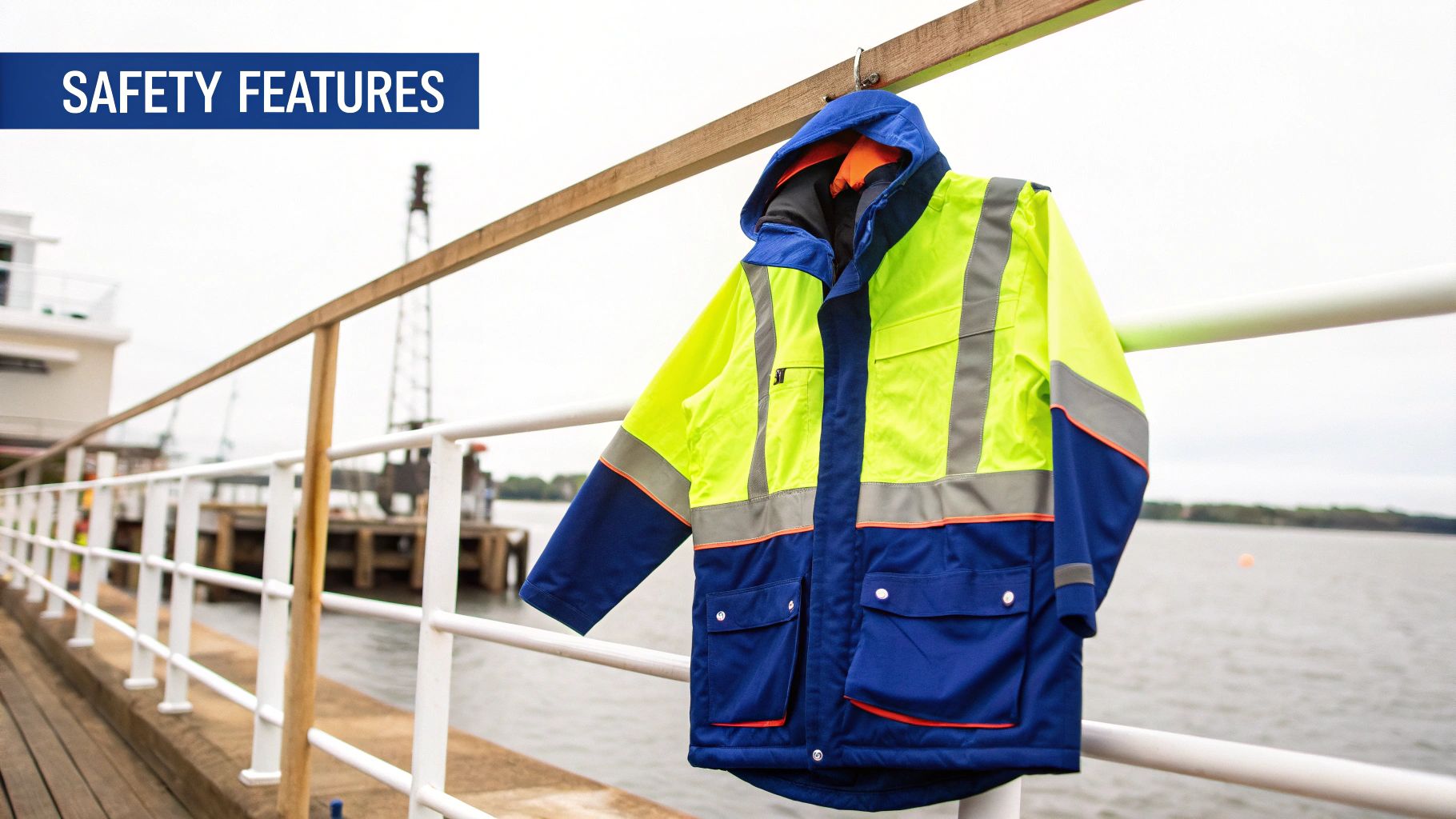
Legend has it Ed Murray once steered through a midday downpour off Jupiter. He watched water bead off his shell instead of soaking his shirt—then landed a marlin without missing a beat.
Key Safety Features:
- PFC-Free DWR makes water bead up and roll off while maintaining breathability.
- Contrast Seam Taping uses visible tape to seal stitches and highlight wear points.
- Articulated Construction mimics your natural stance for smooth casting and hauling motions.
- High-Visibility Panels help crew spot you in dim light or against churning spray.
- Emergency Whistles and Tether Points secure tools and broadcast alerts when conditions worsen.
Articulated Design And Reinforced Areas
Articulated joints trace the bend of your arm and knee, so you don’t end up wrestling with stiff fabric when you hook and haul. Anglers without this feature often feel restricted the moment they need full range of motion.
Reinforced knee patches take the punishment when you kneel on a slippery deck. That extra layer of fabric stops abrasion in its tracks and keeps your gear lasting season after season.
“A single tether point can keep your pliers from disappearing overboard when a rogue wave hits.”
— Frank Murray
Safety Visibility And Emergency Features
When rain dims the light or clouds roll in, reflective strips and bright panels become your lifeline. They make sure fellow anglers or crew spot you against spray, foam, and even fog.
The fishing apparel market hit USD 15 billion in 2021 and is on track for USD 17.5 billion by 2025—jackets driving growth thanks to their waterproof, breathable strengths. Read the full research about the fishing clothing market growth
Rain Gear Feature Comparison
To see how these elements stack up, here’s a quick look at each feature and its main payoff.
| Feature | Description | Benefit |
|---|---|---|
| PFC-Free DWR | Water-repellent finish without harmful chemicals | Keeps outer fabric dry and lightweight |
| Contrast Seam Taping | Sealed seams with visible tape | Blocks leaks and highlights seam wear |
| Articulated Elbows | Pre-bent construction at elbow joints | Enhances mobility during casting and reeling |
| Reinforced Knees | Extra fabric in high-wear areas | Prevents abrasion and extends gear longevity |
| High-Visibility Panels | Bright color inserts on jacket panels | Improves crew visibility in low-light conditions |
| Emergency Whistle & Tether Points | Integrated whistle and sturdy loops | Provides alerts and secures tools in rough seas |
Picking rainwear with these features means you spend less time worrying about leaks or wear—and more time lining up that perfect cast. Every cuff, seam, and panel works together so you can fish hard, no matter what the sky throws at you.
Layering Strategies For Fishing Conditions
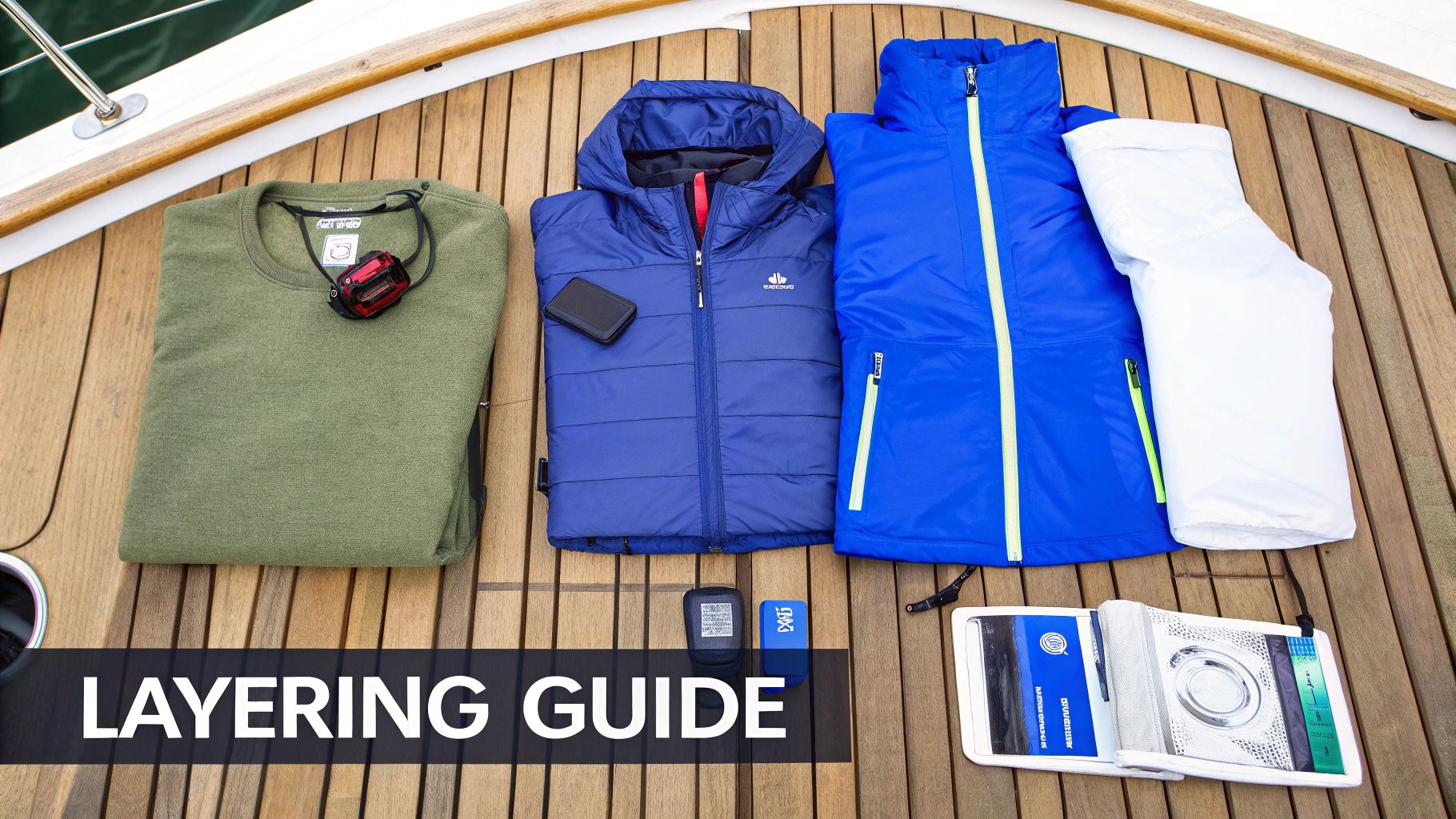
Building a setup for a day on the water is a lot like fine-tuning a race car’s engine. Every layer has a job—some trap heat, others vent moisture, and the shell keeps the spray at bay. Get them dialed in, and you’re ready for anything.
Start with these quick-reference kits:
- Inshore Setups for Misty Dawns: Light base layer, windproof mid-layer, and a shell with pit zips.
- Offshore Kits for Spray and Wind: Robust three-layer shell over a fleece mid-layer.
- Cold-Weather Assemblies: Insulating mid-layer plus waterproof bibs.
- Humid Day Choices: Breathable synthetic base and mesh-lined shells to wick moisture fast.
When a sudden squall hit during a Murray Brothers tournament, they swapped mid-layers in seconds—and still landed the winning sailfish. That’s real-world proof that layering matters as much as technique.
Inshore Layering Basics
On calm flats at first light, mist clings to the air. A snug merino-wool base traps body heat while whisking away sweat. Over that, a light windbreaker stops gusts cold, and a shell with ventilation zips lets you dial in airflow.
“A breathable base means less chill during dawn bites,” Ed Murray once said.
That simple trio keeps you comfortable when the tide is low and the bites are hot.
Offshore Layering Techniques
Out on the blue, wind-driven spray and relentless waves demand a tougher approach. A 20 000 MM three-layer shell seals out saltwater while still breathing. Look for fully sealed zippers and taped seams to withstand deck abrasion.
- Step 1 Base Layer: Synthetic long sleeve to move heavy perspiration away from your skin.
- Step 2 Mid Layer: Lightweight fleece or merino blend for consistent warmth.
- Step 3 Shell: Fully taped, breathable jacket with an adjustable hood.
- Optional Bibs: Waterproof overalls protect your lower half from constant spray.
Murray Brothers’ crews once ranked seam taping durability above all else after testing gear in Gulf squalls where a single wet patch could cost a haul.
Humid Weather Layering
When humidity spikes, escape the clammy squeeze with lightweight synthetics. A mesh-backed base layer feels like an exhaust port for body heat, while a half-zip shell offers instant airflow.
- Choose fabrics with 10 000 g/m²/24h breathability.
- Opt for half-zip shells to vent on the go.
- Pack a minimalist rain shirt instead of a bulky jacket.
Fishing clothing tailored for men, including rain gear, is expected to contribute significantly to the global market at USD 4.04 billion in 2025, rising to USD 5.54 billion by 2032 at a 4.6% CAGR. Read the full report on fishing clothing market growth.
Use this practical checklist to match your layers to conditions:
| Condition | Base Layer | Mid Layer | Shell Type |
|---|---|---|---|
| Inshore Dawn | Merino long sleeve | Windbreaker | Ventilated rain jacket |
| Offshore Spray | Synthetic moisture wicking | Fleece or merino blend | Fully taped three-layer shell |
| Cold Weather | Thermal synthetic | Lightweight fleece | Waterproof bib overalls |
Check out our guide on cold-weather layering essentials for deeper tips.
Proper layering means you adapt to conditions, stay comfortable, and fish longer. A versatile wardrobe is your best ally when the weather dial flips without warning. Always.
Sizing Fit Tips And Maintenance Practices
Getting the right fit means you can move freely on deck and stay dry without feeling like you’re wrapped in a sleeping bag. Think of it like tuning sails on a race boat—too loose and you lose control; too tight and you strain your rigging. By balancing space for mid layers with a sleek silhouette, your rain gear works with you rather than against you.
Measuring For The Perfect Fit
Start with torso length, measuring from the base of your neck down to your hip bone. Then, check sleeve span from shoulder seam to wrist with your arm relaxed. Finally, note your waist and inseam over a thin base layer to mimic layering on the water.
- Relaxed Cut: Roomy silhouette for extra insulation
- Athletic Cut: Snug profile for maximum mobility
“Once Frank Murray dialed in his measurements, he never worried about seam stress during long offshore runs.”
— Murray Brothers Tournament Journal
Plug these numbers into each brand’s size chart. That way, your jacket-and-bib combo bites the waves—not your body.
Cleaning And Restoring DWR
Salt spray and sunscreen build-up slowly wear down your PFC-free DWR finish. To bring back that water-beading magic, follow a gentle cleaning routine that’s kind to both fabric and the planet.
- Rinse gear inside out with fresh water
- Machine wash on a gentle cycle using an eco-friendly, non-detergent cleaner
- Air dry completely in the shade
Once dry, spray on a fresh DWR layer from about eight inches away. Then, heat-activate the coating with a low dryer setting or a warm iron (use a towel as a shield).
90% of anglers notice better water beading right after one DWR refresh.
Storage And Seam Protection
A little care in storage goes a long way toward preventing mold and seam failure. Properly stowed gear is ready to perform when you are.
- Hang jackets on wide, shaped hangers to protect shoulder seams
- Fold bibs loosely or lay them flat to avoid pinched seam tape
- Store everything in a cool, dry spot—skip plastic bags that trap moisture
- Check taped seams every year for any signs of wear
| Storage Method | Benefit |
|---|---|
| Wide Hanger | Maintains shoulder shape |
| Flat Folding | Preserves seam taping |
| Cool Dry Closet | Inhibits mold and fabric fatigue |
Before any trip, give zippers and seam tape a once-over. Finding small wear spots ahead of time keeps you dry on tournament day.
Confirming Fit On The Water
Never rely only on a mirror or hanger. Suit up with your typical base and mid layers before you hit the ramp.
Move through casting and reeling motions to test your range. Bend your knees, raise your arms, even crouch as if hauling a big one aboard. Finally, run a quick drench test at home—pour water over key areas to spot leaks or tight spots. A few minutes now can save you hours of misery later.
Why Murray Brothers Rain Gear Excels
Ed and Frank Murray spent fifty-year chasing marlin off Palm Beach, turning every saltwater tournament into a real-world lab for rain gear. Tournament media often featured Ed’s outrigged 20-footer battling billfish in 40-knot winds, each broadcast reminding the design team what toughness meant in practice.
Storm-driven lessons—weak seams, rigid fabrics, hoods that flapped like sails—pushed them to refine each design on the fly.
Imagine a jacket that bends and stretches like a second skin when you haul in a billfish. Every seam and panel channels decades of offshore trials, so you stay dry even in 50+ knot gusts.
Today, Murray Brothers Palm Beach delivers those hard-earned breakthroughs straight to your gear bag. Sealed seams, tough membranes and ergonomic cuts underpin every jacket and bib we’ll profile below.
Top Jacket And Bib Models
- Offshore Marlin Jacket: Three-layer membrane with 20 000 MM waterproof rating, fully taped seams and an adjustable storm hood. Built to shrug off nonstop spray on the open ocean.
- Shoreline Classic Bibs: Lightweight shell rated 10 000 MM, reinforced knees, sealed zippers and an ergonomic cut for casting and wading.
Each model grew out of Ed and Frank’s tournament runs. Pocket placements let you grab pliers, lures or line cutters in a heartbeat. Bib braces lock under harnesses so nothing shifts when a big fish takes you for a ride. High-visibility panels and reflective piping keep you seen when spray turns the deck into mist. Adjustable cuffs and storm flaps seal out water, while articulated elbows give you full casting range.
Performance In Rough Seas
Out on the blue, wind and spray become relentless opponents. Murray Brothers uses strategic seam placement to channel water away from critical joints. A sculpted hood stays put under pressure and storm-flap–covered zippers never budge.
| Model | Scenario | Outcome |
|---|---|---|
| Offshore Marlin Jacket | 30-knot squall | Dry chest and dry back under duress |
| Shoreline Classic Bibs | Shallow flats wading | No water intrusion at knee and waist |
"We tested these shells in conditions that sank lesser jackets in minutes," recalls Ed Murray.
Those field trials shaped the fabrics, seam-taping methods and hood designs you see today. It’s decades of tournament insight stitched into every seam.
Recommendations For Different Missions
- Inshore Light Tackle Setup
- Shoreline Classic Bibs with a 10 000 MM shell. Ideal for skiffs and shallow-water wading.
- Offshore Big-Game Setup
- Offshore Marlin Jacket paired with waterproof bibs. Delivers 20 000 MM protection in heavy spray.
- Cold-Weather Missions
- Layer Thermal Mid-Layer under an Offshore Marlin Jacket. Add insulated bibs for Arctic chills.
Whether you’re chasing sailfish offshore or stalking trout in a drizzle, these setups draw on Murray Brothers’ tournament archives to work as hard as you do.
Maintenance is simple: rinse your gear in fresh water after each trip, refresh the DWR coating and check seams regularly to keep everything match-ready.
FAQ
Q1: What Makes Rain Gear Waterproof Vs Water-Resistant?
Think of waterproof rainwear as wearing a sealed badge against moisture—nothing gets through. These jackets feature fully laminated membranes and taped seams that lock out water at every stitch.
On the other hand, water-resistant shells behave more like a raincoat with a slick finish. They rely on a surface coating to shrug off light showers but will eventually soak through under sustained downpours.
Key Differences:
- Waterproof: Fully taped pockets, storm flaps, and internal membranes keep you bone-dry.
- Water-Resistant: Surface DWR sheds small amounts of moisture but won’t hold up in heavy rain.
Q2: How Should I Layer for Offshore Fishing in Cold Rain?
Imagine layering like building a campfire—each piece has its job. Start with a moisture-wicking base layer to keep sweat off your skin. Add a lightweight fleece mid layer for warmth, then top it with a breathable, fully waterproof shell.
This system evolved from the real-world trials of anglers Ed and Frank on chilly marlin runs. It lets you peel off or add warmth as conditions shift, whether you’re battling wind-driven spray or a sudden squall.
Layering Checklist
- Moisture-wicking base to remove sweat
- Lightweight fleece mid layer for core warmth
- High-breathability, fully taped shell to block wind and spray
Q3: How Do I Determine the Right Size for Fishing Rain Gear?
Grab your tape measure and note these dimensions:
- Torso length
- Chest circumference
- Arm span
- Waist
- Inseam
Then match those figures against the brand’s sizing chart. Aim for enough space to slip on a mid layer, but not so much extra fabric that it flaps or snags on railings.
Q4: How Do I Maintain and Clean Men’s Fishing Rain Gear?
Treat your rain kit like a prized rod—proper care keeps it performing. Run it on a gentle wash cycle with a mild, eco-friendly detergent. Once the soap’s rinsed out, hang it to air dry; heat can damage coatings and taped seams.
When water stops beading, it’s time for a DWR refresh. Store your jacket on a hanger in a cool, dry spot to preserve its protective finish.
“A quick DWR refresh brings back that water-beading action anglers rely on at sea.”
Gear up for every squall with tournament-tested protection from Murray Brothers Palm Beach
Stay dry.
Leave a comment